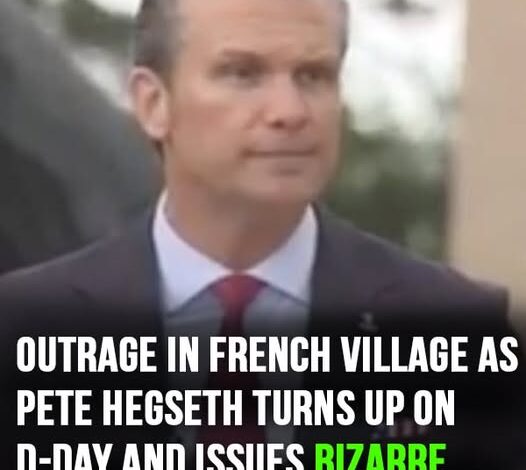
The people of Langrune-sur-Mer believed they were gathering to honor the dead.
For generations, remembrance ceremonies along Normandy’s coast have carried a particular kind of gravity. The beaches, now peaceful and windswept, still hold the weight of history. Every memorial, every wreath, every moment of silence exists for one purpose: to remember the young men who crossed an ocean, stormed hostile shores, and never came home.
In towns like Langrune-sur-Mer, memory is not abstract.
It lives in the landscape.
It drifts through family stories.
It lingers among rows of white crosses stretching toward the horizon.
That is why many residents arrived expecting reflection.
Instead, they found controversy.
As Pete Hegseth spoke, the focus appeared to shift away from the sacrifices of World War II and toward the political battles of the present day. Drawing comparisons between wartime invasions and modern migration, he described contemporary border pressures as a new challenge confronting Europe.
For some listeners, the remarks reflected concerns about national identity, security, and cultural change.
For others, they felt profoundly misplaced.
Many local leaders had already approached the event with caution, aware of Hegseth’s previous public comments and concerned about how history might be framed. As the speech unfolded, those concerns deepened.
Residents who had come to honor fallen soldiers found themselves listening to arguments about immigration, ideology, and contemporary politics.
The contrast was jarring.
To critics, it felt as though the memory of those who died on Normandy’s beaches was being recruited into a modern debate they never chose.
The reaction was swift.
And deeply emotional.
Many residents expressed disappointment not simply because they disagreed with the message, but because they felt the occasion itself demanded something different.
They spoke of remembrance.
Of respect.
Of preserving the meaning of a historic sacrifice without attaching it to present-day political agendas.
Some described a sense of betrayal.
Others voiced frustration that a ceremony intended to unite people around shared history had instead become another battleground in a polarized era.
Underlying much of the criticism was a broader concern about memory itself.
Who controls it?
Who interprets it?
And how should it be used?
For many in Langrune-sur-Mer, the legacy of World War II is not merely a historical event. It represents the defense of democratic institutions, international cooperation, and the postwar order that emerged from one of humanity’s darkest chapters.
When those institutions or values appear to be dismissed or reinterpreted through contemporary political lenses, emotions run high.
History, after all, is never just about the past.
It shapes how people understand the present.
As tensions grew, security around Hegseth and his family increased noticeably.
Additional personnel appeared.
Protective measures expanded.
The atmosphere became more guarded.
The image was striking.
On one side stood heightened security and political controversy.
On the other stood quiet cemeteries and memorials dedicated to men whose stories ended decades ago.
The contrast seemed to capture the larger conflict unfolding beneath the surface.
A conflict not simply about one speech.
Or one public figure.
But about the role memory should play in public life.
Should history serve primarily as a lesson?
A warning?
A source of national identity?
Or can it also become a tool in modern political struggles?
The events in Langrune-sur-Mer exposed just how divided people remain on those questions.
For some, drawing connections between past and present is a natural part of political discourse.
For others, certain places and sacrifices occupy a sacred space that should remain separate from contemporary ideological battles.
Neither side sees the issue as trivial.
That is why the response was so intense.
What unfolded was more than a disagreement over words.
It was a collision between competing visions of remembrance.
One that views history as an active framework for understanding current challenges.
And another that views certain memories as deserving protection from modern political appropriation.
As the ceremony ended and the crowds dispersed, the tension remained.
Not because anyone questioned the bravery of those who fought and died.
But because people disagreed profoundly about how their legacy should be invoked.
In the end, Langrune-sur-Mer became the setting for a larger national and international conversation.
A conversation about memory.
Meaning.
Responsibility.
And who gets to speak on behalf of the fallen.
The crosses remained where they have always stood—silent, orderly, and unchanged by the arguments surrounding them.
Yet the debate they witnessed continues.
A reminder that history is never entirely settled.
And that the struggle over its meaning can be almost as powerful as the events themselves.