For more than a century, the western quoll had almost vanished from landscapes where it once moved like a shadow through the night.
Once widespread across much of mainland Australia, this small but fierce carnivorous marsupial—known locally as the chuditch—had been driven into decline by forces it could not outrun. Land clearing stripped away habitat. Feral cats and foxes hunted relentlessly. Introduced species disrupted the delicate balance of ecosystems that had supported native wildlife for thousands of years.
By the early twentieth century, the western quoll had disappeared from most of its former range.
Only a few populations survived in the south-west of Western Australia.
For conservationists, the message was clear: without active intervention, another unique Australian animal could be lost.
The western quoll is roughly the size of a domestic cat, but its ecological role is far greater than its body suggests. As a native predator, it helps regulate insects, reptiles, and small mammals, contributing to healthy and balanced ecosystems. When predators like quolls vanish, the effects ripple through the landscape.
Their loss was not simply the disappearance of one species.
It was the weakening of an entire natural system.
That is why the work at Mount Gibson Wildlife Sanctuary became so important.
Located about 350 kilometres north-east of Perth in Western Australia’s Wheatbelt region, Mount Gibson covers approximately 1,305 square kilometres. Once used as grazing land, it has been transformed by the Australian Wildlife Conservancy into a refuge for threatened native mammals.
The sanctuary does not look like a miracle at first glance.
It is dry, vast, and rugged.
But beneath its quiet surface, one of Australia’s most ambitious conservation stories has been unfolding.
Beginning in 2016, conservationists started reintroducing native species that had disappeared from the area. The work required patience, planning, and constant monitoring. Before animals could return, the landscape had to be made safe.
That meant controlling feral predators.
Cats and foxes had played a major role in devastating small and medium-sized native mammals across Australia. Without reducing that threat, any reintroduction effort would be doomed from the start.
So ecologists established protected areas, including a feral predator-free fenced zone covering roughly 7,838 hectares. Inside that secure habitat, vulnerable animals could begin rebuilding populations without facing the same overwhelming pressures that had wiped them out.
The western quoll was one of the species chosen for return.
For years, conservation teams carefully translocated animals from existing populations and breeding programs into the sanctuary. Some came from Western Australia’s south-west. Others came through zoo breeding programs in New South Wales. This mixing of backgrounds was intentional and important.
Genetic diversity gives reintroduced populations a stronger chance of long-term survival.
It helps protect against inbreeding.
It improves resilience.
It gives a species room to adapt.
At first, success could only be measured cautiously.
Were the quolls surviving?
Were they finding food?
Were they establishing territories?
Were they avoiding danger?
Radio tracking, camera traps, field surveys, and careful observation became part of daily conservation work. Scientists watched, recorded, waited, and hoped.
Then, in late 2023 and into 2024, something extraordinary appeared on camera.
Young quolls.
Not released adults.
Not animals brought in by human hands.
Wild-born juveniles.
For the first time in more than a century in that part of Australia, western quoll pups had been born at Mount Gibson Wildlife Sanctuary.
The discovery began almost like a mystery.
Food traps were being tampered with. Bait disappeared. Trap doors were triggered. Yet when ecologists checked, there was no animal inside.
At first, it was puzzling.
Then camera footage revealed the answer.
Small juvenile quolls had been sneaking into the traps, eating the bait, and slipping back out again because they were tiny enough to escape.
What might have seemed like mischief became one of the most exciting signs conservationists could hope for.
The quolls were breeding.
The next step was confirmation.
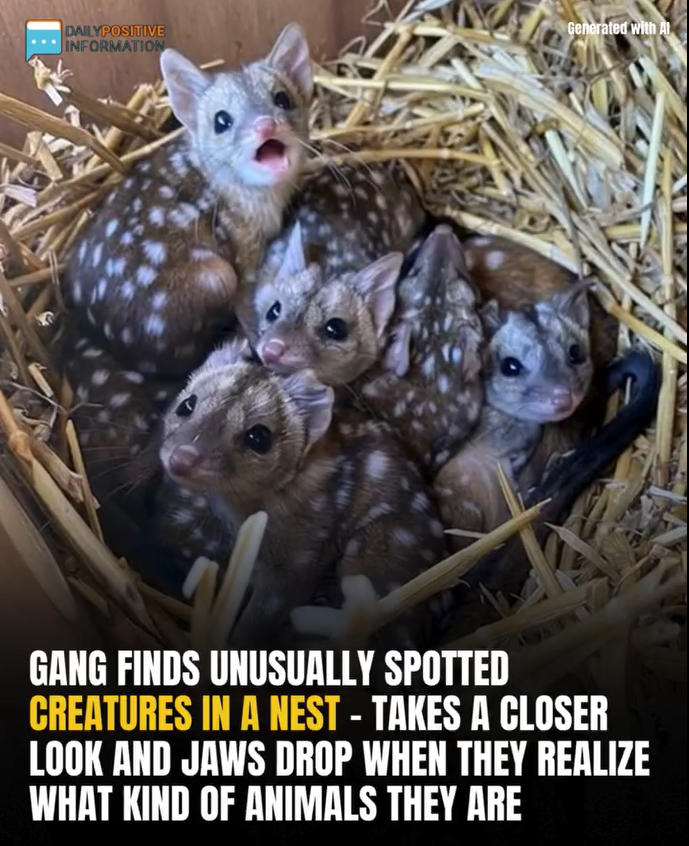
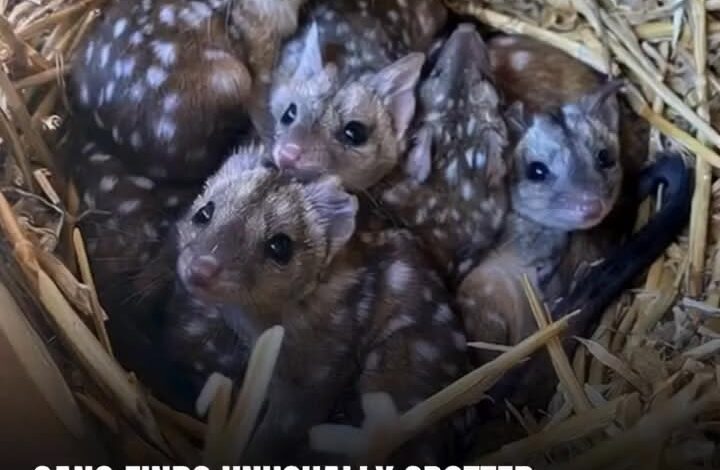
Western quolls have distinctive spot patterns, each animal marked in a way that can be compared almost like a constellation across its fur. By studying those patterns, scientists were able to identify the juveniles and confirm they were offspring of quolls previously released into the sanctuary.
That detail changed everything.
The reintroduced animals had not only survived.
They had found mates.
Raised young.
And produced a new generation capable of moving independently through the landscape.
Researchers identified four independent young quolls, a number small enough to seem modest but powerful enough to signal real progress. In conservation, recovery rarely begins with dramatic numbers. It begins with signs.
A track in the dust.
A flash on a camera trap.
A young animal where none had existed for generations.
Western quolls are seasonal breeders, typically mating between late April and July. Females give birth to litters of two to six young, which spend early development in the mother’s pouch before emerging and learning to survive on their own.
For juveniles to appear at Mount Gibson, every fragile stage had to succeed.
Breeding.
Birth.
Pouch development.
Maternal care.
Early exploration.
Independence.
Each stage represented another barrier crossed.
Each young quoll was proof that the sanctuary was beginning to function not merely as a protected enclosure, but as a living ecosystem.
The achievement also strengthened confidence in other reintroduction programs across Australia. Similar efforts in places like the Flinders Ranges in South Australia had already shown that western quolls could reproduce successfully when given the right conditions.
Mount Gibson added another chapter to that growing body of hope.
Still, conservationists know the work is far from finished.
A few wild-born juveniles do not guarantee permanent recovery.
Predator control must continue.
Habitat must be protected.
Populations must be monitored.
Genetic health must be maintained.
The coming years will determine whether the western quoll can establish a stable, self-sustaining population across restored landscapes.
But for now, the signs are deeply encouraging.
The return of the chuditch is also about more than one animal.
Mount Gibson’s broader restoration project aims to bring back multiple locally extinct mammals, rebuilding ecological relationships that had been broken over time. Small digging mammals, medium-sized marsupials, and native predators each play different roles in restoring the land’s natural balance.
When one species returns, it helps revive a larger story.
The quoll’s comeback has also captured public attention, reminding people that Australia’s wildlife is both extraordinary and vulnerable. It shows what can happen when scientists, conservation groups, local communities, government agencies, and Indigenous land managers work toward a shared goal.
In an age when extinction stories often feel inevitable, Mount Gibson offers a different message.
Loss is not always final.
Damage can sometimes be repaired.
Species can return when people act with enough commitment, patience, and care.
Somewhere in the protected scrublands of Western Australia, young quolls now move through the night, hunting, exploring, and learning the rhythms of a landscape their kind had been absent from for generations.
They do not know they are symbols.
They do not know scientists celebrate every image captured by hidden cameras.
They do not know their survival represents decades of effort.
They are simply living.
And that is exactly what makes their return so powerful.
For the western quoll, the future is no longer only a story of decline.
It is a story of persistence.
A story of restoration.
A story proving that extinction is not always the ending.
Sometimes, with enough care, it can become the beginning of a comeback.