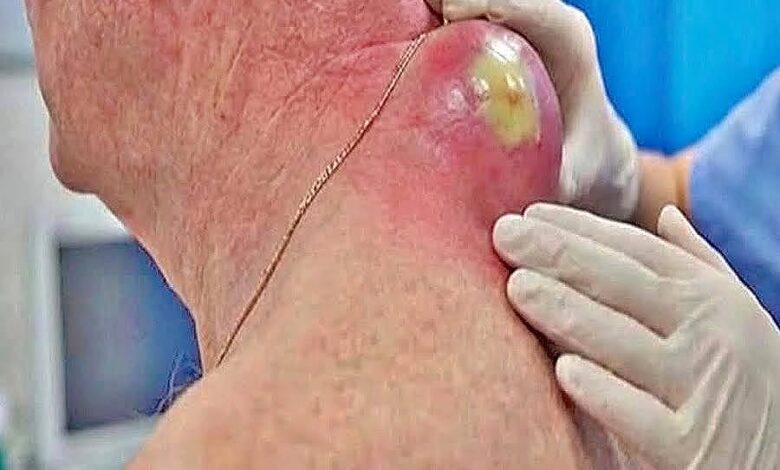
It started as something so small that I convinced myself it couldn’t possibly matter.
At first, I called it a rash.
Then I blamed an irritated muscle.
Maybe I’d slept in an awkward position. Maybe my backpack had rubbed against my skin. Maybe it would disappear if I simply ignored it for another day.
Days turned into weeks.
Instead of fading, the lump became impossible to ignore.
Every morning, my fingers instinctively searched for it before I was even fully awake. Every shower became another opportunity to check whether it had changed. Every glance in the mirror ended with the same unanswered question.
What is happening to my body?
The discomfort wasn’t always severe, but it was constant enough to invade everyday life.
Sitting for long periods became uncomfortable.
Lying on my back no longer felt natural.
Even the light brush of clothing against my skin served as a reminder that something wasn’t right.
Physically, it was frustrating.
Emotionally, it was exhausting.
The uncertainty proved far worse than the discomfort itself.
Like many people, I searched online hoping to reassure myself.
Instead, I found endless lists of possibilities.
Some sounded harmless.
Others were terrifying.
Every article seemed to point in a different direction, and every symptom I read somehow felt familiar.
The more I searched, the more anxious I became.
I stopped talking about it.
Partly because I didn’t want to overreact.
Partly because I was afraid someone would dismiss my concerns.
“It’s probably nothing.”
“I’m sure it’ll go away.”
I repeated those same words to myself over and over, hoping that if I believed them strongly enough, they might become true.
But deep down, I knew something had changed.
Ignoring it wasn’t making the uncertainty disappear.
It was only allowing fear to grow.
Eventually, I reached a point where pretending everything was normal required more energy than simply asking for help.
Scheduling the appointment wasn’t easy.
For days I considered canceling.
I imagined worst-case scenarios before I had even stepped inside the clinic.
The waiting room felt unusually quiet.
Every minute stretched longer than it should have.
When my name was finally called, I walked into the examination room carrying far more anxiety than I realized.
I expected the conversation to begin with bad news.
Instead, it began with questions.
The doctor listened carefully.
Asked when I first noticed the lump.
Whether it had grown.
Whether it caused pain.
Whether I had experienced other symptoms.
There was no panic.
No alarming expressions.
Just calm, methodical evaluation.
That alone helped lower my anxiety.
Then came something even more important.
An explanation.
The doctor explained that many lumps appearing beneath the skin are surprisingly common.
Some result from blocked pores or clogged oil glands.
Others are small collections of fatty tissue known as lipomas.
Certain lumps develop from infections or inflamed cysts.
Many look alarming despite being completely benign.
Of course, not every lump is harmless.
Some require imaging.
Others need testing or removal.
That’s precisely why evaluation matters.
The appearance alone rarely tells the whole story.
Trying to diagnose yourself from a mirror—or an internet search—is almost impossible.
Only a proper medical assessment can determine what you’re actually dealing with.
Hearing that changed everything.
Not because every concern suddenly disappeared.
But because uncertainty had finally been replaced with information.
The fear that had consumed weeks of my life began shrinking the moment I understood there were reasonable explanations.
I also realized something about myself.
I had spent far too much time minimizing what my own body was trying to tell me.
I kept convincing myself not to make a fuss.
Not to waste anyone’s time.
Not to overreact.
In reality, paying attention to changes in your body isn’t overreacting.
It’s responsible.
Our bodies constantly communicate with us.
Pain.
Swelling.
Changes in skin.
Unexpected lumps.
Persistent discomfort.
These aren’t inconveniences to ignore.
They’re signals worth understanding.
That doesn’t mean every symptom points to something serious.
Far from it.
Many skin lumps ultimately turn out to be harmless conditions that require little or no treatment.
Common causes include epidermoid cysts, lipomas, boils, inflamed hair follicles, and other benign growths.
Some resolve on their own.
Others can be treated with relatively simple medical care.
Occasionally, however, a lump may require further investigation to rule out more significant conditions.
That’s why medical professionals encourage people not to rely solely on self-diagnosis.
Certain warning signs deserve prompt evaluation.
A lump that grows rapidly.
Persistent redness or warmth.
Drainage.
Increasing pain.
Changes in color.
Fever.
Or any mass that continues enlarging over time.
Likewise, if a lump feels unusually firm, becomes fixed in place, or appears alongside unexplained weight loss or other concerning symptoms, healthcare providers generally recommend seeking medical advice without delay.
The goal isn’t to create fear.
It’s to encourage awareness.
Too often, people delay appointments because they’re afraid of what they might hear.
Ironically, that delay often creates far more anxiety than the actual medical visit.
The unknown has a remarkable ability to magnify our fears.
Facts usually shrink them.
Whether the diagnosis turns out to be something simple or something requiring treatment, knowing is almost always better than wondering.
Looking back, the appointment taught me something far more valuable than the cause of one lump.
It reminded me that fear grows strongest in silence.
It feeds on assumptions.
On late-night internet searches.
On imagining every possible outcome without evidence.
But fear begins losing its power the moment questions are asked and answers begin replacing uncertainty.
That lesson extends well beyond this single experience.
Listening to your body doesn’t make you anxious.
Ignoring it doesn’t make you brave.
Real confidence comes from taking your health seriously enough to seek reliable information when something feels different.
Doctors aren’t there only for emergencies.
They’re there to help distinguish ordinary conditions from those requiring attention.
Sometimes the news is reassuring.
Sometimes additional testing is needed.
Either way, you move forward with knowledge instead of speculation.
Walking out of that office, I felt lighter than I had in weeks.
Not because every question had disappeared overnight.
But because I finally understood that my greatest burden hadn’t been the lump itself.
It had been the fear of not knowing.
The moment I chose to ask for help instead of pretending everything was fine, that burden became far easier to carry.
Sometimes the hardest step isn’t hearing the answer.
It’s deciding to ask the question.
And often, that’s also the moment healing truly begins.