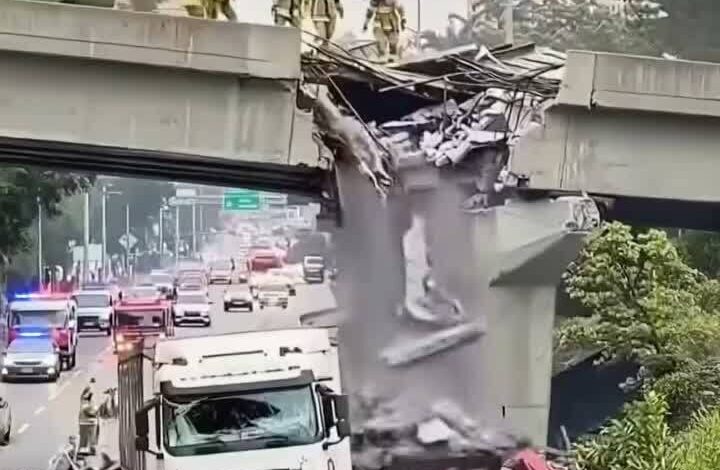
What began as an ordinary Friday morning in Richmond, British Columbia, quickly turned into a major transportation incident that disrupted traffic, raised concerns about infrastructure safety, and renewed debate about commercial vehicle regulations across the province.
At approximately 7:15 a.m., a commercial truck traveling along Knight Street collided with the Cambie Road overpass after its dump trailer remained in a raised position while approaching the bridge. The elevated trailer struck the underside of the overpass with significant force, creating a dramatic scene that immediately halted traffic and triggered a large-scale emergency response.
According to initial reports, the impact was powerful enough to separate the truck’s cab from its trailer. Witnesses described hearing a loud crash followed by the sight of the damaged vehicle coming to a stop beneath the bridge.
Fortunately, no injuries were reported.
However, the collision immediately raised concerns about the structural integrity of the overpass and prompted authorities to close all southbound lanes while emergency crews and engineers assessed the damage.
Immediate Response
Within minutes, police officers, transportation officials, and engineering teams arrived at the scene.
The primary concern was public safety.
Although the bridge remained standing, transportation authorities understood that visible damage often tells only part of the story. Structural impacts can create hidden weaknesses that are not immediately apparent to the naked eye.
Provincial engineers worked alongside Richmond municipal officials to conduct a detailed assessment of the overpass. While the highway falls under provincial jurisdiction, local authorities assisted with traffic management and safety inspections.
Meanwhile, the damaged trailer remained lodged against the bridge for several hours as crews carefully worked to stabilize the area and remove debris.
Motorists were advised to avoid the corridor and seek alternative routes as traffic congestion rapidly spread throughout Richmond and neighboring communities.
Investigating the Cause
The Richmond Road Safety Unit, in cooperation with the Ministry of Transportation and Infrastructure, assumed responsibility for the investigation.
Authorities are examining the circumstances that led to the collision, including why the trailer remained elevated while traveling on a major roadway.
Structural engineers are also conducting comprehensive inspections of the overpass itself. Their work includes evaluating potential cracks, checking expansion joints, examining support structures, and identifying any hidden damage that may compromise the bridge’s long-term durability.
Experts emphasize that even when a bridge appears visually intact, collisions of this magnitude can create internal stress that requires careful analysis before traffic can safely resume.
A Growing Problem
Unfortunately, overpass strikes are not uncommon in British Columbia.
Over the past several years, the province has experienced a growing number of collisions involving over-height commercial vehicles and bridge structures.
Many incidents occur when truck beds, dump trailers, or construction equipment remain raised while traveling. Others result from improperly secured loads or incorrect height calculations.
In some cases, drivers may not realize that their vehicle exceeds clearance limits until it is too late.
According to transportation data, similar incidents have occurred throughout the Lower Mainland and Fraser Valley, creating costly repairs, traffic disruptions, and safety concerns.
A comparable collision in Langley last year was among several overpass strikes recorded on provincial highways within a single year.
Infrastructure Challenges
Transportation experts note that the issue is not always limited to driver error.
Some overpasses were built decades ago under different transportation standards and may offer less clearance than modern freight operations require.
In addition, road resurfacing projects can gradually reduce vertical clearance over time.
Industry advocates have also pointed to inconsistent or inadequate signage in certain locations, arguing that better warning systems could help prevent collisions before they occur.
As freight traffic continues to increase throughout British Columbia, the interaction between modern commercial vehicles and aging infrastructure has become an increasingly important issue.
Technology as Prevention
Industry organizations, including the British Columbia Trucking Association, have called for greater adoption of technology designed to prevent over-height collisions.
One frequently discussed solution involves over-height detection systems.
These systems use laser or infrared sensors to identify vehicles that exceed safe clearance limits before they reach bridges or overpasses. Drivers can then receive warnings and safely reroute before a collision occurs.
Transportation safety experts have also recommended:
- GPS systems with integrated bridge-clearance databases
- Real-time fleet monitoring technology
- Enhanced driver training programs
- Mandatory height verification procedures
- Improved maintenance inspections for hydraulic trailer systems
Many believe that combining these tools with stronger enforcement and education could significantly reduce the number of overpass strikes.
Economic Impact
While the physical damage caused by bridge collisions often attracts the most attention, the economic consequences can be equally significant.
The Knight Street corridor serves as a critical transportation link connecting Richmond, Vancouver, Delta, and communities throughout the Fraser Valley.
When traffic is interrupted, the effects ripple throughout the regional economy.
Delivery schedules become delayed.
Supply chains slow down.
Businesses experience disruptions.
Commuters face longer travel times.
Fuel consumption increases as drivers search for alternate routes.
Even a temporary closure can generate substantial financial costs for businesses and transportation providers that depend on reliable infrastructure.
For logistics companies operating on tight schedules, unexpected delays can affect entire distribution networks.
Calls for Policy Reform
Following the Richmond incident, transportation experts renewed calls for broader policy discussions about infrastructure modernization and commercial vehicle safety.
Some proposals include requiring over-height detection systems on major trucking routes, improving clearance signage, updating aging bridge infrastructure, and incorporating clearance information directly into commercial navigation systems.
Public safety advocates have also emphasized the importance of transparency regarding inspection results and bridge reopening timelines.
As freight traffic continues to grow, many experts believe that proactive prevention strategies will ultimately prove more cost-effective than repeated repairs and emergency responses.
Lessons Moving Forward
Although no one was injured in the Knight Street collision, the incident serves as a powerful reminder of how quickly a single oversight can disrupt an entire region.
The costs of overpass strikes extend far beyond damaged vehicles and repair bills. They affect transportation networks, businesses, commuters, and public confidence in critical infrastructure.
Preventing future incidents will require cooperation among drivers, trucking companies, engineers, regulators, and policymakers.
Training, technology, infrastructure investment, and ongoing safety education must work together as part of a broader strategy.
The Richmond collision may have been contained without serious injuries, but its lessons are likely to influence transportation discussions for years to come.
As investigators continue their review, the event stands as a reminder that safety on modern transportation networks depends not only on infrastructure itself, but on the collective responsibility of everyone who uses it.
For British Columbia’s growing transportation system, the Knight Street overpass collision is more than an isolated accident—it is a wake-up call about the importance of vigilance, modernization, and proactive safety measures in an increasingly complex freight environment.