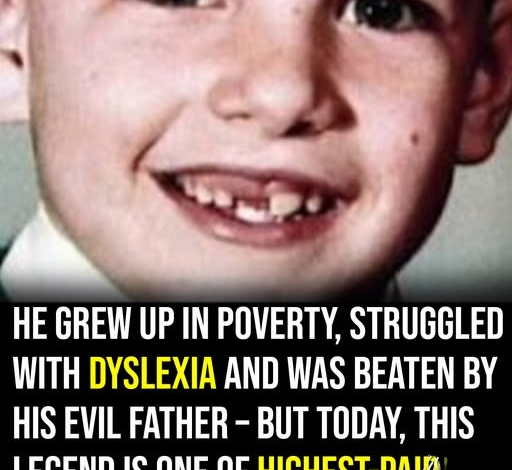
Long before audiences knew his name, he had already mastered a skill that would shape the rest of his life: paying attention.
Not the casual attention most people give the world around them, but the deeper kind born from uncertainty. The kind that develops when a child learns that moods can shift without warning, that peace can disappear suddenly, and that survival sometimes depends on noticing what others miss.
Home was not always a place of comfort.
It was a place of observation.
Every room carried information. Every voice change mattered. Every silence had to be interpreted. While other children moved through their days assuming stability, he learned to scan constantly for signs that the emotional weather might be changing.
That kind of vigilance leaves a mark.
For some people, it becomes anxiety.
For others, fear.
In his case, it eventually became discipline.
The habits formed in childhood did not disappear when circumstances improved. They simply found a new purpose. The same awareness that once helped him navigate uncertainty evolved into extraordinary focus. The same need to anticipate became preparation. The same inability to switch off became an advantage in environments where precision mattered.
What looked like confidence later in life often began as adaptation.
People frequently misunderstand resilience because they imagine it arrives fully formed. They picture strength as something natural, an internal quality some people possess and others do not.
More often, resilience is built.
Slowly.
Under pressure.
One difficult experience at a time.
His early years offered plenty of opportunities to practice.
The family moved often enough that permanence felt unreliable. Friendships disappeared almost as soon as they formed. New schools meant new hierarchies, unfamiliar faces, and the recurring challenge of starting over before the previous chapter had fully settled.
For many children, constant relocation creates loneliness.
For him, it created observation.
When you arrive as the outsider repeatedly, you learn how groups work. You learn who speaks first and who stays quiet. You learn how power moves through a room. You learn how people reveal themselves when they think no one is paying attention.
Those lessons would become unexpectedly useful later.
Bullying added another layer.
Children can be remarkably cruel toward anything they perceive as different. Dyslexia made school harder than it appeared from the outside. While classmates moved through assignments effortlessly, he often faced invisible battles that teachers and peers did not fully understand.
The frustration was not simply academic.
It was personal.
Nothing undermines confidence faster than feeling intelligent while constantly being treated as though you are not.
Yet struggle has a strange way of clarifying priorities.
Some people shrink under repeated setbacks.
Others become stubborn.
He became stubborn.
Again and again, he encountered reasons to lower his expectations of himself.
Again and again, he refused.
That refusal was rarely dramatic.
No speeches.
No declarations.
Just persistence.
The quiet decision to keep moving.
To keep trying.
To continue despite discomfort.
Over time, those choices accumulated into character.
Then came film.
Not fame.
Not success.
Film itself.
Before the recognition, before the interviews, before the red carpets and magazine covers, there was simply the discovery that storytelling offered something he had been searching for all along.
Structure.
Direction.
Focus.
For perhaps the first time, his attention had somewhere to go.
Acting demanded the very qualities life had already trained into him. Observation. Preparation. Emotional awareness. The ability to read people carefully and understand motivations beneath surface behavior.
What had once been survival skills suddenly became artistic tools.
The transition was not immediate.
Careers rarely are.
There were years of uncertainty, rejection, and financial instability. Years where the destination remained invisible and only the next step could be seen clearly.
But effort has a way of compounding.
Each audition taught something.
Each role added experience.
Each setback strengthened resolve.
Eventually, opportunities became larger.
Then larger still.
Audiences began noticing what directors had already recognized: an unusual intensity that felt authentic rather than manufactured. A focus that seemed effortless because they could not see the decades of practice behind it.
By then, people were calling it talent.
And talent was certainly part of the equation.
But talent alone rarely explains endurance.
What they were witnessing was something more complex.
A lifetime of adaptation refined into craft.
The polished performances came from countless rough moments. The confidence came from surviving uncertainty. The discipline came from years spent learning that preparation was safer than complacency.
Even success did not erase the past.
It simply changed the relationship to it.
There is a temptation, especially in public life, to divide experience into neat categories: before and after, weakness and strength, failure and triumph.
Real life rarely cooperates with those distinctions.
The difficult parts remain.
The difference is how they are understood.
With time, he stopped seeing childhood struggles as evidence of damage and began recognizing them as sources of insight. Not gifts exactly, and certainly not experiences he would necessarily choose again, but realities that shaped perspective.
Pain transformed into material.
Fear transformed into awareness.
Instability transformed into determination.
The past stopped being something to escape and became something to understand.
That shift changed everything.
Because once a person understands their history, they no longer spend all their energy fighting it.
They can use it instead.
The steadiness people notice today is not the absence of struggle.
It is the result of struggle.
It is what remains after years of learning how to move forward despite uncertainty. After learning that confidence is not certainty, but action taken without certainty. After discovering that resilience is less about avoiding hardship than adapting to it repeatedly.
From the outside, success often appears clean.
A straight line connecting talent to achievement.
The reality is usually far messier.
Behind every composed public figure stands a private history full of invisible negotiations with fear, doubt, loneliness, and disappointment.
What separates some people is not that they avoid those battles.
It is that they continue walking while carrying them.
The boy who once scanned rooms for danger never completely disappeared.
He simply grew older.
More experienced.
More focused.
The habits remained, but their purpose changed.
Today that same attentiveness helps him understand characters, navigate pressure, and maintain the level of commitment audiences have come to expect. What once protected him now serves him.
And perhaps that is the most remarkable transformation of all.
Not that the struggle vanished.
But that it became useful.
Because real strength is rarely the absence of difficulty.
More often, it is the ability to take what once threatened to limit you and turn it into something capable of carrying you forward.
The child who learned to watch carefully became an adult who notices everything.
The boy who felt different found a place where difference became an advantage.
And the person who once searched constantly for stability eventually built it from within.
That is why his steadiness feels genuine.
It was earned.
One challenge.
One adjustment.
One determined step at a time.