They didn’t call her Pear at first.
At first, she barely looked like a dog at all.
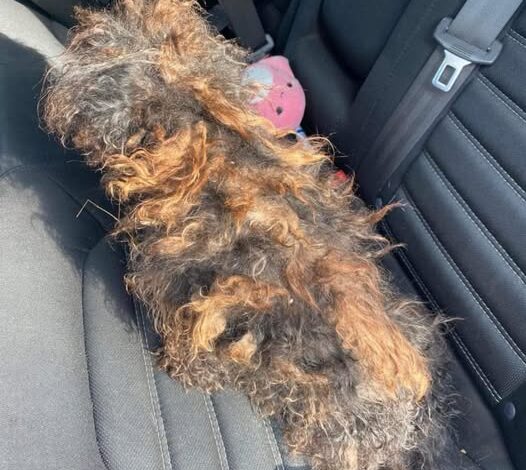
Someone driving along a rural Missouri road spotted movement near the shoulder — not the sharp movement of an animal running, but something slower, heavier, almost mechanical in its exhaustion. From a distance, she looked like a pile of debris dragging itself through gravel.
A shadow.
A shape.
Something alive only because it kept moving.
By the time she arrived at Mac’s Mission, even experienced rescuers fell silent for a moment.
Not because they hadn’t seen suffering before.
They had.
Mac’s Mission exists precisely because animals arrive there carrying versions of neglect most people struggle to imagine fully. Matted coats fused into armor. Bones visible beneath infected skin. Eyes clouded with fear so old it resembles instinct more than emotion.
But every once in a while, a case still cuts through the emotional calluses rescue workers build simply to survive their work.
Pear was one of those cases.
Her fur had grown into thick, hardened masses hanging from her body like wet concrete. Mats twisted around her legs so tightly they altered the way she walked, forcing her into an awkward dragging shuffle that must have caused constant pain. Dirt, urine, and infection lived trapped beneath the layers. The smell alone revealed how long she had existed without care.
And somewhere underneath all that wreckage stood a small dog still trying to stay alive.
The grooming team approached her gently.
Not dramatically.
Not heroically.
Just with the quiet tenderness repetition teaches people who spend their lives helping damaged creatures. Rescue work often looks emotional online — before-and-after photos, dramatic transformations, viral tears. But inside the room itself, it is usually slower and quieter:
steady voices,
careful hands,
long patience.
The clippers began humming softly.
At first, Pear flinched.
Every touch seemed unfamiliar to her body. Animals neglected for long periods often stop expecting comfort entirely. Human hands become unpredictable things associated with pain, abandonment, or fear rather than safety.
Still, she stood there trembling while the team worked carefully through the mats imprisoning her.
Piece by piece, the illusion of “debris” began falling away.
Each heavy clump removed exposed more truth underneath:
fragile pink skin,
scar tissue,
thin muscles shaking from exhaustion.
The transformation looked painful emotionally because it revealed how small she really was. Matted fur had made her appear larger somehow, protected almost. Beneath it stood a tiny creature carrying years of survival directly on her body.
And then they saw the missing eye.
The room quieted again.
No one knew exactly what had happened to her before rescue. Maybe injury. Maybe infection left untreated too long. Maybe cruelty. Rescue workers learn not to ask questions the body already answers partially.
Pear’s scars formed their own language.
A survival ledger written directly into skin.
By the time grooming finished hours later, she looked almost unreal compared to the animal who first arrived. Smaller. Vulnerable. Barely recognizable.
But unmistakably herself now.
Someone wrapped her gently in blankets afterward while food was placed carefully nearby.
Pear ate frantically.
Not greedily.
Fearfully.
Like a creature convinced the meal might disappear before she finished swallowing. Dogs who survive neglect often carry starvation psychologically long after regular feeding begins. The body remembers scarcity even after danger passes.
Every bite looked urgent.
Then, finally, exhaustion overtook adrenaline.
Pear curled against soft bedding and collapsed into sleep so completely it almost frightened the volunteers initially. Her body simply surrendered all at once — as though survival itself had finally loosened its grip enough for rest to enter.
That may have been the real turning point.
Not the haircut.
Not the photographs.
Sleep.
Because true safety begins the moment an abused animal believes, even briefly, that vigilance is no longer necessary every second.
Online, people would later see the transformation pictures:
before,
after,
the dramatic visual contrast built perfectly for social media emotion.
Those images spread quickly because humans respond instinctively to visible redemption stories. We want suffering to become recognizable healing. We want proof that kindness still changes outcomes.
But photographs flatten what actually happened in that room.
The real miracle was quieter than appearance.
It lived inside tiny behavioral shifts almost invisible to strangers.
The first time Pear stopped shrinking away from touch.
The first moment she leaned slightly into a hand instead of flinching from it.
The cautious way her tail eventually twitched when someone spoke gently near her bed.
Trust returning to neglected animals rarely arrives dramatically.
It arrives millimeter by millimeter.
Especially after abandonment.
Because discarded animals do not merely lose homes. They lose expectation. The world teaches them repeatedly that hunger lasts, pain continues, and humans disappear eventually.
Rescue means teaching the opposite slowly enough for frightened bodies to believe it.
At Mac’s Mission, Pear began learning new rhythms:
regular meals,
warm blankets,
voices without anger,
medical care,
hands that touched gently instead of carelessly.
Healing remained uneven.
Bodies damaged that severely do not recover instantly. Her missing eye would never return. Some scars would always remain visible beneath thinning fur. Trauma lingered too. Sudden movements still startled her. Certain sounds froze her completely.
But survival had already done something remarkable inside her despite everything:
it left room for softness to return.
That is what moved people most deeply once they understood her story.
Not perfection.
Not complete recovery.
Willingness.
A dog who had every reason to distrust humans still choosing, cautiously, to try again.
Pear eventually learned how to rest beside people instead of merely enduring their presence. She learned that food could arrive consistently. That touch did not always hurt. That kindness, repeated enough times, becomes believable even to wounded creatures.
And perhaps that is why her story resonated so widely beyond animal rescue communities.
Because beneath the fur and scars sat something painfully familiar to human experience too:
the exhausting weight of carrying survival alone for too long,
the fear that softness invites danger,
the strange vulnerability required to trust care after abandonment.
Pear survived because someone stopped beside a Missouri road long enough to recognize life hiding inside what others may have mistaken for hopeless wreckage.
Then others followed:
clippers humming softly,
hands working patiently,
people choosing tenderness again and again until fear slowly loosened its hold.
Now, when Pear leans into a human hand, the gesture looks small from the outside.
But for creatures shaped by neglect, trust is never small.
It is the bravest thing survival can ask for.
And somewhere beneath fresh fur, old scars, and one watchful remaining eye, Pear keeps learning a new truth every day:
that kindness can cut away even the heaviest things imprisoning a life —
and leave behind not ruin,
but someone finally visible enough to love.