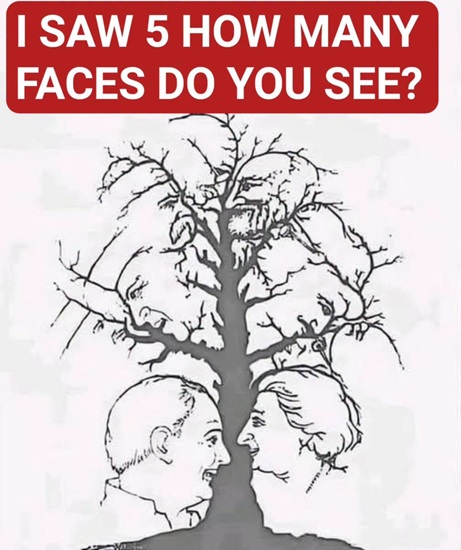
At first glance, it looks like nothing more than an ordinary tree.
Its branches stretch outward. Its trunk twists upward. The image appears simple, almost unremarkable, like a sketch you might glance at for a few seconds before moving on.
But then someone asks a single question:
How many faces can you see?
Suddenly, the tree changes.
What seemed straightforward becomes a challenge. Your eyes begin searching through every branch, every curve, every shadow hidden within the artwork. Shapes that looked random moments earlier start taking on new meaning. Features emerge from the bark. Profiles appear where there were once only leaves and branches.
And before long, you’re no longer looking at a tree.
You’re hunting for secrets hidden inside it.
This fascinating optical illusion, often called the “National Leaders Tree,” has captured the attention of puzzle enthusiasts across the internet. Shared repeatedly on social media, forums, and brain-teaser websites, the image continues to challenge viewers with a deceptively simple task: count the faces concealed within the tree.
The challenge sounds easy.
It isn’t.
Most people immediately spot one or two faces near the lower section of the image. These are the easiest to identify and often give viewers a false sense of confidence.
Then the real puzzle begins.
The longer you stare at the image, the more complicated it becomes.
A branch suddenly resembles a forehead.
A shadow transforms into a nose.
What looked like empty space moments ago begins to resemble an entire face staring back at you.
Every new discovery makes you question what you missed before.
And that is exactly why optical illusions like this remain so popular.
They challenge something we usually take for granted:
Our perception.
Human beings are remarkably good at recognizing faces. In fact, our brains are so specialized for this task that we often see faces where none actually exist. A smiling shape in the clouds. Features hidden in rock formations. Expressions appearing in household objects.
Psychologists call this phenomenon pareidolia.
It is the brain’s tendency to find familiar patterns, especially human faces, within random or ambiguous visual information.
The “National Leaders Tree” takes full advantage of this tendency.
The artist carefully arranged shapes, lines, and shadows so that multiple faces blend naturally into the structure of the tree. Some are obvious. Others are extraordinarily subtle.
Certain faces emerge from curved branches.
Others appear within the bark itself.
Some can only be recognized when viewed from a specific angle or after your brain adjusts to a different interpretation of the image.
That shifting process is part of what makes the puzzle so engaging.
At first, viewers often become frustrated.
They stare at the tree and wonder what everyone else is seeing.
Then something clicks.
A hidden face appears.
Suddenly another emerges nearby.
Then another.
And another.
What once seemed impossible becomes impossible to stop seeing.
The image rewards patience.
The longer you look, the richer it becomes.
Unlike many modern forms of entertainment that deliver instant gratification, optical illusions ask something different from us. They require focus. They encourage observation. They reward curiosity.
There is no timer.
No score.
No competition.
Only the quiet satisfaction of discovery.
That experience is surprisingly addictive.
People often challenge friends and family members to compare results.
“How many did you find?”
“I only saw five.”
“Wait, where’s that one?”
“I completely missed it.”
The image becomes more than a puzzle.
It becomes a conversation.
A shared experience.
A reminder that different people can look at the same thing and notice entirely different details.
Interestingly, there is no universal answer to how many faces someone will immediately see.
Some viewers identify only a handful.
Others uncover many more.
The difference usually has little to do with intelligence and much more to do with attention, patience, and perspective.
A person who scans quickly may overlook details hidden in plain sight.
Someone who studies the image carefully often uncovers layers that seemed invisible at first.
That variability is part of the illusion’s charm.
Everyone experiences it differently.
Some online posts attempt to attach deeper meanings to these results, suggesting that the number of faces a person sees reveals something significant about their personality, intelligence, or mental health.
There is no scientific evidence supporting such claims.
The puzzle is not a diagnostic tool.
It cannot measure intelligence.
It cannot predict personality traits.
And it certainly cannot diagnose medical conditions.
What it can do is exercise observation skills and provide a fascinating glimpse into how perception works.
That alone is enough to make it worthwhile.
Part of the enduring popularity of optical illusions comes from the way they expose the gap between reality and interpretation.
The faces inside the tree do not appear and disappear.
They are always there.
What changes is our ability to notice them.
That distinction matters.
The illusion reminds us that seeing is not simply a matter of looking.
It is a matter of understanding.
Our brains constantly filter information, deciding what deserves attention and what can be ignored. Most of the time, that process happens automatically. We move through life without questioning it.
Optical illusions interrupt that automatic process.
They force us to slow down.
To reconsider.
To look again.
And often, to realize how much we missed the first time.
That is why a simple drawing of a tree continues to captivate people around the world.
It is not really about the tree.
Or even the faces.
It is about perception itself.
The image demonstrates how quickly the familiar can become mysterious and how hidden complexity often exists beneath seemingly simple surfaces.
Every branch becomes a clue.
Every shadow becomes a possibility.
Every discovery encourages another.
By the time most viewers finish examining the “National Leaders Tree,” they are no longer focused on finding the correct answer.
They are enjoying the process.
The search.
The surprise.
The moment when a face suddenly emerges from a section of the image that looked completely ordinary seconds earlier.
In the end, that is the real appeal of the illusion.
Not how many faces you find.
But how many times it makes you look again.
Because sometimes the most fascinating discoveries are not hidden in the image itself.