The house had never felt so quiet.
Long after the relatives had gone home and the condolences had faded into silence, you found yourself sitting alone by the living room window. Moonlight spilled across the floorboards, illuminating the folded shawl resting carefully in your lap. For a long time, you simply stared at it, remembering the laughter that had filled the room only hours before.
Lila’s laughter.
It had been sharp enough to sting.
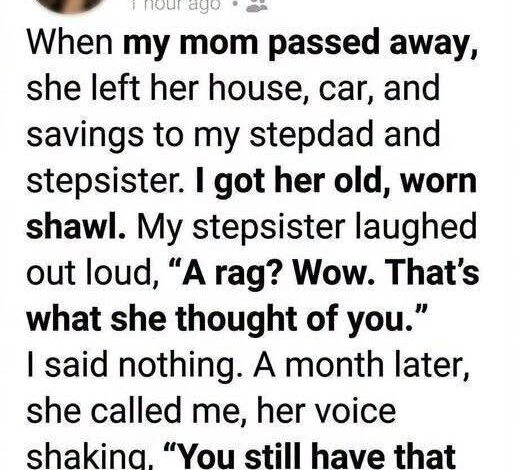
“So that’s what Mom left you?” she had scoffed during the reading of the will. “A worn-out shawl? I suppose someone had to inherit the family rags.”
The others chuckled politely, unwilling to challenge her. You forced a smile, folded the faded fabric without saying a word, and carried it home.
Now, with no one watching, you slowly unfolded it again.
Its edges were soft from decades of careful use, the embroidery slightly uneven where tiny hands had once tried to help repair it. As your fingers traced each loose thread, a familiar fragrance drifted upward.
Lavender.
Not the artificial scent from a bottle, but the gentle aroma that had always lingered around your mother.
In an instant, the years disappeared.
You were six again, curled against her after a nightmare while she wrapped the shawl around both of you until your tears stopped. You were twelve, listening as your grandmother sat beside the window telling stories about courage, sacrifice, and kindness while knitting quietly beneath the afternoon sun. You were seventeen, heartbroken after your first real disappointment, feeling that same shawl settle across your shoulders before your mother whispered, “Some things don’t fix pain. They simply remind you that you don’t have to carry it alone.”
A tear rolled down your cheek.
Suddenly, Lila’s cruel words no longer mattered.
The shawl didn’t feel like a consolation prize.
It felt like home.
More than that, it felt as though your mother had reached across time to place one final embrace around your shoulders.
You couldn’t explain why, but something inside you whispered that this gift had never been chosen by accident.
Days passed.
Life slowly returned to its ordinary rhythm, though the shawl remained draped over your favorite chair. Sometimes you wrapped yourself in it while reading. Sometimes you simply held it when the silence inside the house became too heavy.
Then your phone rang.
Lila.
You almost ignored it.
When you answered, you expected sarcasm.
Instead, you heard panic.
“Please,” she said before you could speak.
Her voice trembled so violently that you barely recognized it.
“I… I need to talk to you.”
You remained silent.
“I was wrong,” she continued. “About everything.”
The confidence that had always defined her was gone.
In its place was desperation.
“I’ll buy it from you.”
You frowned.
“The shawl?”
“Yes.”
“You made fun of it.”
“I know.”
“I thought you said it belonged in the trash.”
“I was wrong.”
The words spilled out faster.
“I’ll pay whatever you want. Name a price. I’ll double it. Triple it.”
You stared through the window into the darkness beyond the glass.
“Lila… why?”
She hesitated.
“I can’t explain over the phone.”
“You’ll have to.”
Another long silence followed.
“I’ve spoken to Mother’s attorney.”
Your heartbeat slowed.
“He told me something he wasn’t allowed to discuss until now.”
She swallowed audibly.
“The shawl isn’t just… a shawl.”
Memories of your mother’s quiet smile returned unexpectedly.
“What do you mean?”
“There was another document.”
You listened without interrupting.
“A legal provision.”
The lawyer had explained that your mother’s financial assets had never been intended for the child who simply inherited them. They were meant for the one who understood why the shawl mattered.
Hidden investments.
Private accounts.
Property held quietly for years.
A fortune neither of you had known existed.
Everything would belong to the person who chose the shawl willingly and kept it without trying to sell or discard it.
It wasn’t a puzzle.
It wasn’t a trick.
It was your mother’s final lesson.
Lila’s breathing became uneven.
“I didn’t know.”
“No,” you answered softly.
“You have to give it back.”
“I don’t.”
“I’ll give you everything.”
“You already had everything.”
“I was angry.”
“You laughed.”
“I wasn’t thinking.”
“No.”
You closed your eyes.
“You were calculating.”
Her voice cracked.
“I need it.”
For a long moment, neither of you spoke.
Finally, you looked down at the faded fabric resting across your knees.
You remembered every tiny repair your grandmother had sewn by hand.
Every winter evening your mother wrapped it around your shoulders before walking you outside.
Every difficult conversation that somehow became easier beneath its warmth.
The value had never been hidden in bank accounts.
Those merely followed it.
The real inheritance had been stitched into every faded thread decades before anyone mentioned lawyers or money.
Your mother had known exactly what she was doing.
She understood that one daughter would see worn fabric.
The other would recognize love.
“You know what I realized?” you asked quietly.
Lila said nothing.
“If the lawyer had never told us about the fortune…”
Your fingers gently smoothed the familiar embroidery.
“…I’d still keep this.”
Silence answered.
Because that was the truth.
No amount of money could purchase the nights your mother stayed awake comforting you.
No investment portfolio could replace your grandmother’s stories drifting through the afternoon light.
No fortune could recreate the feeling of being loved so completely that even an old piece of cloth became a sanctuary.
Eventually, Lila whispered, “So that’s it?”
You smiled sadly.
“No.”
She waited.
“This was never about choosing between money and a shawl.”
“It wasn’t?”
“No.”
You looked once more at the faded lavender fabric resting safely in your hands.
“It was about whether we understood what she was really leaving behind.”
When the call ended, the room was quiet again.
Outside, the wind rustled softly through the trees.
Inside, you folded the shawl with the same care your mother always had and placed it beside you.
Only now did you fully understand why she had entrusted it to you.
The hidden fortune was never meant to reward greed. It was meant to reveal character.
Anyone could inherit wealth.
But only someone who treasured love before riches could truly carry the legacy she spent a lifetime creating.
And in that moment, wrapped in fading lavender and treasured memories, you realized your mother’s greatest gift had never been measured in dollars at all. It had always been measured by the heart she believed you would protect long after she was gone.