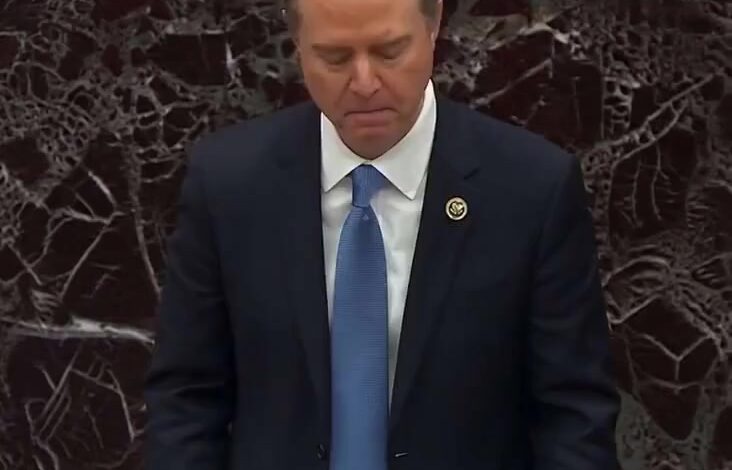
The political shockwaves generated by Adam Schiff’s confirmation continued to spread across Washington long after the final votes were counted. What initially appeared to be another contentious moment in an already polarized political environment quickly evolved into a broader discussion about power, influence, and the future direction of American governance. In the hours following the confirmation, lawmakers, donors, strategists, and political observers from across the ideological spectrum began assessing what Schiff’s rise could mean not only for Congress but also for the nation’s increasingly fragile political climate.
Behind closed doors, Democratic leaders viewed the confirmation as a significant victory. For many within the party, Schiff has become one of the most recognizable figures in modern American politics, known for his prominent role in investigations, oversight efforts, and some of the most consequential political battles of the last decade. His confirmation was interpreted by supporters as a validation of a political strategy centered on accountability and institutional strength. Rather than stepping back from controversial confrontations, Democrats appear determined to continue pursuing investigations and oversight initiatives that they argue are necessary to preserve democratic norms and government transparency.
Party strategists have privately suggested that Schiff’s new position could provide Democrats with a stronger voice during a period of growing political uncertainty. They believe his experience, public profile, and willingness to engage in high-stakes political conflicts make him uniquely positioned to navigate some of the challenges that lie ahead. While critics often portray him as a divisive figure, supporters argue that his determination and visibility are precisely why he remains an influential force within the party.
However, Republicans see the situation in dramatically different terms. For years, conservative leaders have pointed to Schiff as one of the clearest examples of what they describe as partisan politics in Washington. To them, his confirmation represents more than a personnel decision—it symbolizes the continued escalation of political warfare between the two major parties. Many Republican lawmakers are already preparing for a series of confrontations that they believe will inevitably follow.
Within conservative circles, discussions have focused on how Schiff’s expanded authority could influence future investigations, hearings, and public debates. Political operatives are reportedly crafting messaging strategies that place Schiff at the center of broader arguments about government overreach, political bias, and partisan decision-making. Some believe that opposition to Schiff could become a powerful rallying point for Republican voters, particularly as attention gradually shifts toward future elections.
The confirmation has also reignited a broader national debate about the role of institutions in modern American politics. Supporters argue that strong oversight is an essential component of democratic government, especially during periods of intense political tension. Critics counter that excessive investigations and political conflicts can undermine public trust and contribute to an environment where compromise becomes increasingly difficult.
Meanwhile, ordinary Americans continue to watch these developments with a mixture of concern, frustration, and curiosity. Public confidence in political institutions has been tested repeatedly in recent years, and many voters have grown weary of constant partisan battles. Yet despite this fatigue, major political events continue to capture national attention because their consequences often extend far beyond Washington.
Political analysts note that moments like Schiff’s confirmation rarely exist in isolation. Instead, they often become symbols of larger shifts occurring within the political system. Whether viewed as a victory for accountability or as evidence of deepening polarization, the confirmation is likely to influence political conversations for months, if not years, to come.
Looking ahead, the implications remain uncertain. Supporters anticipate a more aggressive approach to oversight and governance, while opponents expect increased political conflict and heightened tensions between the parties. Both sides agree on one thing: the confirmation marks the beginning of a new chapter rather than the end of a political battle.
As Washington adjusts to this reality, attention is already turning toward the next major confrontation. Future investigations, legislative fights, and election campaigns will ultimately determine how Schiff’s confirmation is remembered. Yet even at this early stage, many observers believe it has already secured a place among the defining political moments of the current era.
History often identifies certain votes as turning points—moments when existing tensions crystallize into a new political reality. For supporters, Schiff’s confirmation may represent a commitment to accountability and institutional resilience. For critics, it may symbolize the continued expansion of partisan influence within the nation’s most powerful institutions. Regardless of perspective, few would dispute that the decision has altered the political landscape.
The immediate shock may be fading, but the consequences are only beginning to unfold. As lawmakers return to their respective agendas and political organizations refine their strategies, the significance of the confirmation continues to grow. What happened in a single vote has now become part of a much larger story—one involving power, principle, political rivalry, and the uncertain future of American democracy. The calm that existed before the vote appears increasingly distant, replaced by a sense that the next chapter of political conflict has already begun.