I Adopted Four Siblings Who Were Going to Be Split Up – a Year Later, a Stranger Showed Up and Revealed the Truth About Their Biological Parents

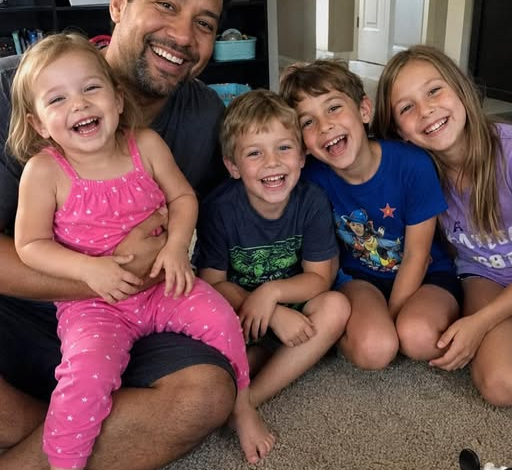
What makes Michael’s story so emotionally overwhelming is that it begins not with heroism, but with emptiness.
Before the adoption,
before the laughter,
before four children filled the house with noise and backpacks and arguments over snacks,
there is just a man sitting alone on a couch at 2 a.m., unable to move forward from grief that has hollowed his life out completely.
The death of his wife Lauren and six-year-old son Caleb did not merely make him sad. It dismantled the structure of ordinary existence itself. The details capturing that grief are painfully recognizable:
Lauren’s mug still beside the coffee maker,
Caleb’s sneakers still by the door,
drawings still hanging on the fridge.
These are not dramatic symbols placed there for storytelling effect. They are the kinds of objects bereaved people often cannot move because removing them feels too final, too much like participating in the disappearance of the people they loved.
And perhaps the most devastating line early in the story is also the simplest:
“I wasn’t strong. I was just still breathing.”
That sentence captures something many grieving people quietly understand but rarely say aloud. Survival after catastrophic loss often does not feel brave or meaningful. It feels mechanical. You wake up because your body continues functioning, not because you have rediscovered purpose.
Michael’s life after the accident is defined by emotional suspension:
sleeping on the couch,
eating takeout,
staring at nothing,
moving through routines without attachment.
Then the Facebook post appears.
Importantly, the transformation does not happen because he suddenly “heals.” It happens because his grief recognizes itself in someone else’s vulnerability.
That is why the line “Likely be separated” hits him so hard.
These children have already lost their parents. Now the system is preparing to take the only remaining stability they possess — each other. Michael immediately understands the terror embedded in that possibility because he knows what sudden aloneness feels like.
He knows hospital hallways.
Funerals.
Walking into silent houses where nobody is waiting anymore.
So when he imagines those siblings being separated, the pain becomes personal almost instantly.
The photo itself matters emotionally too. The children are not smiling hopefully for rescue. They look “like they were bracing.”
That detail is heartbreaking because children in unstable systems often become emotionally older than they should. They learn disappointment early. They stop expecting permanence. Even before Michael meets them, the story establishes that these kids already understand abandonment as possibility.
And then comes one of the most profound moments in the story:
Michael reading the comments.
“Shared.”
“Praying for them.”
“So heartbreaking.”
But nobody saying:
“We’ll take them.”
That contrast exposes an uncomfortable truth about compassion in modern life. Many people feel sorrow sincerely. Far fewer are able or willing to reorganize their entire lives around someone else’s suffering.
Michael does.
Not because he feels prepared.
Not because he feels healed.
But because he cannot tolerate the idea of those children losing one another too.
The scene in Karen’s office is emotionally powerful because it strips adoption of fantasy entirely. There are no magical assurances. No guarantees. Just bureaucracy, exhaustion, and hard reality:
most families cannot take four traumatized children at once.
When Michael says,
“I’ll take all four,”
Karen’s immediate response is not celebration.
It is:
“Why?”
And his answer reveals the moral center of the entire story:
“Because they already lost their parents. They shouldn’t have to lose each other, too.”
That line transforms the adoption from rescue into preservation.
Michael is not trying to replace what the children lost.
He is trying to stop the damage from expanding further.
The first meeting with the children deepens this beautifully.
Each child responds differently to fear:
Ruby hides,
Cole watches silently,
Tessa tests him defensively,
Owen behaves like a tiny exhausted adult already carrying responsibilities no child should hold.
Trauma reshapes children unevenly, and the story captures that with painful realism.
Tessa’s question especially lingers:
“What if you change your mind?”
Children who have experienced instability often stop fearing rejection emotionally because they begin expecting it instead. Her question is not dramatic. It is practical. She is already preparing for abandonment before attachment can fully form.
Michael’s response —
“I won’t. You’ve had enough people do that already.”
— becomes a quiet promise defining everything afterward.
Importantly, the story does not romanticize what comes next.
The adoption is messy,
exhausting,
emotionally chaotic.
Ruby cries nightly for her mother.
Cole pushes boundaries aggressively.
Tessa remains hypervigilant.
Owen collapses beneath the pressure of trying to protect everyone.
And Michael himself struggles too:
burned dinners,
bathroom breakdowns,
moments where he can barely breathe under the weight of responsibility.
That realism matters because love alone does not erase trauma instantly.
Healing inside families usually happens through repetition:
consistent care,
rules maintained calmly,
bedtime routines,
signed school forms,
showing up again and again after difficult days.
Small moments gradually become trust.
The emotional turning points arrive quietly:
Ruby sleeping on his chest during movies,
Cole drawing stick figures holding hands,
Tessa writing his last name after hers,
Owen accidentally saying,
“Goodnight, Dad.”
That last moment is devastating precisely because Owen freezes afterward.
He realizes emotionally before intellectually that attachment has happened.
And so does Michael.
The later revelation about the biological parents’ will transforms the story even further.
The trust,
the house,
the savings —
those details matter practically. But emotionally, the most important discovery is that the children’s parents explicitly wrote:
keep them together.
Always together.
That revelation reframes everything Michael has done.
Without ever seeing the will, he fulfilled the parents’ deepest final wish. While systems and logistics were preparing to divide the children, a grieving stranger unknowingly became the person protecting the exact thing their parents feared losing most.
There is something profoundly moving about that convergence:
love continuing through strangers after death.
The visit to the old house intensifies this emotional continuity beautifully.
The children remember everything:
the swing,
the height marks on the wall,
purple curtains,
burned pancakes in the kitchen.
Memory floods back not abstractly, but spatially. Houses hold emotional architecture long after people disappear.
And perhaps the most important moment arrives when Owen asks:
“Do we have to move here now? I like our house. With you.”
That sentence quietly confirms the adoption’s deepest success.
The old house still matters.
Their parents still matter.
But home has expanded emotionally to include Michael too.
Not as replacement.
As continuation.
That distinction is crucial.
Healthy grief does not erase the dead to make room for new love. It allows attachment to grow alongside memory rather than against it.
By the end, the story becomes less about adoption legally and more about rebuilding family after catastrophic loss. Michael never stops missing Lauren and Caleb. The children never stop loving their biological parents.
But grief and love stop competing for space eventually.
And maybe that is the deepest emotional truth in the story:
sometimes healing begins not when pain disappears,
but when someone chooses connection despite it.
Michael answered a late-night Facebook post while barely surviving himself.
He did not know about inheritance.
Did not know about the house.
Did not know about the will.
He simply saw four children standing on the edge of another devastating loss and said:
“All four.”
And in doing so, he transformed not only their future —
but his own shattered life as well.