I Became a Father at 17 and Raised My Daughter on My Own – 18 Years Later, an Officer Knocked on My Door and Asked, ‘Sir, Do You Have Any Idea What She Has Done?’

Some sacrifices happen loudly.
People applaud them.
Newspapers write stories about them.
Families gather around hospital beds or airport gates or military ceremonies and acknowledge openly that someone gave up part of their life for someone else.
But most sacrifices made by parents happen quietly.
A father skips meals so a child never notices money is short.
A mother works overtime and calls it “just a busy week.”
Someone folds away old dreams carefully into boxes and never mentions them again because survival became more urgent than ambition.
Children usually do not understand any of this while growing up.
And maybe that is the point.
Good parents often hide their sacrifices so completely that their children mistake endurance for normal life.
Brad did that for eighteen years.
He became a father at seventeen, which is an age when most people are still deciding who they want to become themselves.
At seventeen, people are usually worried about prom dates,
graduation parties,
driver’s licenses,
college applications.
Brad worried about diapers.
Formula.
Rent.
Keeping the electricity on.
He and Ainsley’s mother had once believed in forever the way very young couples often do — sincerely, intensely, and without understanding how fragile early certainty can become under pressure.
They planned futures together on the backs of fast-food receipts between part-time shifts because that was the kind of hope available to them then:
small,
practical,
unfinished.
Neither of them had parents to fall back on.
No safety net.
No emergency savings.
No grandparents offering childcare or rent money.
Just two frightened teenagers trying to imagine adulthood before they had fully survived adolescence themselves.
When Ainsley’s mother left for college, she never came back.
No dramatic screaming.
No custody battle.
Just absence.
One August morning she packed for school and quietly stepped out of motherhood entirely.
Brad never chased her.
Never publicly hated her.
Never poisoned Ainsley against her later.
That restraint matters because abandoned parents often carry two responsibilities simultaneously:
raising the child,
and protecting the child from the emotional damage of understanding too early that someone chose not to stay.
So Brad simply stayed himself.
And over time, that became the defining fact of Ainsley’s childhood.
He stayed.
That sounds simple on paper.
In reality, staying requires thousands of exhausting decisions repeated daily:
waking up for nightmares,
showing up at conferences,
learning how to braid hair because your daughter wants pigtails on picture day and disappointment feels unacceptable.
One of the most moving details in their story is the image of Brad practicing braids on a doll at the kitchen table.
Because love often looks exactly like that:
awkward effort performed privately so someone else feels cared for publicly.
There is nothing glamorous about single parenthood on a hardware store salary.
Brad understood this clearly:
“Raising a kid alone isn’t poetry. It’s math.”
That line captures something important about working-class sacrifice that people romanticize too often from a distance.
Love does not eliminate exhaustion.
It simply makes exhaustion purposeful.
Brad worked first at a hardware store and later as a foreman because there were bills to pay and a little girl who deserved stability. He learned to cook because restaurants were too expensive. He attended every school event because being present mattered more than perfection.
And perhaps the most emotionally significant thing about Brad’s parenting was not extraordinary heroism.
It was consistency.
Children build identity partly through repetition:
who shows up,
who remembers,
who remains reliable.
Brad became reliable.
Saturday mornings belonged to cereal and Powerpuff Girls.
Ainsley loved Bubbles — the soft-hearted one who cried easily and laughed loudly.
So Brad started calling his daughter “Bubbles.”
Nicknames inside families matter psychologically because they create private emotional language:
proof someone has been deeply seen over time.
“Bubbles” wasn’t just a cute name.
It represented ritual,
safety,
belonging.
Those mornings on the couch probably felt ordinary while they were happening.
That is another truth about parenthood:
the moments children remember forever rarely announce themselves while occurring.
Years later, Brad still thought of himself simply as a father trying to survive.
He did not realize his daughter had been watching him much more carefully than he understood.
That realization arrived on graduation night.
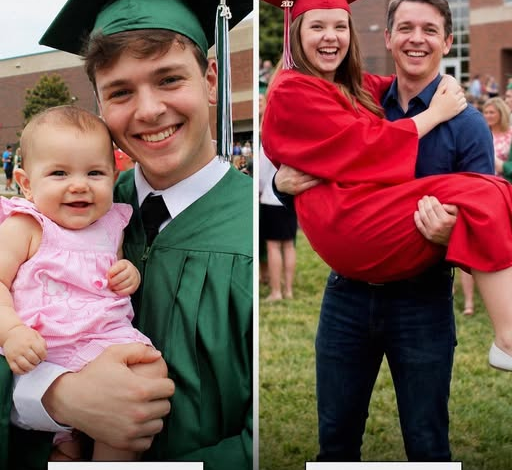
The ceremony itself already overwhelmed him emotionally.
Watching your child graduate after raising them alone changes something inside a parent because it transforms survival into evidence.
Ainsley crossing that stage represented more than academic success.
It meant:
the bills somehow got paid,
the loneliness did not destroy either of them,
the years mattered.
Brad cried openly while clapping loud enough to embarrass nearby strangers.
That image feels deeply authentic because parents who sacrificed heavily often respond emotionally to milestones in disproportionate ways. They are not only reacting to the event itself.
They are reacting to every invisible struggle behind it.
Ainsley came home buzzing with post-graduation energy and disappeared upstairs.
Then came the knock.
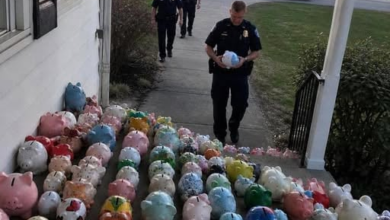
Two police officers standing under the porch light at ten o’clock at night.
Few sights trigger fear faster for parents than unexpected police at the door.
Brad’s body reacted immediately:
cold stomach,
racing pulse,
panic before information.
That physiological response says something universal about parenthood:
once you love someone deeply enough, fear becomes permanently wired into your nervous system.
The officers asked:
“Do you have any idea what your daughter has been doing?”
That phrasing intentionally sounds ominous.
And for several agonizing seconds, Brad likely imagined every terrible possibility available to a father’s imagination.
Instead, the truth was stranger and infinitely more emotional.
For months, Ainsley had been secretly working at a construction site.
Not officially.
Not legally employed through normal channels.
She simply showed up:
sweeping,
carrying supplies,
helping crews quietly.
The foreman initially tolerated it because she worked hard and caused no trouble. Eventually, when paperwork inconsistencies raised concerns, someone reported the situation following protocol.
What matters psychologically here is not the labor itself.
It is motive.
Ainsley was not rebelling.
Not acting recklessly.
She was preparing something.
When she came downstairs carrying the old shoebox, the emotional center of the story shifted completely.
Inside sat pieces of Brad’s abandoned life:
old notebooks,
plans,
drawings,
and an acceptance letter to an engineering program he earned at seventeen before fatherhood rerouted everything.
That letter symbolized an entire future quietly folded away.
And Brad had hidden it so completely he nearly forgot it existed himself.
But children notice more than parents realize.
Especially children raised by people who sacrifice constantly without complaint.
Ainsley found the box accidentally while searching for Halloween decorations. Then she read everything:
career timelines,
budget plans,
house sketches,
dreams.
And suddenly she understood her father differently.
Not merely as “Dad.”
As a young man who once imagined another life before choosing her.
That realization profoundly changed her.
Because children often grow up assuming their parents simply arrived as adults fully formed:
already responsible,
already exhausted,
already stable.
Discovering your parent once carried vulnerable ambition can feel emotionally shocking.
“You always told me I could be anything,” Ainsley said. “But you never told me what you gave up to make that true.”
That line contains enormous emotional intelligence.
Brad never weaponized sacrifice against her.
Never made her feel guilty.
Never said:
“I ruined my life for you.”
Instead, he absorbed the cost privately.
And because he protected her from the burden of that knowledge, she eventually chose gratitude freely rather than obligation defensively.
The construction site job suddenly made sense.
Ainsley wasn’t trying to escape her life.
She was trying to restore part of her father’s.
She had contacted the university herself.
Explained everything:
the teenage fatherhood,
the missed opportunity,
the years spent working instead of studying.
The school now offered an adult learner engineering program specifically designed for people whose education had been interrupted by life responsibilities.
Then came the detail that breaks the emotional dam completely:
Ainsley filled out all the forms herself.
That action transforms gratitude into active love.
Many people appreciate their parents privately.
Far fewer organize their lives around giving something back intentionally.
She worked construction,
a coffee shop,
dog-walking shifts —
all while finishing high school —
because she wanted to hand her father back the dream he buried for her eighteen years earlier.
The envelope she slid across the table contained his acceptance.
Not hers.
His.
Imagine the emotional disorientation of that moment:
a father who spent nearly two decades believing sacrifice permanently closed one future suddenly discovering the child he sacrificed for reopened it quietly behind his back.
Brad’s response revealed something heartbreaking about long-term sacrifice:
“I was supposed to give you everything. That was my job.”
Parents like Brad often struggle receiving love because their identity forms entirely around giving. Accepting care back can feel emotionally destabilizing.
But Ainsley understood something essential:
love is healthiest when it eventually moves both directions.
“You did,” she answered. “Now let me give something back.”
That sentence marks the emotional transition from parent-child hierarchy into mutual human recognition.
For the first time, Brad fully saw not only his daughter,
but an adult capable of loving him intentionally.
That realization often surprises parents more than children understand.
Because children eventually become witnesses to their parents’ humanity.
Not authority figures.
Not providers.
People.
Flawed,
tired,
aging,
afraid.
Brad finally admitted his fear aloud:
“What if I fail?”
That question reveals how deeply abandoned dreams can wound identity over time.
He wasn’t only afraid of engineering classes.
He feared discovering the younger version of himself no longer existed.
Many adults who return to education later experience this exact terror:
being older,
out of place,
surrounded by younger people still moving naturally through opportunities they themselves lost decades earlier.
Ainsley answered with the same emotional logic Brad used her entire childhood:
“Then we’ll figure it out. The way you always did.”
That line matters because children internalize resilience from observation more than instruction.
Brad taught adaptability by living it repeatedly in front of her.
So when his turn came to feel frightened, she simply reflected his own parenting back toward him.
Three weeks later, they walked into orientation together.
Brad felt out of place immediately:
older than everyone,
boots too heavy for campus floors,
uncertain.
And beside him stood the little girl he once taught to braid hair and watch cartoons with on Saturdays —
now steadying him emotionally through the doorway into his second chance.
The final sentence captures the entire emotional truth of the story:
“Some people spend their whole lives waiting for someone to believe in them. I raised one.”
That line reframes parenthood beautifully.
Brad believed he was giving everything away for eighteen years.
In reality, he was building someone capable of returning love with equal depth.
And perhaps that is the quiet miracle hidden inside good parenting:
when done with enough patience, sacrifice eventually stops feeling like loss.
It becomes legacy.