I left the device exactly where I had found it.
For hours, it sat there on the kitchen table, small and silent, occupying far more space in my mind than it did in reality.
Every time I walked past it, I glanced at it again.
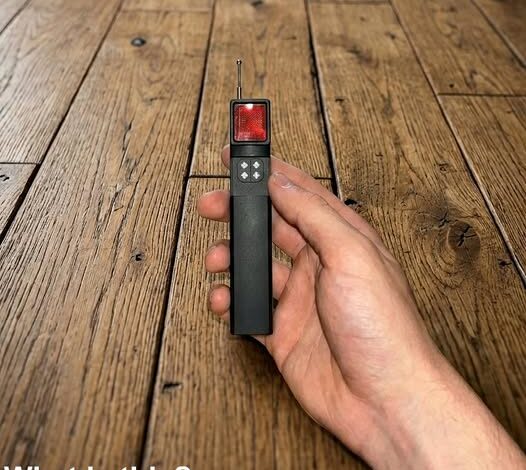
The black casing.
The tiny antenna.
The unfamiliar buttons.
The blinking indicator light.
It looked harmless enough.
Yet the longer I stared at it, the heavier it seemed to become.
Not because I understood what it was.
Because I didn’t.
And ignorance has a way of creating its own stories.
By the time my daughter came home that evening, I had imagined dozens of possibilities.
Some absurd.
Some frightening.
Some that made me angry.
Others that made me afraid.
I replayed the discovery over and over in my head.
The moment I found it.
The confusion.
The unease.
The growing suspicion that there was something happening in my daughter’s life that I knew absolutely nothing about.
That thought bothered me more than the object itself.
Parents spend years convincing themselves they understand their children.
We know their habits.
Their friends.
Their favorite foods.
Their fears.
Their dreams.
At least we think we do.
Then one unexpected discovery reminds us how much of their lives exist beyond our view.
How much happens in classrooms, hallways, group chats, locker rooms, buses, and social circles where we are not present.
How much they carry without telling us.
And how often they protect us from their worries as much as we try to protect them from ours.
When she finally walked through the front door, I immediately knew something was wrong.
Not because of what she did.
Because of what I felt.
The tension I’d been carrying all day made the room feel different.
Heavy.
Charged.
Like there was an invisible conversation already waiting between us.
She tossed her backpack down.
Kicked off her shoes.
Started talking about her day.
Ordinary things.
Teachers.
Homework.
A friend who said something funny during lunch.
The normal soundtrack of teenage life.
Then her eyes landed on the device.
And everything stopped.
The color drained from her face so quickly it startled me.
For a moment, neither of us spoke.
The silence stretched.
I could hear the hum of the refrigerator.
The ticking of the clock.
The faint sounds of traffic outside.
Then she looked at me.
And I looked at her.
And suddenly the strange object on the table felt less like a mystery and more like a crossroads.
I took a breath.
My voice came out shakier than I intended.
“What is it?”
The question sounded simple.
But it carried hours of anxiety behind it.
Days of imagined scenarios.
Years of parental fear.
I expected resistance.
Teenagers often respond to uncomfortable questions with defensiveness.
I expected excuses.
Maybe anger.
Maybe denial.
Maybe one of those frustrating arguments where neither person says what they’re actually feeling.
I prepared myself for all of it.
Instead, I watched something entirely different happen.
Her expression changed.
First fear.
Then embarrassment.
Then something far more painful.
Relief.
The kind of relief people feel when a secret finally becomes too heavy to carry alone.
Her shoulders dropped.
Her eyes filled.
And suddenly she looked much younger than she had just moments earlier.
Not like a teenager.
Like a child.
My child.
The little girl who used to crawl into my lap after nightmares.
The little girl who once believed I could solve every problem simply by showing up.
The little girl I thought I had protected.
“It’s an RF detector,” she said quietly.
I blinked.
An RF detector.
The words meant almost nothing to me.
She explained slowly.
Haltingly.
Like someone testing whether it was finally safe to tell the truth.
It was a device used to detect hidden cameras.
Hidden microphones.
Listening devices.
Surveillance equipment.
Technology designed to find things that weren’t supposed to be there.
I stared at her.
Then at the device.
Then back at her.
My confusion only deepened.
Why would my daughter own something like that?
What could possibly make a teenager feel the need to search for hidden cameras?
The answer came in pieces.
Small fragments at first.
Then larger ones.
And with every sentence, the conversation became less about the device and more about a reality I had never fully understood.
She told me about a man who frequently appeared near the girls’ locker room.
Always by coincidence.
Always with an explanation.
Always just close enough to make people uncomfortable.
Not enough to report.
Not enough to prove anything.
But enough to notice.
Enough to remember.
Enough to make young women feel watched.
She told me about stories circulating among classmates.
A girl who found a hidden camera in a rental apartment.
Another who discovered one disguised as a charger.
Online videos.
Social media posts.
News articles.
Warnings passed between friends.
Advice shared in group chats.
The kinds of conversations young women have with each other when they realize the world requires vigilance.
The kinds of conversations many fathers never hear.
The kinds of conversations many men never have to think about.
She explained that she’d purchased the detector herself.
Saved money.
Ordered it quietly.
Learned how to use it.
Took it with her when staying in unfamiliar places.
Checked hotel rooms.
Checked changing rooms.
Checked vacation rentals.
Checked anywhere that felt uncertain.
Not because something had happened.
Because something might.
That distinction hit me harder than anything else.
She wasn’t reacting to a specific incident.
She was preparing for the possibility of one.
Living with a level of awareness I had never imagined.
Planning for dangers I rarely considered.
Protecting herself in ways I never knew she felt obligated to.
As she spoke, the mystery of the device faded.
In its place came something far heavier.
A realization.
A painful one.
I had spent years believing I understood what it meant to keep my daughter safe.
I taught her to look both ways before crossing streets.
To wear a seatbelt.
To call if she needed help.
To avoid dangerous situations.
To trust her instincts.
I thought those lessons were enough.
I thought protection meant preparation.
I thought awareness meant confidence.
What I hadn’t understood was the constant background noise many young women live with every day.
The calculations.
The assessments.
The exits they notice automatically.
The people they monitor quietly.
The situations they evaluate before anyone else even recognizes a risk.
The energy spent anticipating danger.
The vigilance woven into ordinary life.
My daughter wasn’t paranoid.
She wasn’t irrational.
She wasn’t overreacting.
She was adapting.
Adapting to stories she heard.
Experiences her friends shared.
Warnings passed from one young woman to another.
A world that had taught her caution long before I realized she needed it.
And suddenly I felt ashamed.
Not because I had done something wrong.
Because I had assumed my experience was universal.
I had moved through life believing safety was mostly a given.
A default condition occasionally interrupted by obvious threats.
For her, safety was something different.
Something actively maintained.
Something monitored.
Something never fully guaranteed.
I looked at the device again.
Hours earlier, it had seemed suspicious.
Mysterious.
Potentially troubling.
Now it looked almost heartbreaking.
A small piece of technology purchased not out of curiosity, but necessity.
Not because she was reckless.
Because she was careful.
Not because she distrusted everyone.
Because experience had taught her that trust sometimes requires verification.
The conversation lasted for hours.
Long after the original question had been answered.
We talked about fear.
About safety.
About things she worried about but rarely mentioned.
About things her friends worried about.
About stories I had never heard.
About realities I had never fully appreciated.
And the more she spoke, the more I realized how much strength it takes to navigate the world carrying those concerns.
Strength that often goes unnoticed.
Strength that shouldn’t be necessary.
Yet strength all the same.
At some point, I apologized.
Not for asking.
For not knowing.
For assuming.
For failing to recognize what she carried.
She smiled sadly.
Then said something I’ll never forget.
“You couldn’t know if I didn’t tell you.”
She was right.
Parents spend so much time trying to protect their children that we sometimes forget protection also requires listening.
Not just warning.
Not just teaching.
Listening.
Creating space for truths we may not expect.
Truths that challenge our assumptions.
Truths that reveal realities different from our own.
That night, after she went to bed, I sat alone at the kitchen table.
The RF detector still sat between us.
The same object that had filled me with suspicion only hours earlier.
Now it felt completely different.
It wasn’t evidence of wrongdoing.
It wasn’t a secret life.
It wasn’t a sign that something was wrong with my daughter.
It was evidence of something far more troubling.
The quiet burden she carried.
The precautions she felt obligated to take.
The awareness she developed long before she should have needed it.
And for the first time, I understood that the real discovery wasn’t the device itself.
The real discovery was the gap between the world I thought my daughter lived in and the world she actually navigated every day.
I hadn’t uncovered a dangerous secret.
I had uncovered a hidden reality.
One that millions of young women understand intimately.
One that many parents never fully see.
One that exists beneath ordinary conversations and everyday routines.
A reality where vigilance becomes habit.
Where caution becomes instinct.
Where safety is never assumed.
Only managed.
The mystery on the table had been solved.
But what remained was something much larger than a strange electronic device.
It was the realization that my daughter had been protecting herself from dangers I barely knew existed.
And the most painful part wasn’t discovering how careful she had become.
It was realizing how unsafe she must have felt to believe she needed to.
In that moment, I didn’t feel like I had caught her doing something wrong.
I felt like I had finally glimpsed the invisible weight she carried.
A weight she never asked for.
A weight no child should have to carry alone.
And I silently promised myself something.
Not that I would magically make the world safe.
No parent can.
But that from now on, I would listen more carefully.
Ask more questions.
Assume less.
And make sure she never had to carry those fears without knowing someone was standing beside her.
Because sometimes the most important thing a parent discovers isn’t a secret.
It’s a truth their child has been living with all along.