I Thought My Professional Success Defined Me, But My Mother’s Secret Folder Taught Me The True Meaning Of Wealth

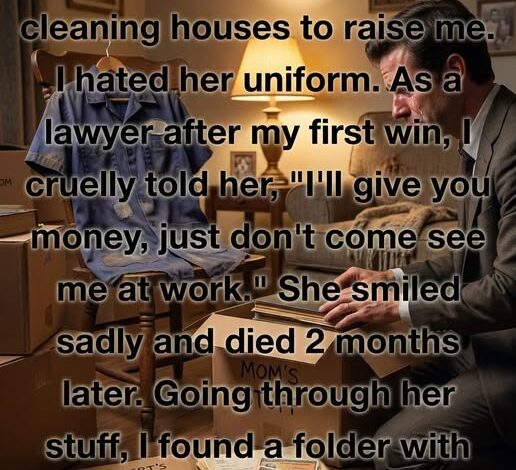
My mother spent most of her life cleaning other people’s homes.
As a child, I hated it.
I hated the scratchy blue uniform she wore every day. I hated the smell of lemon bleach that followed her home. I hated the way her hands looked—red, cracked, and rough from years of scrubbing floors and polishing surfaces that would never belong to us.
Most of all, I hated what her job said about where we came from.
We lived in a small council flat in East London. The wallpaper peeled in the corners. The radiator worked only when it felt like it. Every winter, cold air slipped through the window frames and settled into our bones.
My mother never complained.
She simply worked harder.
Every morning before sunrise, she tied back her hair, pulled on that blue uniform, kissed my forehead, and left for another day of cleaning houses.
I would watch her from the window and make myself a promise.
One day, I would escape.
That promise became my obsession.
While other kids played football after school, I studied.
While my friends spent weekends hanging around shopping centers, I buried myself in books.
I convinced myself that success was the only way out.
And slowly, it worked.
My grades opened doors.
Scholarships followed.
Then university.
Then law school.
By the time I graduated, I felt like I had reinvented myself.
I polished my accent.
Bought better clothes.
Learned how to navigate boardrooms and networking events.
I became the kind of person who belonged in glass towers and expensive restaurants.
Or at least, that’s what I told myself.
The higher I climbed, the more embarrassed I became about where I’d started.
And nowhere was that embarrassment more obvious than in how I treated my mother.
She remained exactly who she’d always been.
Kind.
Generous.
Proud.
Meanwhile, I became someone I barely recognize now.
When colleagues asked about my family, I gave vague answers.
When people talked about their parents’ careers, I changed the subject.
I never lied outright.
But I carefully edited the truth.
Because I was terrified someone would discover that the successful corporate lawyer they admired had been raised by a cleaner.
Then came the biggest case of my career.
A major corporate litigation battle.
Months of work.
Countless sleepless nights.
When we won, my name appeared in industry publications for the first time.
Partners congratulated me.
Clients requested me specifically.
I felt unstoppable.
A week later, my mother came to visit.
Unannounced.
She arrived carrying a plastic container of homemade jollof rice.
The security guard directed her upstairs.
When I saw her standing in the reception area, my stomach dropped.
Not because I wasn’t happy to see her.
Because I was embarrassed.
There she stood in that familiar blue uniform.
Surrounded by marble floors.
Glass walls.
Tailored suits.
Everything I had worked so hard to become.
I immediately rushed over.
Not to hug her.
Not to thank her.
To hide her.
I guided her into a side hallway away from the offices.
Away from my colleagues.
Away from anyone who might see.
She smiled when she handed me the container.
“I made your favorite,” she said.
“I thought maybe we could have lunch together.”
Instead of appreciating the gesture, I said something I would spend the rest of my life regretting.
“I’ll give you money.”
She blinked.
“What?”
“I’ll set up a monthly allowance. You can retire. Just… don’t come here anymore.”
The silence that followed felt endless.
Even now, years later, I can still see her face.
Not angry.
Not hurt.
Just sad.
A sadness so quiet that it somehow hurt more.
She lowered her eyes.
Then nodded.
“I just wanted to see where you work, Julian.”
Her voice was barely above a whisper.
“I wanted to see where my son sits.”
I didn’t know what to say.
So I said nothing.
She handed me the food.
Smiled one last time.
And walked away.
I watched her disappear down the hallway.
Her sensible shoes squeaking softly against the polished floor.
At the time, I felt relieved.
I thought I’d protected my reputation.
I thought I’d established boundaries.
I thought I’d finally separated myself from the life I came from.
Two months later, she died.
A heart attack in her sleep.
No warning.
No second chance.
No opportunity to apologize.
Just gone.
The funeral was small.
Most of the attendees were women she had worked beside for decades.
Cleaners.
Caregivers.
Domestic workers.
People I had spent years trying not to resemble.
As they shared stories about her generosity and kindness, I realized how little I truly knew about the woman who raised me.
After the funeral, I returned to her flat.
Everything felt smaller than I remembered.
The furniture.
The rooms.
The life she’d built.
The smell of lemon bleach lingered in the air.
This time it didn’t embarrass me.
It broke my heart.
I spent hours sorting through her belongings.
Then, hidden beneath neatly folded towels in her wardrobe, I found a worn leather folder.
My name was embossed on the cover.
Inside were decades of memories.
Every report card.
Every certificate.
Every school photo.
Every newspaper clipping that mentioned me.
Every achievement I had forgotten.
She had saved them all.
But then I discovered something unexpected.
Receipts.
Invoices.
Financial records.
Thousands upon thousands of pounds.
Private tutoring fees.
School installments.
Academic support programs.
My confusion grew.
I had always believed I’d attended my prestigious secondary school on a full scholarship.
It was one of the foundations of my identity.
Proof that I had earned everything myself.
Then I found a letter from the school’s bursar.
“Dear Mrs. Adeyemi,
We have received this month’s installment payment. Your dedication to your son’s future continues to inspire us.”
I read the letter three times.
Then a fourth.
Then a fifth.
The scholarship hadn’t been full.
Not even close.
My mother had been paying the difference all along.
Working extra shifts.
Cleaning additional homes.
Sacrificing sleep.
Sacrificing comfort.
Sacrificing herself.
All so I could believe I had achieved everything alone.
The realization crushed me.
But it wasn’t the biggest surprise.
Not even close.
At the bottom of the folder were legal documents.
Property deeds.
Investment records.
Partnership agreements.
At first, none of it made sense.
Then the truth slowly emerged.
Years earlier, one of her longtime clients—a wealthy widower with no family—had left her a share in his real estate portfolio.
A small percentage.
Nothing extravagant at first.
But over time, those investments grew.
And grew.
And grew.
By the time of her death, she was quietly worth millions.
Millions.
My mother.
The woman I had pitied.
The woman I had hidden.
The woman I thought needed my financial help.
She could have retired years earlier.
She could have traveled the world.
Bought a luxury home.
Lived any life she wanted.
Instead, she kept cleaning houses.
Kept wearing that blue uniform.
Kept building a future for me.
I sat on the floor of her bedroom and cried until my chest hurt.
Not because of the money.
Because of what it represented.
Every sacrifice.
Every extra shift.
Every moment she chose me over herself.
And every moment I failed to see it.
Months later, I left my law firm.
Not because I stopped loving the law.
Because I finally understood what success actually meant.
I established the Margaret Adeyemi Scholarship Fund.
Every year, it provides financial support to children of domestic workers pursuing careers in law, medicine, education, and public service.
I bought a house with a garden.
The kind my mother used to point at while walking home.
The kind she’d always dreamed about but never allowed herself.
And in my study, hanging beside my law degree, is her blue uniform.
Framed.
Preserved.
Honored.
Visitors often ask why it’s there.
I always tell them the same thing.
“That uniform paid for everything.”
It paid for my education.
My opportunities.
My confidence.
My future.
Most importantly, it reminds me of a lesson I learned too late.
The people who appear ordinary are often carrying extraordinary burdens.
The sacrifices that shape our lives usually happen quietly.
Without applause.
Without recognition.
Without anyone noticing.
My mother spent her life cleaning up after other people.
Yet somehow, she also built an empire.
Not of money.
But of love.
If I could trade every pound of that inheritance for one more lunch with her, I would.
I’d sit beside her in that hallway.
Eat her jollof rice.
And tell her the one thing I should have said years ago.
“I’m proud to be your son.”
Because the greatest mistake of my life wasn’t being poor.
It wasn’t growing up in a small flat.
It wasn’t wearing second-hand clothes.
The greatest mistake of my life was failing to recognize royalty when it stood right in front of me wearing a cleaner’s uniform.