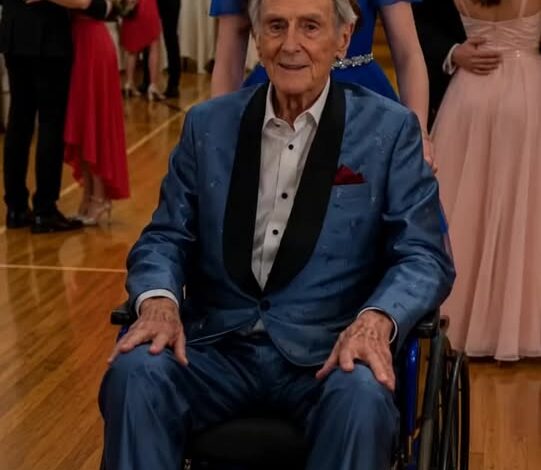
The ballroom went quiet the moment she walked in.
Not because of her dress, though it shimmered softly beneath the golden lights. Not because of the music, which still pulsed through the decorated hall. And not because she had arrived late.
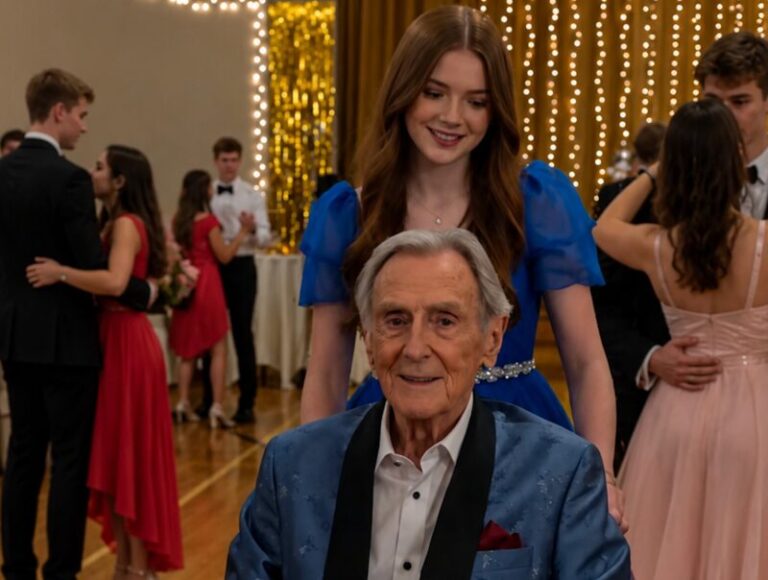
Everyone turned because she came through the entrance pushing her grandfather in a wheelchair.
He wore a deep blue suit, carefully pressed, with a white shirt buttoned neatly at the collar. His silver hair was combed back the way he always liked it, and his hands rested calmly in his lap. Beside him, his granddaughter moved with quiet pride, one hand on the wheelchair, the other gently holding the edge of her dress as she guided him into the room.
For a few seconds, no one seemed to know how to react.
Some students smiled.
Some stared.
A few leaned toward their friends and whispered.
But she did not lower her eyes.
She had expected the looks. She had prepared herself for the questions. She knew people might wonder why an elderly man in a wheelchair had come to prom, a night usually filled with young couples, loud music, flashing cameras, and teenage excitement.
But none of that mattered to her.
Because this night was not about impressing anyone.
It was about keeping a promise.
Years earlier, when she was still a little girl with scraped knees and missing front teeth, her grandfather had made that promise while they sat together on their old living room couch. A movie was playing on television, showing teenagers in gowns and suits dancing beneath bright lights. She had watched the scene with wide eyes, fascinated by the dresses, the flowers, and the music.
“Do you think I’ll go to prom one day?” she had asked quietly.
Her grandfather had looked over at her and smiled.
“Of course you will,” he said. “And when that day comes, I’ll be there.”
She giggled. “Even if you’re old?”
He laughed, a warm, deep sound that always made her feel safe.
“Even if I’m old,” he promised. “Even if I have to come in a wheelchair.”
At the time, it had been a sweet joke between them.
Neither of them knew how much those words would one day mean.
Her life had never been ordinary.
When she was only a toddler, a fire tore through the small house where she lived with her parents. It happened in the middle of the night, fast and merciless, turning walls into smoke and rooms into flames before anyone could fully understand what was happening.
Her parents did not survive.
But her grandfather did something that would shape the rest of both their lives.
He ran into the burning house.
Neighbors later said they could hear people shouting for him to stop. They said the smoke was too thick, the fire too strong, the risk too great. But he did not listen. Somewhere inside that house was the little girl he loved, and that was the only thing that mattered.
He found her.
He carried her out wrapped in a blanket, coughing, crying, and alive.
From that night on, he became everything.
He was no longer only her grandfather. He became her parent, her protector, her teacher, and the steady presence that held her world together when everything else had been taken from her.
He was already in his sixties when he started raising her. Most people his age were slowing down, resting more, thinking about the quieter years of life. But he began again.
He learned how to braid her hair before school.
He packed lunches with little handwritten notes tucked beside her sandwiches.
He sat through parent-teacher conferences, school plays, spelling bees, and doctor appointments.
He worked when he was tired, cooked when his back ached, and stayed awake long after midnight helping her with homework he barely understood but refused to give up on.
Whenever she cried for the parents she could barely remember, he held her until the tears stopped.
Whenever she felt different from the other children, he reminded her she was loved.
Whenever life felt unfair, he taught her not to let pain make her bitter.
“Loss can break your heart,” he once told her, “but love is what teaches it to beat again.”
She carried those words with her for years.
As she grew older, their bond deepened into something few people fully understood. He was there for every important moment. Her first school award. Her first heartbreak. Her first time driving. Her graduation photos. Every victory seemed to matter more because he was there to see it.
But time was not gentle with him.
One winter morning, everything changed.
He suffered a stroke.
She remembered the panic of the hospital, the smell of antiseptic, the machines beeping beside his bed, and the terrifying stillness of his body beneath the thin white blanket. For the first time in her life, the man who had always seemed unshakable looked fragile.
He survived, but he did not come home the same.
His body was weaker. His speech was slower. Walking became difficult, then impossible without help. Eventually, the wheelchair became part of his daily life.
At first, he tried to hide how much it hurt him.
He smiled when she entered the room. He joked about being “harder to knock over now.” He insisted he was fine, even when his hands trembled from frustration.
But she saw it.
She saw the way he looked at the stairs.
The way he paused before asking for help.
The way his eyes sometimes filled with sadness when he thought no one was watching.
Still, he never stopped being her strength.
He encouraged her through school. He listened to her dreams. He reminded her to be kind, even when others were cruel. He told her that dignity had nothing to do with how a person moved through the world and everything to do with how they treated others while doing it.
So when prom season came, she did not hesitate.
Other girls talked about dates, limousines, after-parties, and matching corsages.
She thought only of him.
One evening, she found him sitting by the window, sunlight resting softly across his face.
“Grandpa,” she said, trying to sound casual, though her heart was beating fast. “Will you come to prom with me?”
He looked at her as though he had misheard.
“To your prom?”
She nodded.
His eyes softened, but then his expression changed.
“No, sweetheart,” he said quietly. “That night is for you. You should go with your friends. Dance. Laugh. Have fun.”
“I will,” she said. “With you there.”
He looked down at the wheelchair.
“I don’t want people staring at you because of me.”
She knelt in front of him and took his hands.
“They can stare,” she said. “Let them see the man who raised me. Let them see the reason I made it this far.”
His lips trembled, but he said nothing.
She squeezed his hands tighter.
“You promised me,” she whispered.
For a long moment, he simply looked at her.
Then, slowly, he smiled.
“I suppose I did.”
On prom night, she helped him dress in his best suit, the same blue one he had worn years earlier to a family wedding. She adjusted his tie twice because her hands were shaking, and he teased her gently for fussing over him.
“You’re acting like I’m the one going to prom,” he said.
“You are,” she replied.
When they arrived at the ballroom, the entrance glowed with strings of lights. Music spilled through the doors. Students posed for photos beneath arches of flowers and balloons. Teachers stood near the walls, smiling as cameras flashed.
For one perfect moment, she felt only joy.
Then the whispers began.
She ignored them at first.
She pushed him forward, smiling whenever someone greeted them. A few classmates approached and told her how sweet it was that he came. One teacher wiped at her eyes and said it was the most beautiful entrance of the night.
Her grandfather seemed nervous, but proud.
Then a voice cut through the warmth.
“Well,” a girl said loudly, “I guess they’re letting nursing homes join prom now.”
The laughter that followed was small, but sharp enough to hurt.
The girl who spoke was known for being cruel when she wanted attention. She stood with a group of friends near the refreshment table, arms folded, a smirk on her face.
The granddaughter froze.
Her cheeks burned.
The room seemed to tilt around her.
She felt her hand tighten around the wheelchair handle, but before she could speak, the girl continued.
“Seriously, why bring him here? This is prom, not a hospital visit.”
This time, fewer people laughed.
Most looked away.
That silence hurt almost as much as the words.
The granddaughter swallowed hard, fighting the sting behind her eyes. She had prepared for stares, maybe even questions. But she had not prepared for cruelty spoken so openly in front of the man who had given his life to protect her.
Then she felt her grandfather’s hand reach back and gently touch hers.
“It’s all right,” he said softly.
But it wasn’t.
Not to her.
Not after everything he had endured.
Not after everything he had sacrificed.
She leaned down, ready to ask if he wanted to leave, but he surprised her.
“Take me to the stage,” he said.
She stared at him.
“What?”
“To the stage.”
The music faded as they moved across the ballroom.
At first, only a few people noticed. Then more heads turned. Conversations died one by one until the entire room seemed to hold its breath.
Her grandfather rolled himself the final few feet toward the microphone. A teacher stepped forward to help, but he raised one hand politely, asking for a moment.
The room was silent.
He adjusted the microphone with slow, careful hands.
Then he spoke.
“I have always been proud of my granddaughter.”
His voice was not loud, but it carried.
The girl stood beside him, her heart pounding.
He continued.
“When she was very young, she lost more than any child should ever have to lose. Her parents were taken from her in a fire. That night, I carried her out of a house filled with smoke and flames. I thought I was saving her life.”
He paused, and his eyes glistened.
“But the truth is, she saved mine too.”
No one moved.
“She gave an old man a reason to wake up every morning. She gave me a purpose when grief could have swallowed me whole. I raised her, yes. I fed her, dressed her, taught her, and held her when she cried. But she also taught me something.”
He looked across the room.
“She taught me that love is not measured by age, strength, beauty, popularity, or the ability to stand on two feet.”
His voice grew steadier.
“Love is measured by who stays. Who shows up. Who keeps their promises when life becomes difficult.”
The granddaughter lowered her head as tears slipped down her cheeks.
He turned slightly toward her.
“I promised this girl I would come to her prom. I told her I would be here even if I had to arrive in a wheelchair.”
A faint smile crossed his face.
“And here I am.”
A few students began wiping their eyes.
Teachers stood motionless along the walls.
Even the girl who had mocked them no longer looked amused.
The grandfather looked back at the crowd.
“I know this chair makes some people uncomfortable. I know age makes some people look away. But one day, every person in this room will learn that bodies change. Beauty changes. Popularity fades. But kindness follows you. Cruelty does too.”
His words settled over the room like a weight.
“So before you laugh at someone who looks different, remember this: you do not know what they survived. You do not know who they saved. You do not know what promises brought them to that room.”
He took a breath.
Then he looked at his granddaughter again.
“I am not embarrassed to be here. I am honored. Because tonight, I am sitting beside the greatest achievement of my life.”
The silence broke.
One person clapped.
Then another.
Then the entire ballroom erupted.
Students stood. Teachers applauded. Some cried openly. Others looked ashamed, especially those who had laughed before.
The granddaughter stepped forward and wrapped her arms around her grandfather’s shoulders. He held her hand against his chest, and for a moment, the whole room seemed to disappear around them.
The girl who had made the cruel comment stood frozen near the refreshment table, her face pale. She said nothing. There was nothing left for her to say.
After that, the night changed completely.
People approached them one by one. Some apologized. Some thanked him. Some asked for photos. Others simply told the granddaughter how lucky she was.
She already knew.
When the music began again, a slow song filled the ballroom.
Her grandfather looked up at her.
“I’m sorry I can’t dance with you the way I promised,” he said.
She smiled through her tears.
“You already did.”
Then she took his hands and gently swayed with him beside the wheelchair. Around them, students formed a quiet circle. No one laughed. No one whispered. This time, everyone watched with respect.
For the rest of the night, they were not the strange pair who had arrived together.
They were the heart of the room.
By the end of prom, she understood something she would never forget.
The most beautiful part of the night had not been the decorations, the dress, the music, or the applause.
It had been the man beside her.
The man who had run through fire to save her.
The man who had raised her when he should have been resting.
The man who had kept a promise most people would have forgotten.
And as they left the ballroom together, she pushed his wheelchair slowly through the same glowing entrance where everyone had first stared.
Only now, the stares were different.
They were filled with admiration.
Her grandfather reached back and placed his hand over hers.
“Did you have a good prom?” he asked.
She leaned down and kissed his cheek.
“The best,” she whispered.
Because that night, she had not just brought her grandfather to prom.
She had shown an entire room what love, loyalty, and dignity truly looked like.