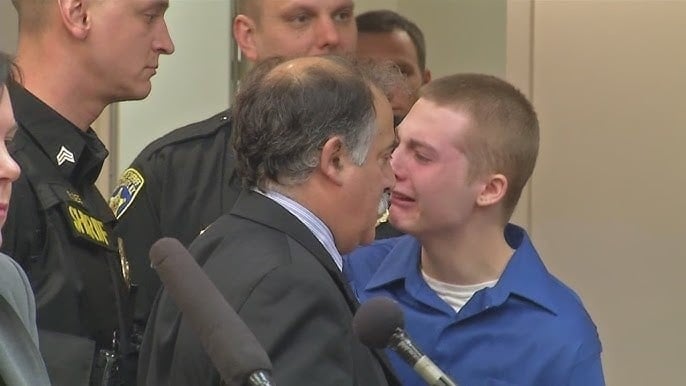
The sentence took only a few seconds to pronounce.
Yet it carried the weight of generations.
The courtroom had been tense all morning. Reporters filled the back rows. Families sat rigidly in their seats. Attorneys shuffled papers that no longer seemed capable of changing anything. The outcome had been anticipated, debated, feared, and defended for months.
Still, no one was truly prepared for the number.
Four hundred and fifty-two years.
When the judge finally spoke the words aloud, the room seemed to lose its ability to breathe.
For a brief moment, silence settled over everyone present.
Not ordinary silence.
The kind that arrives when people are trying to understand whether they heard something correctly.
Then came the murmurs.
A low ripple moving across the courtroom.
Shock.
Relief.
Disbelief.
Satisfaction.
Horror.
Depending on where someone sat, the sentence meant something entirely different.
And that divide had existed from the very beginning.
Because this case was never only about what happened.
It was about what society believes should happen next.
At the center of the room sat a teenager.
Not a child.
Not fully an adult.
A person occupying that complicated space between the two.
A space where society often struggles to decide exactly who someone is and what they deserve.
Throughout the proceedings, two competing versions of that teenager had emerged.
Both were real.
Both were incomplete.
And both fought for dominance in the minds of everyone watching.
The prosecution presented a picture of danger.
A young person whose actions had inflicted profound harm.
A person whose choices had shattered lives, created lasting trauma, and crossed lines that could not simply be explained away by age.
Witness after witness described fear.
The kind that lingers long after an event ends.
The kind that changes routines.
Changes sleep.
Changes relationships.
Changes how people move through the world.
Victims spoke about panic attacks.
Nightmares.
Hypervigilance.
Moments that replayed endlessly in their minds.
Some described checking locks multiple times before bed.
Others described anxiety in crowded places.
Many spoke about the frustration of knowing that while headlines eventually fade, trauma often remains.
The consequences, they argued, did not disappear because the person responsible happened to be young.
Pain does not measure age.
Fear does not ask how old someone is before taking root.
For these victims and their families, accountability demanded severity.
Anything less felt like minimizing what had happened.
Anything less felt like abandoning those who would carry the damage for years to come.
The defense offered a different picture.
Not one that denied harm.
Not one that ignored consequences.
But one that asked a difficult question.
Who is a teenager, really?
A finished person?
Or an unfinished one?
They spoke about development.
About neuroscience.
About impulse control.
About adolescent decision-making.
About the well-established reality that the teenage brain continues maturing long after adolescence ends.
They presented evidence that young people often possess extraordinary capacity for change.
They pointed to studies.
To rehabilitation programs.
To former offenders who rebuilt their lives.
To examples of transformation that would have seemed impossible during the darkest chapters of those individuals’ stories.
Their argument was not that the teenager should avoid punishment.
It was that punishment should leave room for the possibility of growth.
Room for redemption.
Room for change.
Room for a future that did not end before adulthood fully began.
The contrast between those perspectives created an emotional tension that permeated every hearing.
Victims wanted recognition.
The defense wanted possibility.
One side feared what might happen if society forgave too easily.
The other feared what might happen if society stopped believing change was possible at all.
And somewhere in the middle sat parents.
Parents watching their child become the subject of a national debate.
Few experiences can be more devastating.
To see a son or daughter measured not by birthday milestones, school memories, or years still waiting to be lived, but by legal language and sentencing calculations.
They sat motionless through much of the proceeding.
Perhaps because there was little left to say.
Perhaps because every word had already been spoken.
Or perhaps because grief sometimes exhausts language altogether.
For them, the sentence represented more than punishment.
It represented permanence.
A future collapsing into a number.
A life becoming defined by a single chapter.
The courtroom eventually emptied.
But the argument followed everyone outside.
Within hours, the case had become national news again.
Social media erupted.
Commentators weighed in.
Legal experts debated.
Activists organized statements.
Ordinary citizens argued across dinner tables and comment sections.
The sentence became larger than the individuals involved.
It became symbolic.
A proxy battle for deeper questions that have troubled societies for generations.
What should justice accomplish?
Protection?
Punishment?
Rehabilitation?
Deterrence?
Closure?
Can it accomplish all of those things simultaneously?
Or must some goals inevitably compete with others?
Supporters of the sentence saw necessity.
To them, the issue was straightforward.
Certain actions carry consequences so severe that society must respond forcefully.
Victims deserve protection.
Communities deserve safety.
Public trust depends upon accountability.
They argued that focusing too heavily on the offender’s youth risks diminishing the suffering of those harmed.
Compassion, they insisted, cannot come at the expense of responsibility.
For many, the sentence reflected a moral boundary.
A declaration that certain acts demand extraordinary consequences regardless of age.
Others saw the outcome differently.
They viewed the sentence as evidence of a system willing to give up on people before their lives have fully unfolded.
They questioned whether a teenager can meaningfully be judged as the person they will remain forever.
They asked whether justice without the possibility of rehabilitation becomes something closer to despair.
To them, the issue was not excusing harm.
It was recognizing human potential.
The possibility that a person at sixteen, seventeen, or eighteen may not be the same person at forty.
Or sixty.
Or eighty.
The debate is uncomfortable because both sides touch on important truths.
Victims deserve justice.
Public safety matters.
Actions have consequences.
Yet human beings can change.
Young people often do change.
Growth is real.
Transformation is possible.
The challenge lies in balancing these realities without sacrificing one for the other.
Cases like this force societies to confront questions that have no easy answers.
What do we owe victims?
What do we owe communities?
What do we owe young offenders?
Can punishment and hope coexist?
Can accountability leave room for redemption?
Should every life remain open to the possibility of change?
Or are there actions that permanently close that door?
The answers depend largely on what people believe about human nature itself.
Whether they see individuals as defined primarily by their worst actions.
Or by their capacity to become something more than those actions.
That is why this case resonated far beyond a single courtroom.
It touched something deeper.
A collective uncertainty about who we are and what justice means.
The sentence may have ended one phase of the legal process.
It did not end the larger conversation.
That conversation continues in homes, schools, legislatures, universities, and courtrooms across the country.
Because beneath the legal arguments lies a profoundly human question.
How should society respond when terrible harm is caused by someone whose life has barely begun?
There are no simple answers.
Only competing values.
Competing fears.
Competing hopes.
And perhaps that is what made the moment so powerful.
The stunned silence after the sentence was not merely a reaction to the number itself.
It was a recognition of everything that number represented.
The pain of victims.
The fears of communities.
The anguish of families.
The uncertainty of redemption.
The limits of punishment.
The possibility of change.
And the uncomfortable reality that justice, however necessary, rarely resolves every question it creates.
Long after the courtroom emptied, those questions remained.
Waiting.
Demanding answers.
Challenging assumptions.
Forcing a nation to look inward and decide what it truly believes about youth, responsibility, forgiveness, and whether the worst thing a person has ever done must become the only thing they are ever allowed to be.