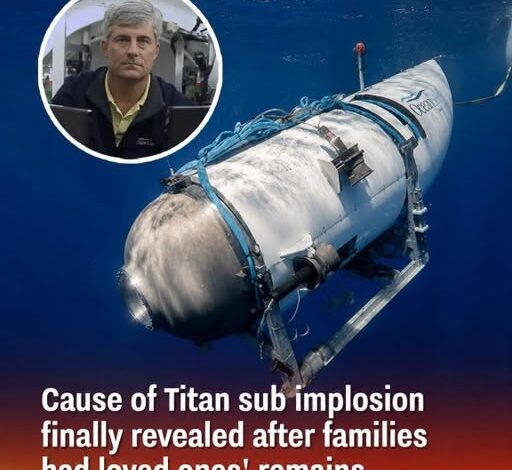
More than three years have passed since the Titan submersible vanished beneath the North Atlantic, yet the disaster continues to haunt public memory.
Not because the story was dramatic.
Not because the Titanic remains one of history’s most famous shipwrecks.
But because of the questions that followed.
Questions about trust.
Questions about risk.
Questions about how a journey that promised wonder and discovery ended in catastrophe.
For many people, the tragedy feels unfinished even now.
The search ended.
The investigation continued.
But the human weight of what happened remains.
Five people descended toward one of the most legendary locations on Earth and never returned.
What should have been a remarkable expedition became one of the most sobering disasters in the history of modern deep-sea exploration.
In June 2023, passengers boarded OceanGate’s Titan submersible with a singular goal: to visit the wreck of the Titanic.
Resting nearly 13,000 feet beneath the surface of the Atlantic Ocean, the Titanic has fascinated generations. Its story is woven into history, tragedy, and human curiosity. For decades, explorers, scientists, and historians have journeyed to the wreck site seeking answers, understanding, and connection to the past.
Titan offered something few experiences could.
A chance to see it with your own eyes.
For those aboard, the dive represented adventure.
Discovery.
A once-in-a-lifetime opportunity.
But less than two hours after beginning its descent, communication with the support vessel was lost.
At first, nobody knew exactly what had happened.
The silence created uncertainty.
And uncertainty created hope.
Around the world, people followed updates as search teams mobilized.
Ships crossed vast stretches of ocean.
Aircraft scanned remote waters.
Experts worked around the clock.
Families waited desperately for news.
Each passing hour became increasingly difficult.
Yet many still believed there was a chance.
Perhaps the submersible had lost power.
Perhaps communication systems had failed.
Perhaps the crew was stranded somewhere on the ocean floor, waiting to be rescued.
The possibility of survival, however slim, kept hope alive.
For days, the world watched.
Then came the news everyone feared.
The Titan had suffered a catastrophic implosion.
The five people aboard were gone.
OceanGate CEO Stockton Rush.
British explorer Hamish Harding.
French Titanic expert Paul-Henri Nargeolet.
Pakistani businessman Shahzada Dawood.
And his nineteen-year-old son, Suleman Dawood.
In a single instant, five lives ended.
Five families were forever changed.
And the story shifted from rescue to investigation.
For those left behind, grief arrived with a brutal finality.
The loss was sudden.
Violent.
Almost impossible to comprehend.
Unlike many tragedies, there was no opportunity for goodbyes.
No final conversations.
No gradual unfolding of events.
One moment their loved ones were descending toward history.
The next, they were gone.
Among the most heartbreaking voices to emerge in the aftermath was Christine Dawood, who lost both her husband and her son.
Her words reflected the unimaginable reality faced by many families connected to the disaster.
The agony of waiting.
The desperate hope during the search.
The devastation of confirmation.
The painful process of receiving recovered remains.
The challenge of accepting a loss that occurred thousands of feet below the ocean’s surface in a place few human beings have ever seen.
For those families, the tragedy was never merely about engineering.
It was personal.
Profoundly personal.
Behind every technical report stood human lives.
Human relationships.
Human futures that vanished in an instant.
As investigators began examining what had happened, attention quickly turned toward decisions made long before the dive ever began.
Questions emerged.
Had the vessel been adequately tested?
Were concerns raised by experts taken seriously?
Did warning signs exist before the disaster?
And if so, why were they not addressed?
Reports soon revealed that concerns had existed for years.
Former employees.
Industry specialists.
Engineering professionals.
Several had questioned aspects of Titan’s design and certification process.
Particularly troubling were concerns surrounding the vessel’s carbon-fiber pressure hull.
Deep-sea exploration operates within one of the harshest environments on Earth.
The deeper a vessel descends, the greater the pressure becomes.
At Titanic depth, the force pressing against a submersible is immense—powerful enough to crush structural weaknesses instantly.
There are no second chances.
No margin for error.
Every material.
Every bolt.
Every calculation.
Every assumption matters.
For that reason, testing and validation are not optional.
They are essential.
As investigators continued their work, a troubling picture gradually emerged.
The disaster was not the result of a single mistake.
Nor was it caused by one isolated failure.
Instead, evidence suggested a series of deeper issues involving design validation, engineering assumptions, material performance, and long-term structural integrity.
The Transportation Safety Board of Canada’s final report provided the clearest explanation yet.
Its findings were sobering.
Investigators concluded that Titan’s carbon-fiber pressure hull had not been fully validated to confirm that it performed as intended under repeated exposure to extreme pressure.
The report also found that construction methods and testing procedures failed to follow accepted engineering practices typically used for vehicles operating in such dangerous environments.
Perhaps most concerning was one central finding:
OceanGate reportedly did not fully understand how long the pressure hull could safely withstand repeated deep-sea dives.
That uncertainty became catastrophic.
By June 18, 2023, Titan had already completed dozens of deep-ocean expeditions.
The fatal dive was its eighty-eighth trip.
Each descent exposed the vessel to extraordinary pressure.
Each ascent relieved that pressure.
Again and again.
Over time, materials experience stress.
Microscopic damage can accumulate.
Fatigue can develop.
What appears strong on the surface may gradually weaken beneath it.
Investigators concluded that questions surrounding those effects had not been fully answered before passengers continued making journeys to Titanic depth.
In the unforgiving environment of the deep ocean, unanswered questions can become deadly.
That lesson echoes throughout the report.
The findings suggest the disaster was not simply about bad luck.
Nor was it solely about ambition.
It was about uncertainty.
About assumptions that were not fully verified.
About confidence that outpaced evidence.
And about the risks that emerge when exploration advances faster than validation.
The tragedy also reignited broader conversations about innovation.
Human progress has always depended on people willing to push boundaries.
From aviation to spaceflight to deep-sea exploration, advances often require courage and vision.
Yet history repeatedly demonstrates another truth:
Ambition alone is not enough.
The most successful explorers respect limits before they challenge them.
They test.
Verify.
Question.
Retest.
And verify again.
Because nature does not negotiate.
The ocean does not care about confidence.
It does not reward optimism.
It responds only to physics.
Pressure remains pressure.
Materials remain materials.
And engineering realities cannot be overcome by belief.
That may be the most enduring lesson of the Titan disaster.
The ocean is beautiful.
Fascinating.
Mysterious.
But it is also unforgiving.
The same depths that inspire human curiosity can punish even small mistakes with extraordinary consequences.
Today, the final report offers something families sought for years: answers.
Not complete comfort.
Not closure.
No report can provide those things.
But understanding matters.
Knowing why a tragedy happened cannot erase grief, yet it can help ensure lessons are learned.
For the families, those lessons come at an unbearable cost.
Five lives.
Five futures.
Countless loved ones left behind.
The report cannot restore what was lost.
It cannot return fathers, sons, friends, explorers, or partners.
But it can serve as a warning.
A reminder that extreme exploration demands extraordinary discipline.
That innovation must be matched by transparency.
That trust must be earned through evidence.
And that every person who steps inside an experimental vessel deserves confidence built on proven safety rather than assumptions.
In the end, the story of Titan is about far more than a failed journey to the Titanic.
It is about the consequences of unanswered warnings.
The dangers of unvalidated confidence.
The responsibility carried by those who ask others to place their lives in the hands of engineering.
And the enduring truth that when human beings venture into the most hostile environments on Earth, hope and ambition must always travel alongside caution.
Because beneath the ocean’s surface, thousands of feet below the world we know, there is no room for uncertainty.
Only consequences.
And Titan stands as a tragic reminder of what can happen when those consequences arrive.