IS YOUR PERSONAL SPACE BEING INVADED? THE SHOCKING TRUTH ABOUT THAT MYSTERIOUS HAND ON YOUR LEG!

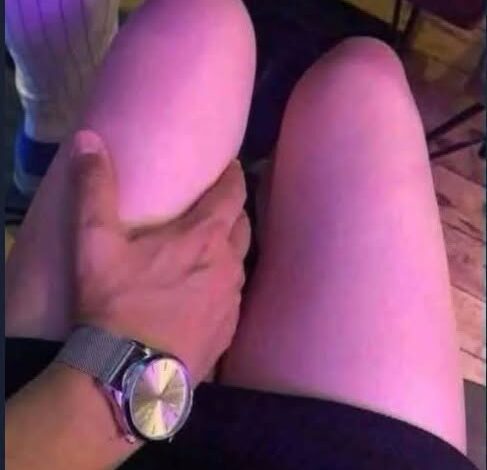
It happens in an instant.
You’re sitting beside someone—maybe a friend, a coworker, a date, or even a complete stranger—and suddenly you feel a hand rest on your leg.
The gesture lasts only a second.
Or maybe it lingers.
Either way, something inside you reacts immediately.
Your body notices before your mind does.
Your heart skips.
Your muscles tense.
A dozen questions rush through your thoughts all at once.
What was that?
Did they mean anything by it?
Was it affectionate?
Was it flirtation?
Was it accidental?
Was it supportive?
Or was it something that crossed a line?
For many people, this moment creates a strange kind of paralysis. The touch itself may be brief, but the uncertainty surrounding it can feel enormous. You may wonder whether you’re overthinking it. You may question whether you should say something. You may worry about creating awkwardness, offending someone, or misreading the situation.
But the truth is that touch is rarely just touch.
Human beings communicate constantly without words. Long before we explain ourselves verbally, we reveal intentions, emotions, and attitudes through body language. A smile can comfort. A glance can intimidate. The distance someone keeps can signal respect, affection, fear, or attraction.
Touch is one of the strongest forms of nonverbal communication we have.
Because of that, it carries weight.
A hand placed on someone’s leg is not the same as a handshake.
It is not the same as brushing past someone in a crowded room.
It is not the same as a quick tap on the shoulder.
The leg is generally considered a more personal area of the body. Reaching into that space often communicates a greater degree of familiarity, intimacy, or emotional intent.
That’s why context matters so much.
The exact same gesture can mean entirely different things depending on who is doing it and why.
Imagine sitting beside a lifelong friend while receiving devastating news. In that moment, a brief hand on your leg may feel comforting. It may communicate support when words seem inadequate. It may be a silent way of saying, “I’m here. You’re not alone.”
Now imagine the same gesture from someone you barely know.
The feeling changes instantly.
What felt comforting in one situation may feel intrusive in another.
The touch hasn’t changed.
The context has.
And context is everything.
This is where many misunderstandings occur.
Some people naturally express themselves through physical touch. They touch a shoulder while talking. They tap someone’s knee while laughing. They lean closer during conversations. In certain families, cultures, and communities, this behavior is normal and expected.
In other environments, personal space is treated much more carefully.
Neither approach is automatically right or wrong.
The problem arises when people assume that their comfort level is everyone else’s comfort level.
It isn’t.
One person may view a hand on the leg as friendly and harmless.
Another may experience the exact same gesture as uncomfortable and inappropriate.
Both experiences are valid.
Intentions matter.
But impact matters too.
A person may genuinely believe they’re being warm, supportive, or affectionate. That doesn’t automatically mean the touch will feel welcome.
This is why emotional awareness is so important.
Respectful people pay attention to reactions.
If someone stiffens, moves away, becomes quiet, avoids eye contact, or looks uncomfortable, those signals matter.
Body language communicates information.
Ignoring it communicates something too.
The romantic context adds another layer of complexity.
In dating situations, a hand on the leg is often interpreted as a sign of attraction.
It may be a subtle way of expressing interest.
A gesture meant to create closeness.
A quiet attempt to build intimacy.
When the attraction is mutual, the touch may feel exciting, natural, or even reassuring.
But attraction does not eliminate the need for consent.
This is where many people become confused.
They assume that because a date is going well, physical access is automatically granted.
It isn’t.
Someone can enjoy your company and still not want to be touched.
Someone can be attracted to you and still have boundaries.
Someone can love you and still have limits.
Consent is not a one-time permission slip.
It exists moment by moment.
Relationship by relationship.
Situation by situation.
The most important question is surprisingly simple:
Do you want the touch?
Not whether the other person meant well.
Not whether they would be offended if you objected.
Not whether other people would mind.
You.
Do you feel comfortable?
If the answer is no, that answer is enough.
You don’t need a lengthy explanation.
You don’t need evidence.
You don’t need to justify your discomfort.
You can move away.
You can remove the hand.
You can say, “Please don’t do that.”
You can say, “I’m not comfortable with that.”
You can say nothing at all and simply create distance.
Your body belongs to you.
A respectful person will understand.
They may feel embarrassed.
They may apologize.
They may realize they misread the situation.
But they will respect the boundary.
What they won’t do is argue with it.
That’s an important distinction.
Someone who values your comfort may make a mistake.
Someone who doesn’t value your comfort will challenge your right to have boundaries.
If a person responds by calling you dramatic, sensitive, rude, difficult, or unfair, they are revealing something important.
Not about you.
About themselves.
People who respect boundaries do not treat them as personal attacks.
They understand that access to another person’s body is not something they are entitled to.
Professional environments require even greater caution.
In workplaces, schools, and other professional settings, a hand on someone’s leg is almost never appropriate. The gesture can create confusion, discomfort, and power imbalances, especially when it involves supervisors, managers, teachers, or authority figures.
Even when described as harmless, such contact can cross significant boundaries.
If it happens repeatedly in a professional setting, documenting details may be important. Knowing when it occurred, who witnessed it, and how you responded can help if the situation needs to be addressed through appropriate channels.
But beyond all the social rules, cultural differences, and relationship dynamics lies a deeper truth.
Your discomfort is not something you need permission to acknowledge.
Many people instinctively doubt themselves.
They wonder whether they’re overreacting.
Whether they’re imagining things.
Whether they’re being unfair.
But our bodies often recognize boundaries before our minds fully understand them.
If something feels wrong, pay attention.
That feeling doesn’t automatically mean the other person had bad intentions.
It simply means your experience matters.
And your experience deserves respect.
Healthy relationships—whether romantic, platonic, professional, or familial—are built on awareness.
The safest people are not the ones who assume they have permission.
They’re the ones who care enough to notice.
They ask.
They pay attention.
They adjust.
They want the people around them to feel comfortable.
Because genuine connection isn’t created by testing how much discomfort someone will tolerate.
It’s created through mutual respect.
So if someone places a hand on your leg and you find yourself questioning your reaction, take a breath.
Notice the situation.
Notice their behavior.
Notice how your body responds.
And remember something important:
You are allowed to decide what happens within your personal space.
Your comfort is not less important than someone else’s intentions.
Your boundaries are not rude.
And protecting them does not require guilt, apology, or explanation.
A hand on the leg can mean many things.
Comfort.
Affection.
Attraction.
Carelessness.
Disrespect.
Connection.
Or misunderstanding.
But whatever meaning the gesture may carry, one thing remains entirely yours.
The right to decide whether it belongs there.