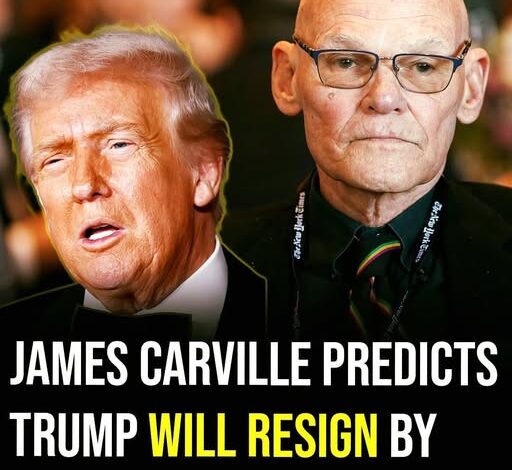
James Carville has never been known for subtle predictions, but this time he isn’t just criticizing Donald Trump—he’s forecasting the end of his presidency. Speaking on his podcast, the veteran Democratic strategist laid out a dramatic scenario in which Trump’s political survival unravels under the weight of his own vulnerabilities. To Carville, the warning signs are already visible. The only question is when the collapse becomes impossible to ignore.
In Carville’s telling, Trump is not a leader confidently steering the country toward a second-term legacy. Instead, he sees a president increasingly consumed by self-preservation, focused more on shielding himself from scrutiny than on governing. Every decision, every public battle, and every political calculation, Carville argues, is driven by a desire to avoid accountability rather than advance a broader vision.
That approach, he believes, comes with a ticking clock.
The strategist points to the 2026 midterm elections as the moment when everything could change. If Democrats regain significant power in Congress, Carville predicts an avalanche of investigations unlike anything Trump has faced before. Subpoenas would begin flying. Hearings would dominate headlines. New revelations could emerge week after week, creating a relentless cycle of political pressure.
But what makes Carville’s prediction so striking is not the investigations themselves—it’s what he thinks Trump will do in response.
Rather than fight indefinitely, Carville imagines a president worn down by years of controversy, legal battles, and nonstop public conflict. He describes a leader growing increasingly detached from the realities around him, protected by loyal advisers who filter out bad news and reinforce the belief that everything remains under control. In that environment, the true scale of public dissatisfaction could arrive as a shock.
Then comes the turning point.
Carville envisions Trump suddenly confronting a political landscape that looks dramatically different from the one he expected. Poll numbers could slide. Congressional allies might distance themselves. The constant stream of damaging revelations could erode even the confidence of supporters who once viewed him as politically invincible.
For Carville, the result is almost inevitable. Faced with an endless storm of investigations and declining support, Trump would decide that continuing the fight is no longer worth the cost. Rather than endure years of mounting pressure, Carville believes he would seek a way out.
It is a bold prediction, one that rests on the assumption that Trump’s resilience has limits and that political exhaustion can eventually overcome even the most combative public figures.
Not surprisingly, Trump’s allies rejected the idea outright.
The White House responded with sharp criticism, dismissing Carville’s analysis as fantasy and portraying the longtime strategist as a bitter political opponent desperate for relevance. Officials mocked his forecast, insisting that Trump remains stronger than ever and continues to command enormous support from his base.
The response highlighted the growing divide between two completely different narratives.
On one side are critics like Carville, who believe Trump’s position is far more fragile than it appears. They see legal risks, political vulnerabilities, and public fatigue slowly accumulating beneath the surface. In their view, what looks like strength today could quickly become weakness if circumstances shift.
On the other side are Trump’s defenders, who argue that similar predictions have failed for years. They point out that countless controversies, investigations, and political challenges have come and gone without delivering the collapse critics repeatedly forecast. To them, Trump has survived every test precisely because his opponents continue to underestimate his ability to rally supporters and defy conventional political expectations.
That clash of perspectives makes Carville’s prediction especially fascinating.
It isn’t merely a debate about polls or election results. It’s a debate about endurance. Critics see a political figure approaching a breaking point. Supporters see a fighter who has already outlasted every prediction of defeat.
For now, neither side can prove its case.
The midterms remain in the future. The investigations Carville anticipates have yet to unfold on the scale he describes. And Trump continues to occupy the center of American politics, commanding attention from both allies and adversaries alike.
Still, Carville has attached a specific timeline to his forecast, raising the stakes considerably. He believes the process will culminate around Easter of 2027, a date he has repeatedly referenced as a potential moment of reckoning. Whether that prediction ultimately proves prophetic or wildly premature remains impossible to know.
What is certain is that Carville has transformed a routine political critique into something much larger: a countdown.
If he is right, the next few years could bring a cascade of investigations, public revelations, and political setbacks that gradually weaken Trump’s hold on power until departure becomes the most attractive option. The unraveling would not come in a single dramatic explosion but through a slow accumulation of pressure that eventually becomes impossible to resist.
If he is wrong, Easter 2027 will pass without consequence, becoming just another date added to the long list of failed predictions about Trump’s political future.
Until then, the argument remains unresolved. One side sees a presidency heading toward an inevitable collapse. The other sees a leader who has repeatedly turned predictions of downfall into political comebacks.
And somewhere between those competing visions lies the answer that only time can provide.