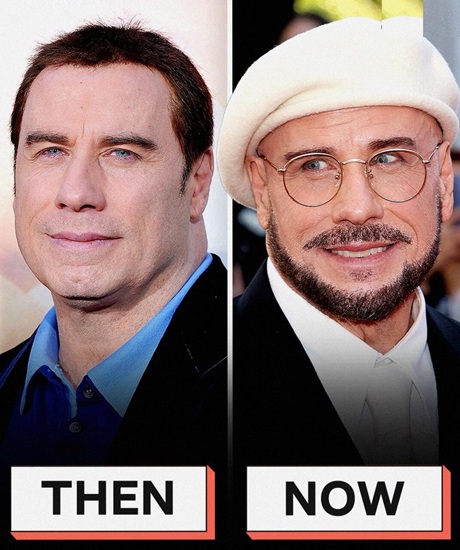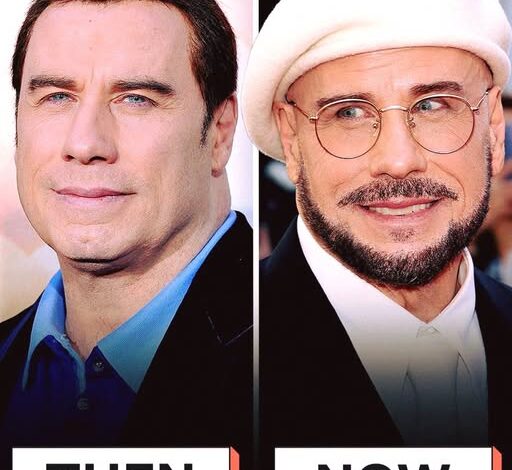
John Travolta’s appearance at the 79th Cannes Film Festival became one of those rare celebrity moments where the internet briefly forgot the movie itself and fixated almost entirely on the face arriving to promote it.
When the 72-year-old actor stepped onto the red carpet at the Palais des Festivals on May 15, 2026, cameras erupted instantly. Cannes has always thrived on spectacle — couture gowns, cinematic legends, carefully choreographed glamour — but Travolta’s entrance generated something different. The reaction was not just admiration. It was confusion, fascination, nostalgia, and intense scrutiny all colliding at once.
For many viewers online, he simply did not look like the version of John Travolta they thought they remembered.
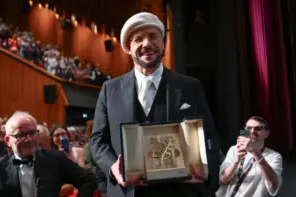
Dressed in a sharply tailored black three-piece suit with a cream-colored tie, polished shoes, silver-rimmed glasses, and a cream beret that gave the entire look a distinctly European elegance, Travolta carried himself with the calm confidence of someone fully aware that all eyes were on him. The outfit itself received widespread praise. Fashion commentators described it as understated but refined — a blend of classic Hollywood formality and modern Cannes sophistication.

But clothing quickly became secondary.
Within minutes of the first photographs appearing online, social media shifted focus toward his face.
People zoomed into close-up images.
Side-by-side comparisons appeared comparing his Cannes look to older red carpet appearances.
Threads exploded across Reddit, X, TikTok, and entertainment forums debating the same question:
Why does he look so different?
Some users reacted positively, insisting he looked healthier, more energetic, and remarkably youthful for his age. Others were stunned by what they perceived as a dramatic transformation, questioning whether the appearance reflected cosmetic procedures, weight loss, styling changes, advanced grooming, or simply the effect of professional lighting and photography.
As always happens online now, the conversation escalated rapidly beyond ordinary observation into speculation.
That escalation says as much about modern celebrity culture as it does about Travolta himself.
Aging in public has become increasingly brutal for celebrities because audiences simultaneously demand authenticity and perpetual youth. If stars appear visibly older, headlines dissect their decline. If they appear refreshed or rejuvenated, speculation immediately shifts toward cosmetic intervention.
Either way, the face becomes public property.
And Travolta’s face carries unusual emotional weight culturally because generations of people remember him frozen in specific cinematic eras:
the swagger of Saturday Night Fever,
the cool menace of Pulp Fiction,
the charm of Grease,
the larger-than-life confidence of his peak Hollywood years.
Audiences unconsciously compare every new image against decades-old versions preserved permanently in popular memory.
That creates an impossible standard.
No ordinary person ages against a backdrop of iconic performances replayed endlessly across forty years of media history.
Travolta’s Cannes appearance became a particularly intense example of this phenomenon because the contrast between expectation and reality felt visually dramatic to many viewers. Under bright festival lighting and high-definition photography, every detail became amplified. Some social media users praised what they saw as careful rejuvenation. Others insisted he looked almost unrecognizable compared to recent appearances.
Cosmetic professionals and aesthetic experts eventually weighed in publicly as well, though cautiously. Several emphasized that any commentary remained speculative because no confirmed information existed regarding procedures or treatments. Many noted that modern non-invasive aesthetic techniques, combined with strategic lighting, grooming, makeup, styling, and photography, can dramatically alter how someone appears publicly without requiring extreme surgical changes.
That nuance, however, rarely survives online discussion for long.
The internet prefers certainty.
Either someone is “aging naturally” or “completely altered.”
Either they look “amazing” or “unrecognizable.”
Subtlety disappears quickly inside viral discourse.
Yet while social media obsessed over appearance, something much more meaningful was actually unfolding beneath the surface of the evening.
Travolta was not at Cannes merely as a celebrity attendee.
He arrived carrying one of the most personal creative projects of his career.
The film being screened, Propeller One-Way Night Coach, marked his debut as a director and represented the realization of a deeply emotional passion project decades in the making. Based on a children’s book he originally wrote and illustrated in 1997, the film blended aviation, family storytelling, nostalgia, and imagination — themes long connected to Travolta’s personal life and identity.
Aviation especially has always occupied a central place in his world.
Unlike many celebrities who adopt hobbies casually, Travolta’s love for flying became almost foundational to his identity outside Hollywood. He earned multiple pilot licenses, famously owned aircraft, and often described aviation as one of the deepest constants in his life. That passion carried directly into the film’s story, which follows a young aviation enthusiast and his mother on a symbolic cross-country journey through the “golden age of flight.”
The project clearly meant more to him than a standard acting role.
He served not only as actor, but writer, director, and co-producer. His daughter, Ella Bleu Travolta, also appeared in the film, turning the production into a family collaboration rather than merely another industry assignment.
That family element shaped the emotional atmosphere of the Cannes appearance significantly.
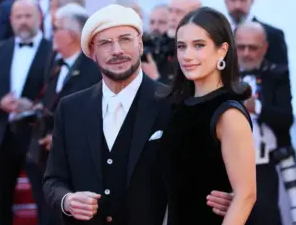
Ella Bleu attended the festival beside her father wearing a black velvet gown accented with Chopard jewelry and vintage-inspired styling. Photographers captured them together repeatedly throughout the evening, and many observers noted the visible warmth between them.
Those images carried extra emotional resonance because Travolta’s public life has long been marked not only by fame, but by profound personal loss.
The deaths of his son Jett in 2009 and wife Kelly Preston in 2020 permanently altered public perception of him. Over time, audiences increasingly stopped viewing him merely as a movie star and began seeing him as someone who had endured extraordinary grief while remaining publicly composed.
That context quietly followed him onto the Cannes carpet too.
So while internet users debated his appearance endlessly, another narrative unfolded simultaneously:
a widowed father premiering a deeply personal film beside his daughter while receiving one of the highest honors in international cinema.
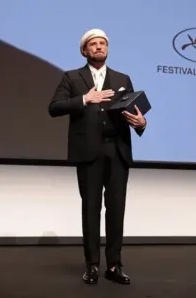
Before the screening began, Cannes festival director Thierry Frémaux surprised Travolta with an honorary Palme d’Or recognizing his lifetime contributions to film. The moment reportedly left him visibly emotional.
And perhaps understandably so.
Very few actors sustain cultural relevance across as many eras as Travolta has. His career survived dramatic rises, collapses, reinventions, industry ridicule, critical rediscovery, and generational change. He experienced the rare phenomenon of becoming iconic more than once.
Most actors receive one defining era.
Travolta somehow lived several.
The audience responded to the honorary award with extended applause while Travolta reflected on his career and expressed gratitude for the recognition. According to accounts from the event, he described the moment as one of the most meaningful of his professional life.
That emotional sincerity shifted public conversation noticeably afterward.
As clips from the ceremony circulated online, attention gradually moved away from cosmetic speculation and back toward the broader significance of the night itself:
a legendary actor entering a new creative chapter,
sharing a project rooted in family and memory,
while being honored for decades of cinematic influence.
Even the film itself reflected themes of continuity and reinvention. Propeller One-Way Night Coach explored imagination, ambition, emotional connection, and inherited dreams — subjects that felt strangely parallel to Travolta’s own life at this stage in his career.
That parallel likely explains why the Cannes screening affected audiences so strongly.
The evening was not merely about celebrity glamour.
It became a meditation on aging publicly, surviving loss, reinventing oneself creatively, and remaining emotionally open after decades inside one of the world’s most unforgiving industries.
And perhaps that is why the internet’s initial obsession with his appearance eventually began feeling oddly shallow in comparison.
Because underneath all the speculation stood a seventy-two-year-old man still creating, still risking vulnerability, still showing up beside his daughter to present something deeply personal to the world.
The face people debated online was ultimately only the surface of the story.
The deeper reality was much more human:
an aging artist confronting time not by disappearing from public life,
but by continuing to build something meaningful within it.
By the end of the night, the discussion surrounding Travolta had evolved from curiosity about how he looked to renewed appreciation for everything he had endured and contributed.
And maybe that transformation says something important about fame itself.
Appearances capture attention instantly.
But endurance —
real endurance —
is what people remember after the cameras stop flashing.