Karmelo Anthony murder trial reveals Austin Metcalf’s last words after he was fatally stabbed at track meet

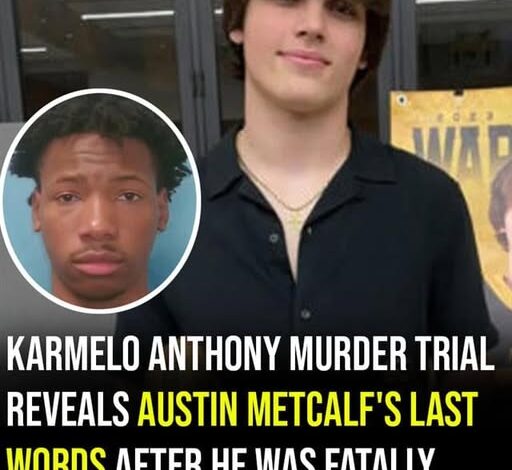
In a packed courtroom, the legal language is precise, measured, and clinical. Terms like “evidence,” “intent,” and “reasonable doubt” dominate the proceedings. Yet beneath the formal structure of the trial lies a far more human reality: two families confronting a moment that changed everything in a matter of seconds.
At the center of the case is the death of Austin Metcalf, a 17-year-old whose future ended during what witnesses describe as a dispute that escalated with shocking speed. What began as an ordinary day at a school track meet has become the subject of intense scrutiny, legal arguments, and public attention.
For Austin’s family, every day of testimony forces them to revisit the worst moment of their lives.
Photographs, witness statements, timelines, and forensic evidence may serve a legal purpose, but they also carry an emotional weight that no courtroom procedure can soften. Each detail is a reminder that the young man they loved is no longer here to tell his own story.
Particularly painful is the testimony of Austin’s twin brother, Hunter.
Twins often share a bond difficult for others to fully understand—a relationship built not only on family ties but on a lifetime of shared experiences, milestones, and memories. Now Hunter must describe events that no sibling should ever have to witness.
The courtroom hears about confusion, panic, and the terrifying realization that an ordinary confrontation had suddenly become a life-threatening emergency. Jurors listen carefully as he recounts those final moments, knowing that his memories are not simply evidence. They are the last chapter of his brother’s life.
Across the courtroom sits Karmelo Anthony.
He, too, is a teenager.
And that fact adds another layer of complexity to a case already filled with tragedy.
The defense argues that Anthony reacted out of fear during a rapidly escalating situation. They portray him as a young person confronted by circumstances that unfolded faster than judgment could keep pace. According to that narrative, the actions taken that day were not driven by a desire to kill but by panic, confusion, and an instinctive effort at self-preservation.
Prosecutors see the events differently.
They argue that fear alone cannot explain what happened.
Their case focuses on decisions made before, during, and after the confrontation. They point to evidence they believe demonstrates criminal responsibility, emphasizing that a young life was lost as a result of a deliberate act.
Between those competing narratives lies the central challenge facing the jury.
The question is not whether something terrible occurred.
Everyone agrees on that.
The question is how the law should interpret what happened.
Was this an act of murder?
Was it self-defense?
Was it a split-second reaction to perceived danger?
Or was it a response that exceeded any reasonable claim of protection?
The answers are rarely simple.
Trials involving teenagers often highlight uncomfortable truths about adolescence itself. Young people are still developing emotionally and psychologically. Impulse control, risk assessment, and decision-making continue evolving throughout the teenage years.
Yet society also expects individuals to be accountable for their actions.
The courtroom becomes the place where those realities collide.
As more than thirty-five witnesses take the stand, the jury is tasked with reconstructing a sequence of events that lasted only moments but produced consequences that will last for decades.
They must evaluate testimony, examine evidence, and determine which version of events best aligns with the facts presented.
Outside the courthouse, public opinion often moves quickly.
People choose sides.
They form conclusions.
They debate guilt and innocence.
Inside the courtroom, however, the process moves more slowly.
Every witness matters.
Every detail matters.
Every inconsistency is examined.
Because the stakes could not be higher.
For Austin’s family, the trial represents a search for justice and accountability after an unimaginable loss.
For Anthony and his family, it represents a determination of responsibility that could shape the rest of his life.
The tragedy of the case is that no verdict can fully restore what has been lost.
A conviction cannot bring Austin back.
An acquittal cannot erase the events that occurred.
The legal system can assign responsibility, but it cannot reverse time.
That reality hangs over every day of testimony.
As jurors listen to evidence and weigh competing interpretations, they are ultimately being asked to do something extraordinarily difficult: separate emotion from law while acknowledging that human lives exist at the center of both.
The trial is not simply about a single confrontation.
It is about how the law interprets fear, intent, and accountability when tragedy unfolds in an instant.
And when the proceedings finally conclude, the jury’s decision will not only determine a legal outcome. It will become part of the lasting story of two young lives forever connected by one irreversible moment.