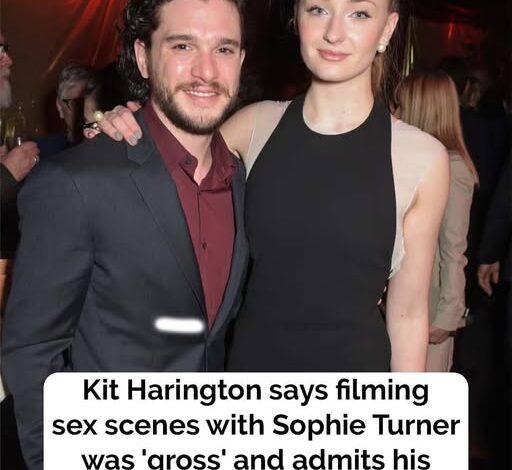
For nearly a decade, audiences watched Kit Harington and Sophie Turner grow up together on screen. As Jon Snow and Sansa Stark, they shared one of television’s most recognizable family bonds—two survivors navigating war, betrayal, and loss while fighting to reclaim their home. To millions of viewers, they became inseparable parts of the same fictional family. Even after Game of Thrones ended, that image remained firmly fixed in the public imagination.
Which is why their latest project felt so unexpected.
Years after playing Stark siblings, Harington and Turner reunited for The Dreadful, a dark medieval drama that places them in a completely different relationship. Instead of family, they portray characters drawn together by romance—a shift that neither actor found easy to embrace.
In fact, both have openly admitted that the transition felt deeply uncomfortable.
For Harington, Turner has long occupied a space closer to family than co-star. They spent some of the most formative years of their lives working side by side, growing from teenagers into adults under the intense scrutiny of global fame. The bond they built during that time was real, making the new dynamic feel strange from the moment they read the script.
Turner experienced the same reaction.
As she moved through the pages for the first time, she reportedly found herself increasingly horrified by where the story was headed. Every chapter seemed to demand greater intimacy between their characters, forcing her to confront the surreal reality that she would be performing romantic scenes opposite someone she had spent years viewing as a brother figure.
The discomfort became an ongoing joke between them.
Humor, after all, was often the only way to navigate situations that felt absurd.
According to those involved in the production, the two actors leaned heavily on sarcasm and laughter to get through the most awkward moments. Between takes, they reportedly mocked the situation relentlessly, turning embarrassment into comedy whenever possible.
Yet beneath the jokes was genuine professionalism.
Neither actor wanted discomfort to undermine a story they believed in.
So they pushed forward.
The process was hardly glamorous. Some scenes reportedly left them cringing before cameras even rolled. Others required emotional vulnerability that felt unusually challenging because of their shared history. There were moments when the absurdity of the situation became almost overwhelming, prompting laughter, groans, and exaggerated complaints before they could continue.
But they never walked away.
Instead, they treated the challenge as part of the job.
That commitment impressed many of their colleagues, including former Game of Thrones castmates who understood the unusual circumstances better than anyone.
Among them was Peter Dinklage, who has spoken highly of Turner’s growth as an actor over the years. Watching her evolution from a young performer into a confident leading actress has inspired admiration throughout the industry. For Dinklage, Turner represents one of the most remarkable success stories to emerge from the phenomenon that was Game of Thrones.
And in many ways, The Dreadful serves as another milestone in that evolution.
The project asks both actors to step outside the identities audiences have assigned them for years. It challenges viewers to separate performers from the roles that made them famous and to see them through an entirely different lens.
That transition isn’t always easy.
Actors often spend years trying to escape characters that become cultural landmarks. The stronger the audience’s attachment, the harder the separation becomes.
Harington understands that reality better than most.
Even now, years after the final episode of Game of Thrones, many people still see him primarily as Jon Snow. The role transformed his life, launched his career into the global spotlight, and permanently linked his image to one of television’s most beloved characters.
But time changes perspective.
Today, Harington approaches his work from a different stage of life.
He is no longer the young actor simply trying to establish himself. He is a husband, a father, and someone increasingly aware of how his career choices will one day be viewed by his children.
That awareness has created moments of reflection.
In interviews, he has joked about the surprisingly long list of nude scenes scattered throughout his career. The comments are delivered with humor, but beneath the laughter lies a more thoughtful question: how will those performances look through the eyes of his children years from now?
It’s a concern many actors eventually face.
Roles that once seemed straightforward take on new meaning when viewed through the lens of parenthood.
For Harington, those reflections are part of a larger reckoning with the unusual life he has lived. Few people spend their adolescence and early adulthood under constant public observation. Fewer still emerge from that experience without carrying complicated feelings about fame, identity, and personal growth.
Turner knows that struggle as well.
Like Harington, she spent her formative years becoming famous in front of millions. Every success, mistake, transformation, and challenge unfolded under public scrutiny. Their generation of actors didn’t simply grow up; they grew up while the world watched.
That shared history gives their reunion an added layer of complexity.
The Dreadful is not merely another film.
It is a collision between past and present.
It brings together two performers whose lives have been intertwined for years while asking them to explore territory neither expected to visit. The discomfort they experienced is understandable precisely because the connection between them is so genuine.
Yet perhaps that is also what makes the collaboration interesting.
The awkwardness is real.
The history is real.
The trust required to navigate such material is real.
And sometimes the most compelling performances emerge from challenges actors never anticipated facing.
For audiences, the project may feel surprising.
For Harington and Turner, it was something even stranger—a reminder of how much life has changed since the days they wandered the halls of Winterfell together.
They are no longer the young actors who first stepped into those roles.
They are adults with careers, families, responsibilities, and years of experience behind them.
But every now and then, a project arrives that forces them to look back while moving forward.
The Dreadful appears to be exactly that kind of project.
A reunion.
A challenge.
And a strangely fitting chapter in the story of two performers who grew up together in front of the world, only to discover that adulthood can sometimes be even more unexpected than fantasy.