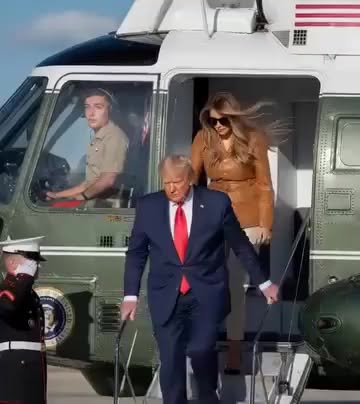
What began as a routine helicopter flight over the United Kingdom suddenly became a stark reminder that even the most powerful people in the world remain vulnerable to the same laws of physics as everyone else.
For a brief but tense stretch of time, a journey expected to last just 20 minutes transformed into something far more uncertain.
At roughly 3,000 feet above the ground, a mechanical issue forced an emergency landing, turning an ordinary presidential transfer into a high-stakes episode watched closely by officials, security personnel, and observers on both sides of the Atlantic.
In moments like these, titles and status matter little.
When an aircraft encounters trouble, every passenger is reminded of the same uncomfortable reality: control can disappear far more quickly than expected.
What should have been a straightforward flight became a 40-minute ordeal marked by contingency planning, rapid coordination, and the calm execution of backup procedures.
Yet by the time Donald Trump stepped off a replacement helicopter at Stansted Airport, the narrative had already begun shifting.
The story was no longer about mechanical failure.
It was about resilience.
The image projected to supporters and allies was clear: a president who had just navigated an unexpected disruption without allowing it to derail a far larger mission.
The incident in the sky quickly gave way to events on the ground, where diplomacy, economics, and strategic partnerships took center stage.
The setting itself carried historical weight.
At Windsor Castle, King Charles III and Queen Camilla welcomed Trump for a rare second state visit, an event significant not only because of its symbolism but because such honors are rarely repeated.
The meetings underscored the enduring relationship between two nations that have spent decades describing their connection as “special,” even as political landscapes have shifted dramatically over time.
But behind the ceremonial pageantry lay something more consequential.
The real focus was the future.
From Windsor to Chequers, discussions increasingly centered on technology, investment, energy, and national competitiveness in a rapidly changing world.
Standing alongside British Prime Minister Keir Starmer, Trump presented an ambitious vision of a strengthened transatlantic partnership built around innovation and industrial growth.
The figures involved were enormous.
A proposed £250 billion framework for cooperation was described not merely as an economic arrangement but as a blueprint for the next era of development.
Artificial intelligence.
Quantum computing.
Fusion energy.
6G communications.
Advanced manufacturing.
Small modular nuclear reactors.
The language surrounding the initiative often sounded less like traditional diplomacy and more like a race toward the future.
Both governments framed these sectors as the engines that could define economic power for generations to come.
The message was straightforward: the countries that lead these industries will help shape the global order that follows.
Trump’s approach remained characteristically direct.
His emphasis focused heavily on deregulation, energy production, private-sector investment, and creating environments where businesses could move quickly and scale aggressively.
The promise he offered was practical and transactional.
More investment.
More jobs.
More opportunities.
Billions of dollars flowing between allied economies.
For supporters, it represented a familiar argument that economic growth and innovation thrive when governments remove barriers and encourage private capital.
For critics, it raised questions about regulation, oversight, and how the benefits of technological expansion would ultimately be distributed.
Yet beneath the political messaging and economic forecasts, another theme quietly emerged.
Security.
Not merely military security, but economic security.
Technological security.
Energy security.
In an increasingly competitive world, both nations appeared to be making a similar calculation.
Neither wants to face the future alone.
The technologies discussed during the meetings are not simply commercial ventures. They are increasingly tied to national influence, strategic independence, and geopolitical stability.
Who controls advanced AI?
Who develops next-generation energy systems?
Who builds the infrastructure powering future communications networks?
The answers to those questions could determine much more than corporate profits.
They could shape global power itself.
That reality gave the discussions a significance extending far beyond trade agreements or investment announcements.
At its core, the partnership being promoted was built on mutual dependence.
The United States gains a trusted ally with deep technological expertise and financial influence.
The United Kingdom gains access to investment, scale, and strategic alignment with its closest international partner.
Together, both nations hope to strengthen their positions in an increasingly uncertain global environment.
Ironically, that broader message was reflected in the day’s unexpected beginning.
A mechanical issue interrupted a helicopter flight.
Backup systems activated.
Alternative plans were implemented.
The mission continued.
In many ways, the diplomatic relationship being showcased followed the same principle.
Strength is not the absence of vulnerability.
Strength is having trusted systems, trusted partners, and trusted institutions capable of responding when things go wrong.
By the end of the day, attention had largely shifted away from the emergency landing itself.
The focus returned to economic strategy, technological competition, and the future of the US-UK relationship.
But the image lingered.
A president stepping from a replacement aircraft after an unexpected failure.
A reminder that uncertainty can appear without warning.
And a reminder that resilience is often measured not by avoiding disruption, but by continuing forward despite it.
As discussions concluded at Windsor and Chequers, both governments sought to project confidence about the decades ahead.
The promises were ambitious.
The investments substantial.
The expectations enormous.
Whether every goal is achieved remains to be seen.
But the broader message was unmistakable.
In an era defined by rapid technological change, geopolitical competition, and economic uncertainty, the United States and the United Kingdom are placing a significant bet on each other.
A bet that innovation can drive prosperity.
A bet that partnership can strengthen security.
And a bet that even when the engines falter, trusted allies can help keep the journey moving forward.