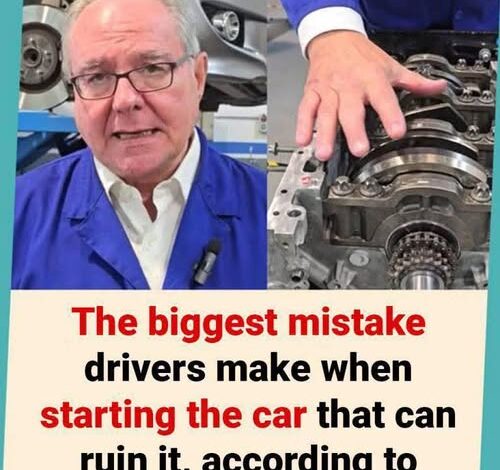
The biggest mistake drivers make when starting their car that can ruin it, according to a mechanic

Most drivers never think twice about it.
The alarm rings.
They grab their keys.
Rush out the door.
Slide into the driver’s seat.
Start the engine.
And within seconds, they are backing out of the driveway or pulling away from the curb.
The entire sequence feels normal.
Efficient.
Responsible, even.
After all, modern life moves fast. Few people want to spend precious time sitting in a parked vehicle when work, school, appointments, and daily obligations are already demanding enough.
Yet according to many mechanics and automotive specialists, one of the most common habits among drivers may also be one of the most damaging.
The mistake is deceptively simple.
Starting the engine and driving away immediately.
At first glance, the warning seems outdated.
Many people associate engine warm-up advice with older cars from decades ago, not modern vehicles equipped with advanced fuel injection systems, computer-controlled engines, and sophisticated lubricants.
But experts say there is an important distinction.
While modern engines generally do not require long periods of idling before driving, they still benefit from a brief pause immediately after startup.
And those few seconds can make a meaningful difference over the lifespan of the engine.
The issue revolves around something most drivers rarely think about:
Oil.
Motor oil is often described as the lifeblood of an engine, and for good reason.
Without it, the thousands of metal components inside an engine would quickly grind against one another, generating enormous friction, heat, and wear.
Bearings.
Camshafts.
Pistons.
Connecting rods.
Crankshafts.
Valvetrain components.
Every moving part depends on a thin protective film of lubricant to separate metal surfaces and prevent damage.
When the engine is running normally, oil circulates continuously through an intricate network of passages.
An oil pump creates pressure and pushes lubricant throughout the engine.
As the oil moves, it forms protective barriers between components moving at tremendous speeds.
Those barriers reduce friction.
Control heat.
Minimize wear.
And help ensure that expensive engine parts survive hundreds of thousands of kilometers or miles.
The challenge occurs during startup.
After a vehicle has been sitting for several hours—or overnight—much of the oil drains back into the oil pan.
A protective film remains on many surfaces, but full oil pressure no longer exists throughout the system.
The next time the engine starts, the lubrication process must begin again.
The oil pump activates.
Pressure builds.
Oil moves through galleries and channels.
Critical components receive fresh lubrication.
The process happens quickly.
But not instantly.
According to many mechanics, allowing the engine to run for roughly 30 to 40 seconds before placing it under load gives the lubrication system time to do its job properly.
That brief waiting period allows oil to circulate throughout the engine and reach areas that may have experienced reduced lubrication while parked.
The concept may sound insignificant.
What difference can half a minute really make?
The answer, specialists argue, becomes visible over years rather than days.
One startup causes little concern.
A hundred startups rarely create obvious damage.
But thousands of cold starts performed under load can gradually accelerate wear.
Tiny amounts of friction accumulate.
Microscopic damage compounds.
Eventually, components that should have lasted longer begin showing signs of deterioration.
One mechanic, posting educational content through the TikTok account @tallerredista, highlighted exactly this concern.
In a widely discussed video, he explained how drivers often unknowingly shorten engine life through seemingly harmless habits.
The vehicle owner featured in the example had a routine familiar to millions of drivers.
Start the engine.
Shift into gear.
Drive immediately.
Every day.
For years.
Nothing dramatic happened at first.
The car continued operating normally.
No warning lights appeared.
No obvious symptoms emerged.
Everything seemed fine.
Until it wasn’t.
When the engine was eventually inspected, significant wear had developed in critical internal components.
The connecting rod bearings and crankshaft bearings had suffered enough deterioration that extensive machine work became necessary.
The crankshaft required grinding to restore proper tolerances.
Major disassembly followed.
Labor costs accumulated.
Replacement parts were needed.
The repair became expensive, time-consuming, and avoidable.
For the owner, the lesson arrived too late.
The damage had already occurred.
The financial consequences were real.
And all because of a habit repeated so routinely that it never seemed worth questioning.
Stories like this often surprise drivers because modern engines appear incredibly durable.
And in many ways, they are.
Today’s vehicles can routinely travel hundreds of thousands of kilometers when maintained properly.
Manufacturing tolerances are tighter.
Lubricants are better.
Materials are stronger.
Engine management systems are more sophisticated than ever before.
Yet durability does not eliminate physics.
Metal still experiences wear.
Friction still generates heat.
Lubrication still matters.
And engine longevity remains heavily influenced by daily habits.
One of the biggest misconceptions involves the relationship between startup and acceleration.
Many drivers assume that if the engine starts smoothly, it is immediately ready for full operation.
Mechanically, that assumption is not entirely accurate.
Starting an engine and demanding maximum performance from it are very different things.
The moment the engine fires, lubrication begins.
But optimal lubrication, temperature stabilization, and pressure distribution still require a short amount of time.
Accelerating aggressively immediately after startup increases stress precisely when the engine is least prepared to handle it.
Oil may still be circulating.
Temperatures may still be low.
Clearances may not yet be operating under ideal conditions.
The result is increased wear during one of the most vulnerable phases of engine operation.
Cold starts are particularly important.
When temperatures are low, oil becomes thicker.
Thicker oil moves more slowly.
Pressure may take slightly longer to stabilize.
Lubrication reaches critical components less efficiently than it would under normal operating temperatures.
In colder climates, the issue becomes even more significant.
Engine components also expand as they warm.
Metal parts are engineered to operate within specific temperature ranges.
Before reaching those ranges, tolerances and clearances differ slightly from their ideal operating conditions.
Again, the effect is small.
But repeated thousands of times, small effects become meaningful.
Mechanics frequently compare engine wear to compound interest.
One event changes little.
Repeated events change everything.
A few extra seconds each morning may not seem important.
Yet over five years, ten years, or fifteen years, those small decisions accumulate.
An engine that receives proper lubrication before being stressed may remain healthier longer.
Bearings may last longer.
Internal surfaces may remain smoother.
Repair costs may remain lower.
The difference often becomes visible only after many years of ownership.
Experts emphasize that this advice should not be confused with extended idling.
Older vehicles often required lengthy warm-up periods before driving.
Modern engines generally do not.
In fact, excessive idling can create its own problems.
Fuel consumption increases.
Carbon deposits may accumulate.
Efficiency decreases.
The goal is not to sit parked for ten or fifteen minutes.
The goal is simply to allow the lubrication system enough time to establish proper oil circulation.
Thirty to forty seconds.
Sometimes less.
Sometimes slightly more depending on conditions.
A brief pause.
Not a prolonged wait.
Once the vehicle begins moving, specialists often recommend gentle driving for the first few minutes.
Moderate acceleration.
Reasonable engine speeds.
Allowing temperatures to rise gradually.
Avoiding aggressive throttle inputs until the engine reaches normal operating conditions.
This approach balances efficiency with mechanical sympathy.
The vehicle warms naturally while driving.
Yet critical components avoid unnecessary stress during their most vulnerable moments.
The consequences of ignoring this advice can vary widely.
Some drivers may never experience catastrophic failures.
Others may notice increased wear over time.
In severe cases, inadequate lubrication during repeated cold starts can contribute to bearing damage, overheating, scoring of internal surfaces, and other costly mechanical issues.
Extreme damage may eventually require major engine repairs or replacement.
Depending on the vehicle, such repairs can become extraordinarily expensive.
Engine rebuilds often involve extensive labor.
Precision machining.
Replacement components.
Specialized expertise.
Costs can easily reach thousands of dollars.
In some cases, repair bills approach the value of older vehicles themselves.
That reality is why mechanics continue emphasizing preventative habits.
Prevention is almost always cheaper than repair.
And few preventative measures are easier than waiting half a minute.
The broader lesson extends beyond engine care.
Modern technology often creates the illusion that maintenance no longer matters.
Vehicles have become smarter.
More reliable.
More advanced.
Yet even the most sophisticated machine still depends on basic principles.
Lubrication.
Temperature control.
Proper operation.
Respect for mechanical systems.
Those principles have not changed.
What has changed is how easy it is to forget them.
Today’s drivers rarely open hoods.
Rarely think about oil pressure.
Rarely consider what happens inside the engine after turning the key or pressing the start button.
The machine feels invisible.
Until something breaks.
Then every hidden component suddenly becomes very expensive.
That is why specialists continue repeating what sounds like surprisingly simple advice:
Start the engine.
Take a breath.
Wait thirty to forty seconds.
Let the oil circulate.
Then drive away gently.
The habit costs almost nothing.
No special tools.
No expensive products.
No technical expertise.
Just patience.
And sometimes, the most effective form of maintenance is not what happens in the repair shop.
It is what happens in the first few moments of every drive.
Because extending the life of an engine often begins long before the vehicle reaches the road.
It begins with a simple decision to give the machine a few extra seconds to protect itself before asking it to work.