SAD NEWS Just 30 Minutes Ago, Jimmy Kimmel with tears in their eyes made the sad announcement!

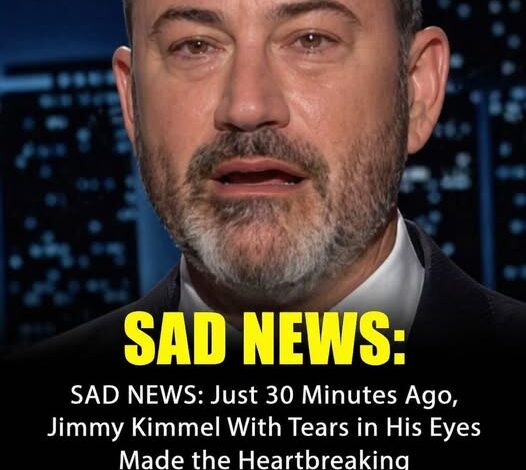
What made Jimmy Kimmel’s monologue resonate so strongly after the 2016 election was not simply its politics, but its emotional honesty.
Late-night television usually survives on rhythm:
setup,
punchline,
applause,
release.
But that night, the familiar machinery of entertainment seemed to falter in real time. Kimmel looked less like a polished host delivering commentary and more like someone trying to process shock publicly while millions of people watched him think through it sentence by sentence. The pauses mattered as much as the words. So did the uncertainty.
Television rarely allows discomfort to remain visible for long.
Normally, fear is softened with irony.
Pain is redirected into humor.
Silence gets filled immediately before audiences become uneasy.
Instead, Kimmel let the unease stay in the room.
That decision transformed the monologue emotionally because viewers recognized something authentic beneath it: he was not performing certainty. He was reacting as a citizen first and an entertainer second.
And for many Americans watching that night, uncertainty itself felt overwhelming.
Election coverage had been framed for months through statistics, polling models, partisan predictions, and media spectacle. Politics had become almost gamified — maps glowing red and blue, commentators discussing turnout like sports analysts discussing strategy.
Then suddenly, as results solidified, the emotional abstraction collapsed.
People began thinking not about campaigns, but consequences:
health insurance,
immigration status,
civil rights,
economic survival,
social hostility,
personal safety.
That emotional transition is what Kimmel captured.
He shifted the conversation away from political theater and toward vulnerability. When he referenced immigrants, sick people, elderly citizens, and struggling families, he translated policy anxiety into human anxiety. Instead of debating ideology abstractly, he forced viewers to imagine actual lives destabilized by political change.
That distinction matters enormously.
Politics often feels distant until people suddenly fear it may alter the conditions of ordinary life itself:
whether they can afford medicine,
whether relatives might face deportation,
whether protections they assumed permanent might disappear.
Kimmel’s reaction reflected the moment many Americans realized elections are not only symbolic contests between parties. They shape emotional realities:
who feels safe,
who feels targeted,
who feels visible,
who feels abandoned.
Importantly, what made the monologue memorable was not simply opposition to Donald Trump. American television has long contained partisan criticism and political satire. What felt different that night was the visible collapse of emotional distance between public commentary and private fear.
Kimmel did not speak like someone analyzing politics from safely above it.
He sounded affected by it.
That emotional vulnerability stood out because late-night hosts typically maintain a protective layer of detachment through comedy. Humor creates control. It allows difficult subjects to feel manageable. But in that monologue, comedy itself seemed temporarily inadequate.
The laughter kept dissolving.
And perhaps audiences responded so strongly because many people were experiencing the same thing simultaneously:
the unsettling realization that the country contained emotional and political divisions far deeper than they previously understood.
Election night revealed parallel Americas existing beside one another with radically different experiences of the same result.
For Trump supporters, the election represented rebellion against political elites, media institutions, economic frustration, and cultural exclusion. Many felt ignored for years by establishment politics and saw the outcome as long-overdue disruption.
For many opponents, however, the victory felt destabilizing and frightening, particularly among communities who feared rising hostility toward immigrants, minorities, LGBTQ individuals, Muslims, and other vulnerable groups.
That emotional split produced something larger than ordinary political disagreement:
a crisis of shared reality.
People were not simply arguing about policy.
They were experiencing entirely different emotional versions of the country itself.
One side saw restoration.
Another saw rupture.
Kimmel’s monologue became memorable partly because it captured that rupture before public discourse hardened fully into familiar partisan combat. There was still visible rawness in the reaction — confusion, grief, disbelief, uncertainty about what came next.
And television rarely preserves those transitional emotional moments honestly.
Usually, media moves quickly toward certainty:
strong opinions,
instant narratives,
predictable outrage.
But uncertainty is psychologically more revealing.
Kimmel’s hesitation communicated something many viewers recognized instinctively:
the feeling that the social contract itself suddenly seemed less stable than people had assumed.
That is why the references to healthcare, immigrants, and struggling families landed so heavily. He was articulating fear not just about politics, but about precarity — the realization that systems many people depended upon emotionally and materially might not be as secure as they believed.
In retrospect, the monologue also marked a broader transformation in late-night television itself.
Hosts increasingly became not just entertainers but emotional interpreters of national events. Audiences no longer turned to them only for jokes, but for reassurance, catharsis, outrage, and moral framing. Comedy programs evolved into spaces where viewers processed anxiety collectively.
That evolution reflects broader changes in media culture.
Traditional trust in political institutions, journalism, and authority figures had already eroded significantly. Many people increasingly sought emotional authenticity rather than institutional neutrality. A visibly shaken comedian sometimes felt more believable than polished political analysts calmly discussing electoral math.
Because emotion signals stakes.
And stakes are what many viewers suddenly felt most intensely that night.
The phrase “the America many believed they lived in, and the America revealed on election night” captures the emotional core beautifully. Elections do not create divisions from nothing. They expose existing fractures:
racial,
economic,
cultural,
geographic,
educational,
and ideological.
For some Americans, 2016 shattered assumptions about national consensus, tolerance, and democratic norms. For others, it exposed how disconnected elite institutions had become from huge portions of the country feeling economically and culturally alienated.
Both reactions contained real emotional truth.
And perhaps that is why the moment continues lingering culturally years later.
Not because one monologue changed politics.
But because it documented a collective emotional shift in real time:
the moment millions of people realized the country they imagined emotionally was not experienced the same way by millions of others.
That realization can feel deeply destabilizing.
Yet there is also something valuable about moments where public figures allow vulnerability instead of certainty. Kimmel did not offer solutions that night. He did not deliver triumphant rhetoric or polished reassurance.
He simply acknowledged fear openly.
And sometimes acknowledgment matters more than resolution.
Especially during moments when a nation is struggling to understand itself.