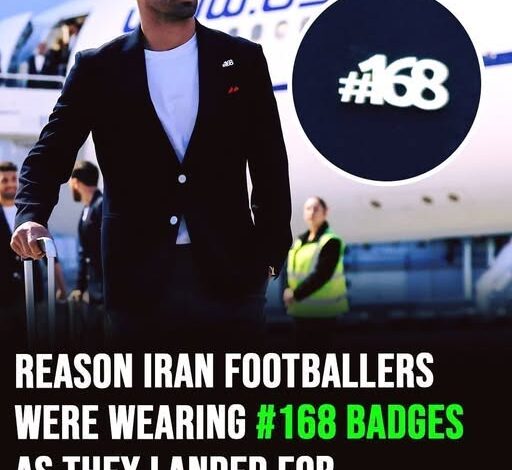
What began as a small detail during the arrival of Iran’s national football team quickly became an international talking point.
Long before the opening whistle of their first World Cup match, cameras captured something unexpected.
A symbol.
A number.
A message displayed on the jackets of several Iranian players that immediately sparked questions around the world.
The hashtag read simply:
#168
To casual observers, it looked insignificant.
To journalists, political analysts, and football fans, it became the center of a growing debate that extended far beyond sports.
Within hours, images of the badge were circulating across social media platforms and international news outlets.
People wanted answers.
What did it mean?
Why were the players wearing it?
And would football’s governing authorities allow it to remain visible during one of the world’s most watched sporting events?
As the tournament approached, a story that initially seemed connected to football rapidly evolved into something much larger.
A Tournament Already Surrounded by Tension
Iran’s participation in the World Cup was attracting attention long before the team arrived.
The tournament itself was taking place amid a complex geopolitical environment, with matches scheduled across venues in the United States and other host locations.
For Iran, participation came with challenges that extended beyond training sessions and tactical preparations.
Political tensions between governments had already raised questions about travel arrangements and visa approvals.
For weeks, uncertainty surrounded whether all members of the Iranian delegation would be permitted entry into the United States.
Officials worked through diplomatic channels.
Deadlines approached.
Questions remained unanswered.
As preparations continued, concern grew within the team’s camp.
Eventually, visas were issued to players and many members of the traveling delegation.
But according to reports, not everyone received approval.
Unexpected Obstacles
Several individuals connected to the team’s support structure reportedly faced entry restrictions.
Among those affected were administrative personnel, technical staff members, analysts, media representatives, and others responsible for helping the team operate during a major international tournament.
While the players themselves would still compete, the absence of certain support personnel created logistical complications.
As a result, alternative arrangements were made.
Rather than establishing their primary base entirely within the United States, the Iranian delegation reportedly organized accommodations in Tijuana, Mexico.
The decision allowed the team to continue preparations while navigating the practical challenges created by travel restrictions.
But it was their arrival in Mexico that would unexpectedly generate global headlines.
The Appearance of #168
As cameras documented the team’s arrival, observers noticed something unusual.
Several players were wearing jacket badges featuring a simple but highly visible symbol:
#168
The number immediately attracted attention.
Photographs spread rapidly.
Comment sections filled with speculation.
Reporters began asking questions.
The symbol appeared deliberate.
Intentional.
Meaningful.
Yet its significance was not immediately obvious to international audiences.
Soon afterward, explanations attributed to Iranian officials began emerging.
According to those statements, the number was intended to honor the memory of 168 children connected to a tragic event referenced by Iranian authorities.
The gesture was described as an act of remembrance.
A symbolic tribute intended to draw attention to a loss that officials believed should not be forgotten.
But as details emerged, so did disagreement.
A Symbol Open to Interpretation
The tragedy connected to the #168 message has been discussed through competing narratives and differing political interpretations.
Various governments, organizations, and commentators have presented conflicting views regarding the circumstances surrounding the event and questions of responsibility.
As a result, the symbol quickly became more than a memorial.
It became a subject of international debate.
Supporters viewed the gesture as humanitarian.
A simple act of remembrance honoring lives lost.
Critics viewed it differently.
Some argued that the badge carried political implications because of the broader context surrounding the event being referenced.
Others questioned whether a global sporting competition was the appropriate venue for such symbolism.
The differing interpretations reflected larger geopolitical divisions already surrounding the tournament.
And because there was no universally accepted narrative regarding the tragedy itself, discussions surrounding the badge became increasingly complex.
The FIFA Question
The controversy also raised an important question for football’s governing authorities.
FIFA has long maintained rules designed to limit political, religious, and personal messaging during official competitions.
The organization generally seeks to preserve neutrality within tournament environments.
Over the years, teams, players, and national federations have occasionally faced scrutiny when symbolic statements appeared on uniforms, equipment, or official apparel.
In some cases, disciplinary measures followed.
In others, governing bodies determined that no violation had occurred.
The situation involving Iran appeared less straightforward.
Reports indicated that the badges were observed during arrival activities rather than during official match play.
That distinction created uncertainty.
Would FIFA consider the gesture part of the tournament environment?
Would the organization view the symbol as political?
Or would it conclude that the display fell outside the scope of competition regulations?
At the time of the reports, no official public ruling had been announced.
The absence of immediate clarification only fueled further speculation.
Global Reactions Intensify
As images of the badges continued spreading online, reactions became increasingly polarized.
Football fans debated the issue across social media.
Commentators offered competing interpretations.
News organizations highlighted the broader context surrounding the symbol.
For some observers, the story represented a reminder that athletes and teams do not exist in isolation from world events.
For others, it reinforced concerns about politics becoming intertwined with international sports.
The discussion soon extended beyond football itself.
Questions emerged about diplomacy.
International relations.
Free expression.
And the role athletes should—or should not—play in drawing attention to humanitarian causes.
What had started as a simple visual detail on a jacket became one of the most discussed off-field developments leading into the tournament.
More Than a Football Story
Major sporting events have often served as stages for larger conversations.
The World Cup, perhaps more than any other competition, places nations, cultures, and political realities under an intense global spotlight.
Because of that visibility, even small gestures can acquire enormous significance.
The appearance of the #168 badges demonstrated how quickly a symbolic act can transcend sports and enter the realm of international debate.
For the players wearing them, the badges may have represented remembrance.
For observers, they became symbols open to interpretation.
For media organizations, they became a developing story.
And for tournament officials, they presented questions that had yet to be fully answered.
As the Tournament Begins
As teams finalize preparations and attention shifts toward the matches themselves, the discussion surrounding Iran’s symbolic gesture continues.
Whether viewed as a memorial, a political statement, or something in between, the incident highlights the reality that modern sporting events rarely exist apart from the world around them.
The games may be played on the field.
But the conversations surrounding them often extend far beyond the stadium.
What began as a small number on a jacket has become an international topic involving memory, symbolism, regulation, and interpretation.
And as the World Cup unfolds, the story serves as another reminder that in global sports, actions taken away from the pitch can sometimes attract as much attention as the competition itself.