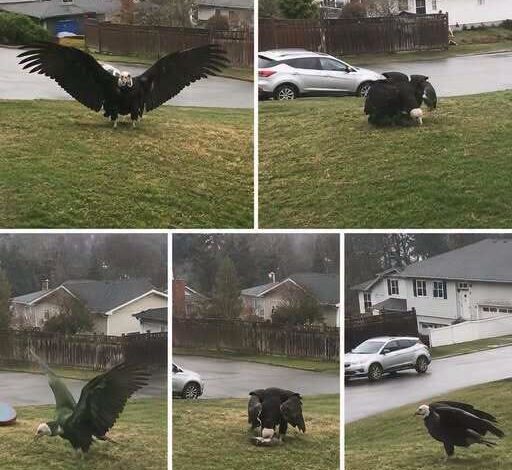
Inside a heavily secured research facility in Brownsville, an enormous bird sits quietly behind layers of reinforced steel mesh, watching every visitor with an intensity that is impossible to ignore.
Scientists have nicknamed it the “Giant Eagle of the Border.”
It rarely moves without purpose.
Every turn of its head seems deliberate, and its piercing gaze follows researchers as though it understands far more than anyone expected.
Beyond the enclosure, laboratories operate around the clock as geneticists race to answer a question no one can yet explain.
Exactly what is this bird?
Samples from its DNA are being analyzed repeatedly using advanced sequencing technology. Researchers compare its genetic profile with those of modern eagles, condors, hawks, and other large birds of prey. They have even examined similarities with extinct species in hopes of uncovering clues hidden within its remarkable genome.
Instead of providing clear answers, each new analysis seems to deepen the mystery.
Certain genetic markers closely resemble those found in familiar raptors.
Others appear unexpectedly different, resisting easy classification.
The unusual combination has fueled speculation that the bird could belong to an unknown branch of an existing species—or perhaps represent an ancient lineage that somehow survived unnoticed despite decades of scientific surveys and extensive monitoring along one of the world’s most closely watched borders.
For researchers, every new discovery raises as many questions as it answers.
Outside the research center, the implications of the find extend far beyond science.
Communities throughout the region have become captivated by the extraordinary discovery, and discussions have quickly expanded from biology to conservation, tourism, culture, and public policy.
Local leaders see the potential for increased visitors eager to witness one of the most unusual wildlife discoveries in recent memory.
At the same time, conservation experts urge caution, warning that protecting the animal and its habitat must take priority over commercial interests or public curiosity.
Many believe the bird’s long-term survival should come before any plans for exhibitions or tourism.
The discovery has also sparked thoughtful conversations among Indigenous communities and residents who have lived near the border for generations.
For many, the bird represents more than an unusual scientific finding.
It has become part of a broader discussion about history, identity, stewardship of the land, and who should be responsible for telling the story of a creature discovered within a landscape rich in both cultural and ecological significance.
Questions surrounding ownership, preservation, and responsibility have become almost as significant as the mystery surrounding the bird itself.
In an era defined by satellites, drones, artificial intelligence, and sophisticated surveillance systems, many people assume that every corner of the natural world has already been explored and documented.
This remarkable bird challenges that assumption.
Its existence serves as a reminder that nature continues to surprise us, even in places we believe we know intimately.
There are still discoveries waiting beyond the limits of our maps, databases, and expectations.
Whether the Giant Eagle of the Border ultimately proves to be an undocumented species, a rare evolutionary survivor, or something entirely different, its appearance has already accomplished something extraordinary.
It has reignited curiosity.
It has reminded scientists that the natural world still holds unanswered questions.
And it has encouraged people far beyond Brownsville to wonder what other remarkable creatures might still exist beyond the edges of what we think we know.
For now, the great bird remains calm inside its secure enclosure, observing the people who have become so fascinated by its presence.
It does not explain itself.
It simply waits.
And in that quiet patience, it leaves behind one unmistakable message: even in a world that believes it has discovered everything, nature still has the power to surprise us.