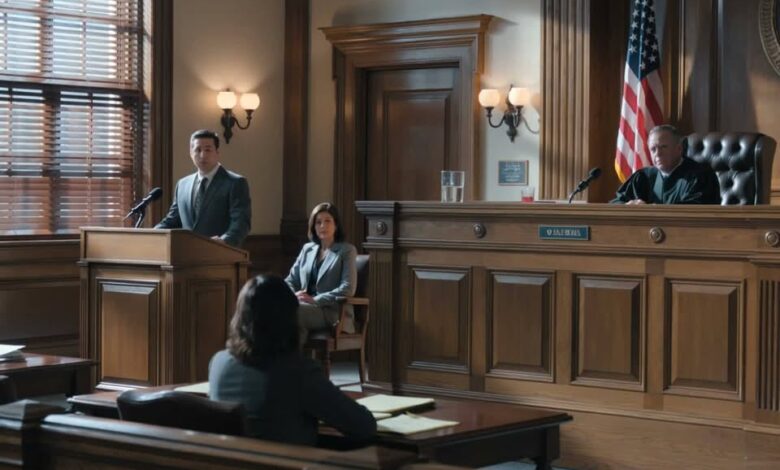
My parents sued me for my entire fortune and smiled while their lawyer called me a thief. Then I said two words, and my father’s face lost all color.

Three months after the trial ended, I was standing in a warehouse outside Milwaukee watching a refrigerated trailer back into loading bay seven when my assistant called and said, “You have a visitor.”
I glanced at my watch.
“Did we have a meeting scheduled?”
“No.”
“Who is it?”
A pause.
Then she said, carefully, “Your mother.”
The trailer’s backup alarm continued beeping behind me.
Workers moved pallets of temperature-controlled pharmaceuticals through the open dock doors.
Cold air drifted across the concrete floor.
For a second I simply watched the operation continue.
Movement.
Schedules.
Deadlines.
The ordinary mechanics of a company that never stopped because one person’s emotions demanded attention.
“My mother is in Chicago?”
“She’s sitting in reception.”
I closed my eyes briefly.
“Did she say what she wants?”
“Only that she’d like ten minutes.”
Ten minutes.
People always ask for ten minutes when they want much more.
“I’ll be back this afternoon.”
“Should I tell her that?”
“No.”
Another pause.
“What should I tell her?”
I watched a forklift disappear around a corner.
Then I said, “Offer her coffee.”
And hung up.
When I returned to headquarters a little after three, my mother was still there.
That surprised me.
Not because she waited.
Because she waited publicly.
The Lena Lennox I grew up with rarely placed herself in situations where uncertainty might become visible.
Yet there she sat in one of the reception chairs, hands folded in her lap, untouched coffee cooling on the table beside her.
She looked smaller.
Not physically.
People think aging always changes the body first.
Often it changes certainty.
The receptionist glanced toward me.
I nodded.
“It’s fine.”
My mother stood when she saw me.
For a moment neither of us spoke.
The lobby around us carried on normally.
Phones rang.
Visitors signed in.
Employees crossed through carrying laptops and paperwork.
Nobody paid particular attention.
Which seemed appropriate.
Family disasters always feel historic to the people inside them.
The rest of the world continues answering emails.
“Hello, Zara.”
“Mom.”
She nodded once.
The silence stretched.
Finally I said, “You wanted ten minutes.”
She looked away.
Then back again.
“I wasn’t sure you’d agree.”
“I didn’t.”
That landed.
Not cruelly.
Just accurately.
Something flickered across her face.
Regret maybe.
Or recognition.
They look similar from certain angles.
I gestured toward a conference room.
“Ten minutes.”
We sat across from each other at a polished oak table.
The room overlooked the river.
Cargo trains moved slowly in the distance.
My mother studied the view before speaking.
“It’s larger than I imagined.”
“The office?”
“The company.”
I folded my hands.
She laughed softly.
Not with humor.
With embarrassment.
“I suppose that sounds ridiculous.”
“A little.”
She nodded.
“I deserve that.”
I wasn’t interested in making her suffer.
That surprises people sometimes.
They assume betrayal creates permanent hunger for punishment.
Mostly it creates exhaustion.
“What do you want, Mom?”
She stared at her hands.
For the first time in my life, I noticed they looked old.
Not weak.
Just lived in.
The hands that packed school lunches.
Balanced household budgets.
Buttoned winter coats.
Signed court documents.
Human hands.
Complicated hands.
“I came because your father won’t.”
I said nothing.
“He should.”
Still nothing.
“He won’t.”
Outside the window, a train horn echoed across the river.
My mother continued.
“Victor still believes he was right.”
I laughed once.
Short.
Sharp.
“He lost.”
“That doesn’t mean he thinks he was wrong.”
No.
It didn’t.
That sounded exactly like my father.
She looked up.
“He thinks the court misunderstood.”
“Of course he does.”
“He thinks lawyers distorted things.”
“Naturally.”
“He thinks—”
“I know what he thinks.”
The room fell quiet again.
Finally my mother whispered, “I don’t.”
That got my attention.
Not because of what she said.
Because of how she said it.
Lena Lennox had spent decades standing beside certainty.
Watching uncertainty appear in her felt almost disorienting.
“What changed?”
She looked out the window.
“A lot of things.”
“Such as?”
Her smile was sad.
“Silence.”
I waited.
“After the lawsuit ended, people stopped calling as much.”
She traced one finger along the edge of the table.
“Church friends stopped asking questions because they already knew the answers.”
The smile disappeared.
“Some of them weren’t very flattering.”
I leaned back in my chair.
She continued.
“Then your father retired.”
That explained more than she realized.
Men like Victor often mistake professional authority for permanent authority.
Retirement removes the stage.
Not the personality.
The stage.
“How’s he handling that?”
“He isn’t.”
I nodded.
That tracked.
“He spends a lot of time explaining the trial.”
“To who?”
“Anyone who will listen.”
I looked away toward the river.
Cargo containers sat stacked like colorful building blocks along the rail yard.
Movement.
Systems.
Predictability.
Things I understood.
My mother took a breath.
“Last month I found the loan documents.”
I turned back toward her.
“What loan documents?”
“The ones from Bill Mercer.”
My expression didn’t change.
She noticed anyway.
“I never saw them before.”
“No.”
“You knew that?”
“Yes.”
She nodded slowly.
“I asked your father why he never told me.”
I waited.
“What did he say?”
“He said it wasn’t important.”
For the first time all afternoon, genuine anger touched her voice.
Small.
Controlled.
Real.
I understood immediately.
Because suddenly this wasn’t only about me anymore.
It was about her.
About discovering she had spent years participating in a story whose facts she had never been allowed to fully inspect.
“I asked him why he never looked at your business plan.”
Her eyes met mine.
“He couldn’t remember.”
I laughed.
Actually laughed.
Not because it was funny.
Because it was impossible.
My father remembered everything.
Dates.
Names.
Conversations from twenty years ago.
He remembered because remembering helped him remain correct.
My mother knew it too.
“He remembered,” I said.
“Yes.”
“He just didn’t like the answer.”
“Yes.”
We sat quietly.
Then she said the thing I never expected to hear.
“I should have asked more questions.”
The sentence was simple.
Almost disappointingly simple.
No dramatic apology.
No speech.
No tears.
Just accountability.
The rarest currency in some families.
I looked at her for a long time.
Then asked, “Why didn’t you?”
Her answer came immediately.
Because she’d been waiting for it.
“Because it was easier not to.”
The honesty of that hit harder than any apology would have.
She wasn’t blaming my father.
Or culture.
Or misunderstanding.
She was naming a choice.
Small.
Repeated.
Convenient.
The kind that reshapes entire lives.
“I thought peace was the same thing as goodness.”
Her eyes filled.
“Sometimes I think I spent forty years confusing the two.”
The conference room suddenly felt very quiet.
Outside, another train rolled through the yard.
My mother wiped her eyes.
Not dramatically.
Efficiently.
As though apologizing for the inconvenience.
“I don’t expect forgiveness.”
“Good.”
That surprised her.
Then she nodded.
“Fair.”
“I don’t even know what forgiveness means here.”
“Neither do I.”
More silence.
Then she reached into her purse and pulled out a small envelope.
“I brought this.”
I didn’t take it.
“What is it?”
“Something that belonged to your grandmother.”
That changed things.
Slowly, I reached forward.
Opened the envelope.
Inside was a folded sheet of paper.
Yellowed slightly with age.
Recognizable immediately.
My grandmother’s handwriting.
I unfolded it carefully.
Read.
Then read again.
The note was dated three months before her death.
Addressed to my mother.
Not me.
Lena,
You worry too much about keeping harmony and not enough about keeping truth.
One of those things heals people.
The other only postpones pain.
Watch Zara carefully.
She sees things others miss.
Do not mistake that for rebellion.
It is a gift.
Love,
Mom
For a long moment I couldn’t speak.
Neither could my mother.
Finally I looked up.
“When did you find this?”
“Two weeks ago.”
“Where?”
“In a box of her papers.”
I stared at the note again.
My grandmother.
Gone for years.
Still somehow seeing the whole thing more clearly than anyone else.
My mother stood.
The movement startled me.
“Our ten minutes are probably up.”
I looked at the clock.
Forty-three minutes.
Neither of us mentioned it.
She gathered her purse.
Smoothed her jacket.
Then paused at the door.
“Zara.”
“Yes?”
“I was proud of you.”
I waited.
“Even when I didn’t say it.”
The old version of me would have needed that.
Maybe even cried over it.
But healing changes the shape of hunger.
I believed her.
And strangely, because I believed her, I didn’t need it anymore.
“I know.”
Her eyes widened slightly.
Then softened.
She nodded once.
And left.
I watched her walk through the lobby.
Past reception.
Out the revolving doors.
Into the Chicago afternoon.
Then I looked back down at my grandmother’s note.
Outside my office window, freight trains kept moving.
Deliveries kept arriving.
Employees kept solving problems.
Life kept expanding.
Not because anyone finally approved of it.
Because it had never needed permission to exist in the first place.