The steady beeping of the monitors had become the soundtrack of Sarah’s nightmare.
Day after day, night after night, she sat beside her six-month-old son, Lucas, in the pediatric intensive care unit. The machines surrounding his tiny crib glowed softly in the darkness, tracking every heartbeat, every breath, every fragile sign that he was still fighting.
To the nurses and doctors, the sounds were routine.
To Sarah, they were terrifying.
Each beep felt like a countdown.
Each pause between them felt far too long.
She sat in the same chair for hours at a time, refusing to leave for more than a few minutes. Her hand rested gently against Lucas’s tiny fingers, holding onto him as if her touch alone could keep him anchored to the world.
The baby who once filled her home with laughter now lay motionless beneath hospital blankets.
And despite everything modern medicine could offer, he wasn’t getting better.
The doctors had tried.
No one could accuse them of giving less than their best.
Specialists came and went. Treatments were adjusted. Tests were repeated. Every possible option was explored.
But Lucas’s condition remained critical.
Then came the conversation Sarah had been dreading.
The attending physician entered the room with a careful expression that immediately told her the news before he spoke.
She felt her stomach tighten.
Her hands began to tremble.
The doctor sat beside her.
“Sarah,” he said gently, “we need to talk.”
Those four words shattered what remained of her hope.
The discussion that followed felt unreal.
The medical team explained that Lucas’s body was not responding as they had hoped. They were reaching the limits of what treatment could accomplish.
Continuing aggressive interventions might not change the outcome.
Sarah heard every word.
Yet somehow, none of them seemed real.
Because as long as Lucas was breathing, she couldn’t accept the possibility of giving up.
When the doctors left, she leaned over his crib and pressed her forehead against the railing.
Tears streamed silently down her face.
“I’m still here, baby,” she whispered.
Her voice cracked.
“I’m not going anywhere.”
And she meant it.
No matter what happened.
No matter what anyone said.
She would stay.
What few people in the hospital understood was that Lucas had another protector waiting for him at home.
A German Shepherd named Rex.
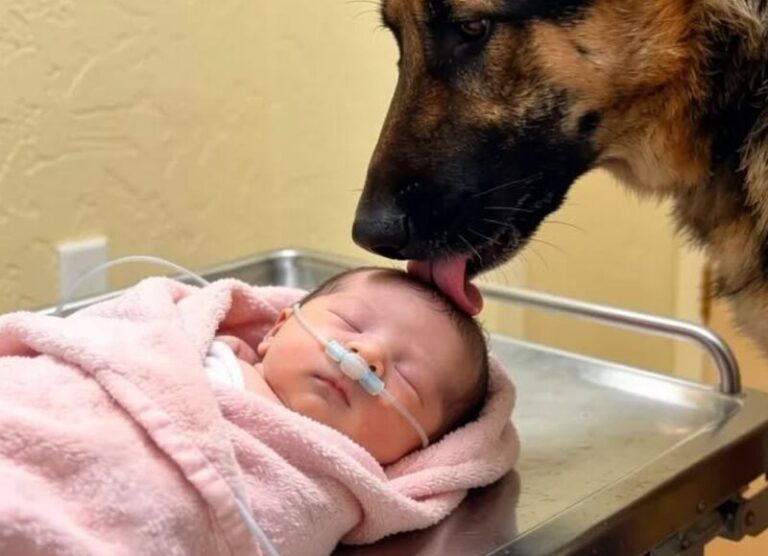
From the day Lucas was born, Rex had treated the infant as if protecting him were his life’s purpose.
The dog slept near the baby’s crib.
Followed him from room to room.
Reacted instantly whenever Lucas cried.
Visitors often joked that Rex behaved less like a pet and more like a bodyguard.
But Sarah knew it was deeper than that.
The bond between them had formed naturally.
Instinctively.
Almost mysteriously.
And when Lucas was rushed to the hospital weeks earlier, Rex had noticed immediately.
The house changed.
The routine changed.
Everything changed.
The dog paced endlessly near the front door.
He wandered into the nursery repeatedly.
Sometimes he would sit beside Lucas’s empty crib for hours.
Waiting.
Listening.
Searching for someone who wasn’t there.
Watching him broke Sarah’s heart.
Because she understood exactly how he felt.
Both of them were waiting for Lucas to come home.
As Lucas’s condition worsened, a thought began growing in Sarah’s mind.
A desperate thought.
Maybe Rex could help.
Not medically.
Not physically.
But emotionally.
Maybe Lucas needed his friend.
Maybe Rex needed Lucas.
Maybe one final reunion would bring comfort to them both.
The hospital administrators refused immediately.
Animals weren’t permitted inside critical care units.
The regulations were strict.
No exceptions.
Sarah pleaded.
She explained the bond they shared.
She explained what Rex meant to Lucas.
But the answer remained the same.
No.
Days passed.
Lucas continued fighting.
Sarah continued waiting.
And Rex continued pacing at home.
Eventually, one nurse could no longer ignore Sarah’s pain.
She had watched the exhausted mother spend countless nights beside her son’s bed.
She had witnessed her determination.
Her heartbreak.
Her refusal to abandon hope.
Quietly, the nurse approached Sarah.
“What if…” she began carefully.
Sarah looked up.
The nurse lowered her voice.
“What if nobody officially knew?”
Several hours later, a plan was set in motion.
A risky one.
One that could get people into trouble.
But nobody involved was thinking about rules anymore.
They were thinking about a baby.
And a loyal dog.
That evening, Rex entered the hospital.
At first, everything seemed normal.
Sarah knelt beside him, tears filling her eyes as she clipped a temporary visitor tag onto his collar.
“Easy, boy.”
His tail wagged gently.
He seemed excited.
Hopeful.
As if he knew exactly where he was going.
The elevator ride was quiet.
The hallway was quiet.
The nurse led them toward Lucas’s room.
Sarah imagined the reunion a hundred different ways.
She imagined Rex gently approaching the crib.
She imagined Lucas responding somehow.
She imagined one beautiful moment amid so much pain.
But the instant Rex entered the room, something unexpected happened.
Everything changed.
The dog froze.
Completely froze.
His ears stood upright.
His muscles tightened.
His eyes moved rapidly across the room.
Not toward Lucas.
Toward everything else.
Sarah frowned.
“Rex?”
The dog ignored her.
Instead, he began slowly circling the room.
Carefully.
Methodically.
His nose twitched constantly.
His posture grew increasingly tense.
The nurse exchanged a confused glance with Sarah.
This wasn’t normal.
Not at all.
Rex suddenly stopped near a cabinet containing medical supplies.
He stared.
Then sniffed aggressively.
Then moved away.
Next, he approached several feeding bags stored near the wall.
Again, he reacted.
This time more intensely.
Then he moved toward a corner of the room and became completely fixated.
His attention locked onto a specific section of wall behind Lucas’s crib.
A low growl escaped his throat.
Sarah felt a chill run through her body.
She had never seen Rex behave like this.
Not once.
The dog scratched at the floor.
Then at the wall.
Then barked sharply.
Once.
Twice.
Again.
The nurse immediately recognized that something wasn’t right.
This wasn’t excitement.
This wasn’t stress.
This was detection.
Rex was trying to communicate something.
Moments later, the room door burst open.
Several staff members arrived after receiving reports about the unauthorized dog.
But before anyone could demand explanations, the room itself responded.
The lights flickered.
Once.
Twice.
Then again.
A strange alarm sounded briefly.
Not a patient alarm.
Something different.
Something mechanical.
And then everyone smelled it.
Burning.
Faint at first.
But unmistakable.
The smell of overheated wiring.
Instantly, the mood shifted.
Hospital staff stopped focusing on Rex.
Now they focused on the wall.
The exact wall he’d been staring at.
Maintenance teams were called immediately.
Engineers arrived within minutes.
Panels were removed.
Equipment was inspected.
What they discovered stunned everyone.
Hidden behind the wall was a section of electrical wiring that had been overheating for an unknown period of time.
The damage was severe.
Much worse than anyone expected.
According to technicians, the problem could have escalated into a dangerous electrical fire.
Not days later.
Not weeks later.
Soon.
Very soon.
The revelation sent shockwaves through the pediatric unit.
The danger had been invisible.
Undetected.
And Rex had somehow sensed it before any human noticed.
But the discoveries didn’t stop there.
During the emergency inspection process, staff conducted a broader review of equipment and supplies throughout the unit.
What they found raised additional concerns.
Certain feeding materials stored nearby showed signs that warranted immediate investigation.
Several items were removed for testing.
Additional safety protocols were implemented.
Multiple patient care procedures were reviewed.
Suddenly, what began as a secret visit from a dog had become a major safety operation.
Lucas was transferred immediately to another monitored room.
Doctors reassessed every aspect of his care.
Sarah watched the chaos unfold around her in disbelief.
Hours earlier, she had prepared herself for the possibility of losing her son.
Now the entire hospital was scrambling to address dangers nobody knew existed.
And somehow, Rex had been at the center of it all.
That night, Sarah barely slept.
Neither did the medical team.
The following morning brought something nobody had expected.
Lucas’s condition stabilized.
The improvement was subtle.
Small.
But real.
For the first time in weeks, doctors saw encouraging signs.
They remained cautious.
Careful.
Professional.
Yet Sarah could see hope returning to their faces.
The change wasn’t dramatic enough to declare victory.
But it was enough to continue fighting.
And for Sarah, that meant everything.
The days that followed felt completely different.
Repairs were completed.
Safety reviews expanded.
Investigations continued.
Administrators examined maintenance records.
Suppliers faced scrutiny.
Questions demanded answers.
Meanwhile, Lucas continued making gradual progress.
One tiny victory at a time.
A stronger response.
A better reading.
A more stable night.
Each improvement felt miraculous.
And throughout it all, conversations about Rex spread throughout the hospital.
Doctors discussed him.
Nurses discussed him.
Technicians discussed him.
The dog that should never have been there had helped reveal dangers hidden in plain sight.
Many who initially criticized his presence began seeing the situation differently.
Protocols existed for good reasons.
But so did instinct.
And sometimes instinct noticed what procedures missed.
Weeks later, Sarah stood beside Lucas’s crib once again.
But this time the room felt different.
The fear that once consumed every corner had begun to fade.
Lucas opened his eyes more often now.
His breathing was stronger.
His tiny fingers curled around hers.
Outside the hospital, Rex waited faithfully for his return.
Just as he always had.
Looking back, Sarah often struggled to explain exactly what happened.
Some called it coincidence.
Others called it luck.
Some believed Rex simply reacted to sounds humans couldn’t hear.
Perhaps they were right.
Perhaps not.
But one thing remained undeniable.
A loyal dog entered a hospital room.
He reacted to dangers nobody knew existed.
Those dangers were discovered.
Lives were protected.
And a little boy who seemed to be running out of time was given another chance to keep fighting.
For Sarah, that was enough.
She no longer viewed Rex as merely a pet.
He was family.
A guardian.
A silent protector who never stopped watching over the child he loved.
And whenever she thought back to those terrifying days, one image stayed with her above all others:
A German Shepherd standing between a vulnerable child and hidden danger, refusing to look away until someone finally listened.
Sometimes heroes don’t wear uniforms.
Sometimes they walk on four legs.
And sometimes, when hope feels completely lost, they arrive exactly when they’re needed most.