Part1: My sister-in-law called me from a resort to ask me to feed her dog, but when I opened her house, there was no dog. There was a five-year-old boy locked inside, dehydrated, trembling, and whispering: “Mom said you weren’t going to come.” I only brought dog food. I ended up carrying my nephew to the emergency room. And when Chloe sent me that threatening text, I understood that this was no accident.

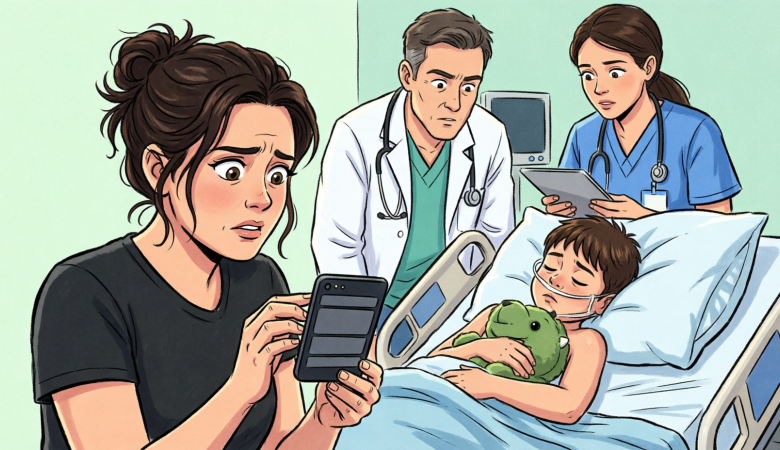
I didn’t sleep that night.
Every time I closed my eyes, I saw the guest room door.
The key.
The stale heat.
Leo’s cracked lips.
The way he whispered, “Mom said you weren’t going to come,” as if rescue itself had become something dangerous to hope for.
The hospital finally discharged us close to midnight, but exhaustion never arrived properly. Fear kept replacing it. I sat alone at my kitchen table with the bear-shaped weight of everything pressing against my chest while Scottsdale glowed quietly outside my apartment window.
Rex sat beside me where Leo accidentally left him earlier before Richard drove the children to the temporary family housing arranged through Child Protective Services.
And my phone would not stop vibrating.
News alerts.
Missed calls.
Texts from relatives who suddenly wanted explanations after years of politely ignoring Chloe’s perfection.
I answered none of them.
Because once you witness something real enough, small conversations begin feeling obscene.
At 2:11 a.m., another message arrived from Richard.
I’m sorry.
Just that.
No defense.
No excuses.
No attempt to minimize what happened.
And somehow that made it sadder.
Because apologies after children survive terror always arrive too late to matter cleanly.
I stared at the text for a long time before setting the phone face down again.
Then my mind returned to Sophia.
That little girl had barely spoken at the hospital. Even while nurses treated her for heat exhaustion, she watched every adult entering the room with the same expression Leo carried:
careful,
measuring,
waiting to discover which version of reality she was expected to perform.
Children raised around fear learn surveillance before freedom.
That realization haunted me more than Chloe’s screaming ever could.
By morning, the story had already started spreading publicly.
Not details.
Not names yet.
Just fragments:
a child hospitalized,
a police investigation,
an incident involving neglect in an affluent Scottsdale neighborhood.
People always sound shocked when cruelty happens inside beautiful homes.
As if money sterilizes suffering.
As if clean countertops and matching patio furniture somehow guarantee kindness.
But some of the cruelest environments survive precisely because they photograph well.
At nine that morning, Maricela called.
Her voice sounded even firmer now.
“We executed the emergency protective order,” she said. “And we found additional evidence inside the house.”
My stomach tightened immediately.
“What kind of evidence?”
A pause.
“Documentation. Schedules. Restrictions.”
Another pause.
“Paula… there were charts.”
Cold spread slowly through my chest.
Charts.
Maricela explained carefully:
bathroom access monitored,
food portions tracked,
behavior punishments escalating based on “disobedience.”
Everything typed neatly into color-coded binders.
Not chaos.
Control.
That disturbed me most.
Because part of me still wanted Chloe to be irrational somehow. Angry. Unstable. Explosive.
But organized cruelty feels different.
Organized cruelty wakes up early.
Pays bills on time.
Smiles during school pickup.
Answers politely at neighborhood barbecues.
Organized cruelty survives because it understands presentation.
“And Sophia?” I asked quietly.
Maricela exhaled slowly.
“She told the child psychologist she used to count how long Leo cried before he stopped making noise.”
I closed my eyes immediately.
Not because I couldn’t handle the image.
Because I could.
Too clearly.
And somewhere inside that understanding came a fresh wave of guilt.
How many moments had all of us witnessed separately without connecting them together?
Leo apologizing constantly.
Sophia freezing whenever Chloe entered a room.
Richard laughing nervously every time Chloe interrupted the children midsentence.
Tiny warning signs scattered everywhere like breadcrumbs.
And still, we all kept moving.
That is the terrible thing about abuse hidden inside ordinary life:
people normalize discomfort gradually until horror starts looking like personality.
By afternoon, detectives requested another formal statement from me downtown.
The interview room looked exactly like every crime documentary room ever filmed:
gray walls,
cheap coffee,
air-conditioning too cold for comfort.
A detective named Alvarez slid photographs across the table carefully.
The guest room.
The lock.
The empty bottle beside the bed.
Then another photo.
Leo’s wrist.
Purple fingerprints.
I physically stopped breathing for a second.
Because somehow I had missed that part while focused on everything else.
“You didn’t fail him,” Alvarez said quietly, noticing my expression.
But guilt doesn’t disappear because someone reasonable tells it to.
I looked at the photograph again.
Five years old.
No child should learn silence that early.
Then Alvarez showed me something worse.
Screenshots recovered from Chloe’s phone.
Drafted text messages prepared in advance.
One intended for Richard:
Leo got overwhelmed again. Paula offered to keep him a few days.
Another intended for me:
Thanks again for checking on the house! Buddy was happy 🙂
Another unsent note stored privately beneath reminders:
Need cleaner story before Richard gets home.
My hands started shaking.
Cleaner story.
Not panic.
Not regret.
Narrative management.
The detective studied me carefully.
“We believe she was preparing multiple versions of events depending on what happened.”
The room suddenly felt too small.
Because until then, some part of me still wanted to believe Chloe simply spiraled into cruelty through stress or narcissism or emotional instability.
But this?
This was planning.
Contingencies.
A woman calmly arranging possible outcomes around a suffering child while lounging beside a resort pool.
I remembered the audio again:
Leo needed to learn.
The casualness of it still made me nauseous.
Before I left, Detective Alvarez stopped me near the doorway.
“There’s something else,” he said carefully. “Sophia asked for you specifically.”
That surprised me enough to forget exhaustion momentarily.
“She did?”
He nodded.
“She said you’re the only adult who yelled.”
I stared at him.
Then slowly understood.
Children trapped inside fear often measure safety differently than adults do. Calm voices do not always feel safe. Smiling faces do not always feel kind.
Sometimes safety sounds like someone finally refusing the lie loudly enough to interrupt it.
That evening I visited the temporary placement center where Richard stayed with both children under supervision while emergency custody hearings moved forward.
The facility looked nothing like people imagine.
No harsh fluorescent lights.
No cages.
Just soft-colored walls, tired social workers, donated toys, and families trying to survive catastrophic emotional rearrangements quietly.
Sophia sat cross-legged on the floor coloring when I arrived.
Buddy lay beside her protectively.
The second she saw me, she froze.
Not fear.
Recognition.
Then slowly, carefully, she held up the crayon drawing in her lap.
A little house.
A giant yellow dog.
A stick figure woman standing beside an open door.
No lock.
No key outside.
Just an open door.
“That’s you,” she whispered.
My throat tightened painfully.
“Can I show you something?” I asked softly.
She nodded.
I pulled Rex gently from my bag.
Leo’s dinosaur.
Sophia smiled for the first time since the hospital.
A tiny smile.
Still cautious.
But real.
“He sleeps better when Rex watches the door,” she explained seriously.
I knelt beside her slowly.
“Well,” I said, placing the dinosaur carefully beside Buddy, “Buddy’s watching now too.”
Sophia looked down at the dog pressed against her legs.
Then finally asked the question that shattered me completely:
“Do you think Leo knows he’s allowed to be loud now?”
I covered my mouth instantly because grief arrived too fast to stop.
Allowed to be loud.
That was the childhood they had inherited:
one where survival depended on taking up as little emotional space as possible.
And suddenly I understood something horrifyingly simple:
abuse had not only starved them of food or safety.
It had starved them of permission.
Permission to cry.
Permission to need.
Permission to interrupt.
Permission to exist inconveniently.
I swallowed hard before answering.
“Yes,” I whispered.
“He’s learning.”
Sophia nodded thoughtfully.
Then she picked up a blue crayon and drew the house door even wider.