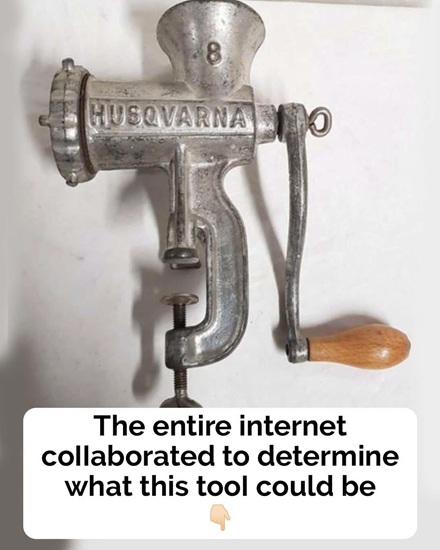
People across the internet came together to identify a mysterious object that left many puzzled.

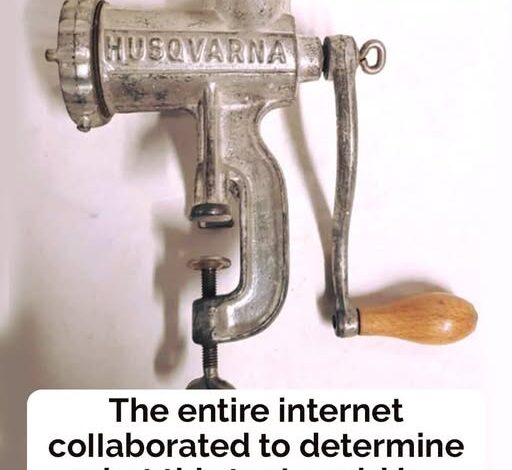
At first glance, it looked like a relic from another world.
Made of heavy metal and fitted with a hand crank, the strange device appeared in a photograph shared online, leaving thousands of people scratching their heads. Some guessed it was an antique machine part. Others thought it might be old farming equipment, a workshop tool, or even a forgotten industrial invention.
The theories poured in.
Yet the real answer turned out to be far simpler—and far more familiar.
The mysterious object was a traditional meat grinder, also known as a meat mincer, a kitchen tool that once played an essential role in households around the world.
For older generations, its purpose was instantly recognizable.
For many younger viewers, however, it was a fascinating glimpse into a time before electric appliances transformed everyday cooking.
Long before food processors and modern kitchen gadgets became common, preparing meals often required considerable manual effort. Families frequently purchased larger cuts of meat and processed them at home, making tools like the meat grinder indispensable.
Its design was remarkably straightforward.
Chunks of meat were placed into an opening at the top of the device. Turning the hand crank rotated an internal screw that pushed the meat forward toward a metal plate filled with small holes. As pressure increased, the meat was forced through the openings, emerging as finely ground strands ready for cooking.
Simple.
Efficient.
And surprisingly effective.
The invention gave home cooks far greater control over food preparation. They could choose the freshness of ingredients, adjust textures to suit recipes, and reduce waste by making use of cuts that might otherwise be difficult to prepare.
Although most people associate meat grinders with processing beef, pork, or poultry, their usefulness extended well beyond meat.
Depending on the model and available attachments, they could also handle fish, vegetables, fruits, nuts, and other ingredients. Home cooks often used them to prepare fillings, spreads, sauces, pâtés, and countless traditional family recipes.
Their versatility made them one of the most valuable tools in many kitchens.
The origins of mechanical meat grinders date back to the nineteenth century, a period marked by rapid innovation and industrial development. Inventors across Europe sought practical ways to simplify everyday tasks, and one of the early designs commonly linked to the meat grinder’s evolution is associated with German inventor Karl Drais.
While modern versions have changed significantly, those early inventions laid the foundation for a device that would become a household staple for generations.
During the nineteenth and early twentieth centuries, access to pre-packaged food was limited.
In many communities, purchasing ready-ground meat simply wasn’t an option.
Families often processed ingredients themselves, making kitchen tools not just convenient but necessary. The meat grinder reduced preparation time, improved efficiency, and allowed households to stretch ingredients further during periods when minimizing waste was especially important.
Many vintage grinders were built from cast iron or similarly durable metals.
Their construction reflected an era when products were designed to last.
Unlike many modern appliances, these machines contained few moving parts and could function for decades with proper care. Some examples passed from one generation to the next and remain operational more than a century after they were manufactured.
Collectors and cooking enthusiasts still restore antique grinders today, appreciating both their craftsmanship and historical significance.
One of the most recognizable features of traditional meat grinders was their clamp system.
The device attached securely to the edge of a table or countertop, preventing movement while the crank was being turned. This practical design allowed users to apply significant force without worrying about stability.
It was a simple solution that worked remarkably well.
As electricity became increasingly common in homes during the twentieth century, kitchen technology began evolving rapidly.
Manufacturers introduced electric meat grinders capable of performing the same tasks with greater speed and less physical effort. These machines transformed food preparation for households, butcher shops, restaurants, and commercial food producers.
Modern grinders can process large quantities of meat in minutes.
Many include interchangeable grinding plates that allow users to choose coarse, medium, or fine textures. Some models feature specialized attachments for making sausages, pasta, and other foods, expanding their capabilities far beyond the original designs.
Despite these technological improvements, the core principle remains virtually unchanged.
A mechanism pushes food through a perforated plate.
The result is controlled grinding and consistent texture.
The same basic idea that worked over a century ago still works today.
For many home cooks, meat grinders continue to offer advantages beyond convenience.
Grinding meat at home provides greater control over ingredients, freshness, fat content, and food quality. This level of transparency appeals to people who prefer preparing food from scratch and knowing exactly what goes into their meals.
The recent fascination with antique meat grinders highlights something larger about modern life.
As technology advances, once-common household objects gradually disappear from everyday experience. Tools that previous generations used routinely can seem mysterious to those encountering them for the first time.
This is where online communities have become surprisingly valuable.
Every day, historians, collectors, hobbyists, and curious users collaborate to identify forgotten objects and explain their purpose. Through shared knowledge, they help preserve pieces of everyday history that might otherwise be lost.
Antique kitchen tools are especially fascinating because they tell stories about how people once lived.
They reveal how meals were prepared.
How households functioned.
How practical challenges were solved before modern conveniences existed.
The meat grinder stands as a perfect example.
It wasn’t flashy.
It wasn’t revolutionary in appearance.
But it solved a real problem in a reliable and effective way.
Today, many vintage grinders serve as decorative collectibles, while others continue to function exactly as they did decades ago. Their durability, craftsmanship, and historical significance have made them popular among collectors and cooking enthusiasts alike.
What began as a simple hand-cranked device eventually evolved into the powerful electric appliances found in modern kitchens around the world.
Yet its essential design remains remarkably familiar.
The next time a strange object appears online and leaves thousands of people guessing, it may turn out to be another forgotten tool from everyday life.
And just like the humble meat grinder, its story may reveal far more about history, innovation, and human ingenuity than anyone first imagined.