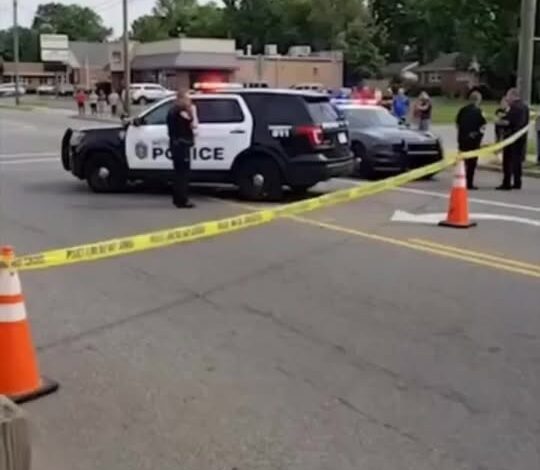
For years afterward, people would return to that night in conversation.
Not because they ever learned the full story.
But because they never did.
The barricades eventually disappeared. Police vehicles rolled away. Officers packed up equipment and withdrew from positions that had, for hours, transformed familiar streets into something unrecognizable. By morning, traffic resumed, businesses reopened, and the city slowly slipped back into its usual rhythm.
On the surface, life continued.
But something had changed.
The city felt the same.
And yet it didn’t.
Residents walked the same sidewalks, drove the same routes, and visited the same stores. Still, many found themselves paying attention in ways they never had before. They noticed exits. They scanned crowds. They measured distances to safety without realizing they were doing it.
Ordinary places suddenly seemed more fragile.
The illusion of permanence had been shaken.
In the days that followed, officials stepped forward with carefully crafted statements. Press conferences offered reassurance, emphasizing that the situation had been successfully managed and that the threat had been contained before greater harm could occur.
The operation had worked, they said.
The danger had passed.
The public was safe.
For many people, those explanations provided comfort.
But they did not provide closure.
Important details remained unclear. Questions lingered. The spaces between official statements became fertile ground for speculation, discussion, and quiet unease.
Conversations continued long after the headlines faded.
In living rooms, neighbors compared what they had seen.
In restaurants, coworkers exchanged theories.
In family group chats and late-night phone calls, people revisited the same unanswered questions again and again.
What really happened?
How close had the danger come?
What had authorities discovered that they weren’t saying?
No matter how many times the subject surfaced, complete answers never seemed to arrive.
Perhaps that uncertainty was what made the experience so unforgettable.
The night became more than a news event.
It became a personal marker in time.
A moment when many people realized how quickly normal life can be interrupted.
How thin the line can be between routine and crisis.
How easily the familiar can become uncertain.
Most days, people move through life assuming tomorrow will look much like today.
That night challenged that assumption.
Not dramatically.
Not permanently.
But enough.
Enough to leave a lasting impression.
Because sometimes the events that stay with us are not the ones that end with clear answers or dramatic conclusions.
Sometimes they are the moments that remind us how much we take for granted.
The quiet drive home.
The ordinary dinner.
The familiar voices in the next room.
The certainty that everyone we care about will still be there when morning comes.
For many, that became the lasting lesson of that night.
Not fear.
Not suspicion.
Not even the mystery itself.
But gratitude.
A deeper appreciation for ordinary moments that suddenly seemed less ordinary.
Years later, details would blur. Memories would soften. Stories would change slightly each time they were retold.
Yet one feeling would remain remarkably clear.
The quiet relief that came with sunrise.
The comfort of seeing familiar faces.
The realization that sometimes the greatest victory is not discovering every answer.
Sometimes it is simply waking up and finding that the people you love are still there.
And that life, fragile as it may be, has been given one more ordinary day.