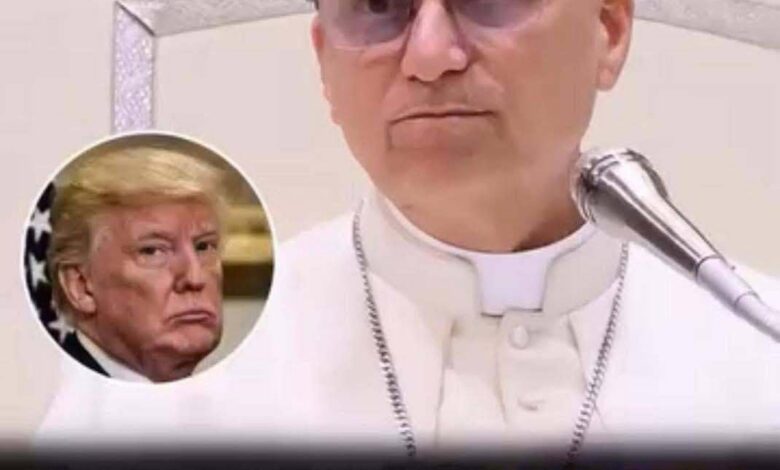
Pope Leo XIV’s One-Word Message to America Sparks Global Discussion
Just days after beginning his papacy, Pope Leo XIV found himself at the center of international attention because of a brief exchange that quickly spread across news outlets and social media platforms around the world.
During a meeting with journalists on May 12, a reporter asked the newly elected pontiff whether he had a message for the United States. The question seemed straightforward, but the response that followed immediately captured public interest.
The pope paused, smiled, and answered with a single word:
“Many.”
He then concluded with a simple blessing: “God bless you all.”
The moment lasted only a few seconds, yet it generated widespread discussion. Some observers viewed the response as thoughtful and deliberate, while others interpreted it as unusually loaded with meaning. The combination of the pause, the brief answer, and the pope’s decision not to elaborate left people searching for clues about what he intended to convey.
For some, the word suggested concern about challenges facing American society, including political polarization, social division, immigration debates, economic inequality, and the growing difficulty of constructive public dialogue. Others saw the remark differently, interpreting it as a reflection of hope, opportunity, responsibility, or the many blessings and possibilities that still exist within the nation.
The uncertainty surrounding the answer became part of its significance. Rather than offering a direct political statement or a carefully scripted response, Pope Leo XIV left room for reflection, allowing people to draw their own conclusions.
The exchange attracted even greater attention because of the pope’s unique background.
Born Robert Francis Prevost in Chicago, Pope Leo XIV became the first American-born pope in the history of the Catholic Church when he was elected on May 8, 2025. His election immediately created intense interest in how he would relate to the United States, a country that had never before produced a pope.
Unlike previous pontiffs who observed American affairs from abroad, Leo XIV brings both personal familiarity and institutional distance to discussions involving the United States. He understands the country’s culture and political landscape, yet his role now extends far beyond any national identity.
That combination makes even his shortest comments particularly significant.
Observers have also revisited his public statements from before his election. During his years of church leadership, Prevost frequently spoke about issues involving migrants, refugees, poverty, and the treatment of vulnerable populations. His views often reflected longstanding principles of Catholic social teaching, which emphasize human dignity, compassion, solidarity, and care for those on the margins of society.
At the same time, analysts note that Pope Leo XIV has not positioned himself as a figure easily aligned with any single political movement. While some critics have focused on his comments regarding immigration policies, others point out that his positions emerge primarily from religious and moral principles rather than partisan loyalties.
His approach reflects a broader tradition within Catholic teaching that can challenge assumptions across the political spectrum. Themes such as economic justice, the dignity of work, the protection of human life, care for migrants, peacebuilding, and social responsibility often resist simple classification within modern political debates.
That reality may explain why his one-word answer resonated so strongly.
The response offered neither endorsement nor criticism. It avoided slogans, partisan framing, and immediate controversy. Instead, it suggested that the relationship between the papacy and the United States cannot be reduced to a single statement or political headline.
The pope’s choice of name has also shaped early interpretations of his priorities.
By selecting the name Leo XIV, he invited comparisons to Pope Leo XIII, one of the most influential figures in modern Catholic social teaching. Leo XIII is remembered for addressing issues of labor rights, economic justice, workers’ dignity, and the responsibilities of society toward ordinary people during periods of rapid social change.
Many Vatican observers believe the choice signals a desire to engage modern challenges through a framework of moral responsibility, human dignity, and social solidarity rather than ideological conflict.
His early public addresses appear to support that interpretation.
Rather than focusing on partisan disputes, Pope Leo XIV has repeatedly emphasized peace, dialogue, reconciliation, and the importance of building bridges between divided communities. Speaking to members of the media shortly after his election, he called for communication that promotes understanding rather than hostility and encourages truth rather than resentment or hatred.
Those themes have become recurring elements of his early papacy.
Yet the reaction to his brief message demonstrates the challenges he faces. In an era of intense political polarization, even the simplest remarks can become subjects of extensive debate. Every gesture, pause, and phrase from the first American pope is likely to be examined through political, cultural, and ideological lenses.
Supporters will look for moral guidance. Critics will search for hidden agendas. Commentators will attempt to place his words within existing political narratives.
Pope Leo XIV appears aware of that reality.
His response suggested a willingness to resist easy categorization and avoid becoming trapped within partisan frameworks. Rather than offering a statement tailored to a particular audience, he chose brevity, allowing the message to remain open-ended while maintaining its significance.
In many ways, the viral moment may reveal more about public expectations than about the pope himself. People often seek clear declarations and immediate answers from influential figures, particularly when political tensions are high. Yet spiritual leadership frequently operates differently, encouraging reflection rather than reaction.
For now, the exchange remains one of the defining moments of Pope Leo XIV’s first days as pontiff.
He did not offer America a lecture.
He did not deliver a political warning.
He did not provide a carefully crafted slogan.
Instead, he suggested that there was much to say—perhaps more than could be expressed in a passing exchange—and then offered a blessing.
As his papacy continues to unfold, that combination of restraint, reflection, and measured communication may become one of its defining characteristics. The United States asked for a message. Pope Leo XIV answered that there were many.
What those messages ultimately are may become clearer not through a single viral moment, but through the choices, priorities, and moral vision that shape his years as leader of the Catholic Church.