Sometimes the most powerful statement is a single word spoken slowly enough that everyone hears their own conscience inside it.
“Many.”
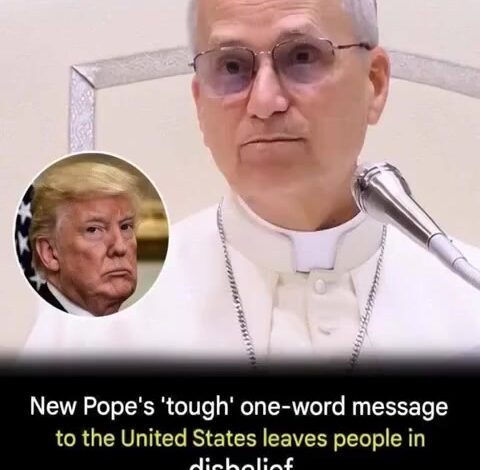
That was all Pope Leo XIV said when asked what message he had for the United States.
No lecture.
No policy speech.
No carefully outlined Vatican declaration.
Just one word.
And somehow, in its brevity, it landed heavier than paragraphs ever could.
Perhaps because ambiguity invites revelation. When people hear an open-ended statement from a figure carrying enormous symbolic authority, they instinctively rush to complete the meaning themselves. In doing so, they often expose more about their fears and loyalties than about the speaker’s intention.
That is exactly what happened after Leo’s remark.
Within hours, commentators across the political spectrum transformed the single word into competing narratives. Some heard warning. Others heard blessing. Some called it diplomatic restraint. Others called it veiled criticism sharpened deliberately through understatement.
And maybe all of them were hearing fragments of themselves reflected back.
Pope Leo XIV occupies an unusually complicated symbolic position already.
A Chicago-born pontiff shaped partly by American culture yet formed spiritually through global Catholic tradition, he stands at the intersection of two very different moral imaginations. America often frames power through individuality, momentum, competition, and national exceptionalism. The Catholic tradition, by contrast, frequently emphasizes universality, humility, suffering, obligation, and moral accountability beyond borders.
Inside Leo, those worlds coexist.
That tension makes every public word feel loaded before he even speaks.
Especially now.
Especially to Americans hungry to know whether one of their own views the nation with pride, disappointment, caution, or hope.
So when Leo answered “many,” people immediately began filling the silence surrounding the word.
Many blessings.
Many divisions.
Many sins.
Many responsibilities ignored too long.
Many people suffering unseen beneath political spectacle.
The word sounded strangely like both prayer and verdict simultaneously.
That duality unsettled people.
Because Americans increasingly prefer clarity from public figures:
tell us which side you’re on,
name the enemy,
confirm our moral certainty.
But Leo refused the simplicity modern political culture demands.
His critics interpreted the remark as quiet condemnation of American contradictions:
immigration crackdowns defended alongside Christian language,
economic abundance existing beside crushing inequality,
public declarations of faith paired with political cruelty or indifference toward vulnerable people.
To them, “many” carried disappointment.
A pope acknowledging a nation powerful enough to influence the world yet still unable — or unwilling — to reconcile its ideals with its behavior consistently.
Others heard something entirely different.
Not condemnation.
Restraint.
A pastor resisting the pressure to become another ideological mascot in an already exhausted political landscape. Supporters praised Leo for refusing immediate alignment with either American faction, insisting implicitly that the Gospel stands above partisan categories altogether.
That interpretation matters too.
Because throughout modern history, religious figures capable of transcending tribal loyalty often frustrate everyone equally. The moment a spiritual leader critiques only one side predictably, they risk becoming politically useful rather than morally challenging.
Leo seemed unwilling to surrender to that role.
Instead, his answer functioned almost like a mirror.
People projected onto it instinctively:
their anxieties,
their hopes,
their suspicion,
their longing for moral clarity.
And perhaps that was intentional.
After all, Catholic tradition has long understood the spiritual power of silence and restraint in ways modern media culture struggles to tolerate. Contemporary discourse rewards speed, certainty, and maximal visibility. Every issue demands immediate commentary. Every silence gets interpreted as weakness or evasion.
But spiritual authority often operates differently.
Sometimes saying less forces deeper listening.
Christ himself frequently answered direct questions obliquely:
through parables,
through questions,
through unsettling ambiguity that required listeners to examine themselves instead of merely consuming conclusions passively.
Leo’s single word carried traces of that older tradition.
Not because it solved anything.
Because it interrupted certainty.
And interruption matters in cultures drowning in noise.
America, especially, exists inside near-constant commentary about itself:
its decline,
its greatness,
its divisions,
its responsibilities,
its hypocrisies.
Every institution competes to define what the country “really” is. Politicians narrate America through ideology. Media narrates it through outrage cycles. Citizens increasingly sort one another into moral camps rigid enough that disagreement begins resembling existential threat.
Against that backdrop, Leo’s “many” felt disorientingly spacious.
Too spacious for people comfortable with binaries.
Was he blessing America?
Warning it?
Mourning it?
Praying for it?
The answer may be all of those simultaneously.
Because nations, like people, contain contradictions large enough to hold grace and failure at once.
America inspires genuine hope globally while also exporting immense suffering through power exercised carelessly.
It shelters millions seeking freedom while struggling repeatedly to welcome newcomers compassionately.
It speaks passionately about faith while often confusing religious identity with political identity.
A serious moral observer would struggle reducing such complexity into simple praise or condemnation honestly.
Leo seemed unwilling to pretend otherwise.
That refusal may explain why reactions to his remark became so emotionally charged so quickly.
People did not merely analyze the word.
They inhabited it.
Some heard accusation because guilt already lived close beneath the surface.
Others heard mercy because exhaustion made them desperate for reassurance.
Still others heard wisdom precisely because the statement resisted becoming propaganda for anyone.
In that sense, the real story was never the word itself.
It was the national reaction surrounding it.
How quickly Americans demanded interpretation.
How intensely they searched for confirmation.
How revealingly they exposed their own spiritual and political wounds while arguing about what Leo “must have meant.”
Maybe the pope understood that from the beginning.
A man elevated to global spiritual leadership inevitably recognizes that language functions symbolically as much as literally. One carefully placed ambiguity can reveal a culture’s anxieties more effectively than direct accusation ever could.
And perhaps Leo knows something else too:
a pope cannot repair America.
He cannot legislate compassion.
Cannot erase polarization.
Cannot force institutions toward justice or citizens toward humility.
But he can hold up a mirror.
He can interrupt certainty long enough for people to confront themselves honestly inside the silence.
That may be what “many” ultimately accomplished.
Not resolution.
Reflection.
A reminder that nations, like souls, are too morally complicated for slogans alone.
And that sometimes the wisest response to a country asking what you think of it is not a speech at all —
but a single word spacious enough to contain blessing, grief, warning, hope, and judgment simultaneously.
Many.
Enough meaning for everyone to hear something different.
Enough restraint to leave the real answer unfinished.
Perhaps intentionally so.