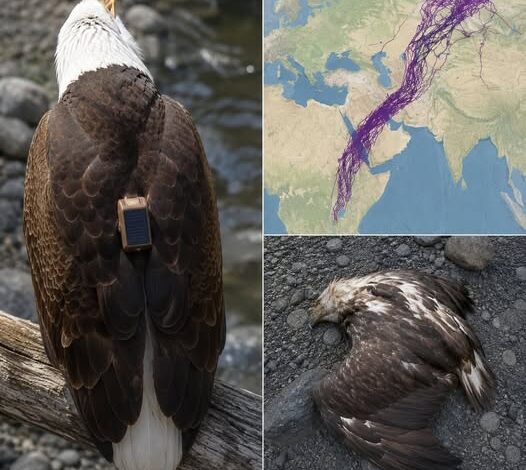
At first glance, the eagle’s GPS trail looked like a mistake.
The line zigzagged across maps with no obvious logic. It doubled back on itself. It veered unexpectedly. It wandered away from what researchers assumed would be the most efficient route, only to return later from a completely different direction. To the scientists tracking its movements, the pattern appeared chaotic—almost as if the bird couldn’t decide where it wanted to go.
For months, they struggled to make sense of it.
Migration models favored efficiency. Animals, they believed, should conserve energy by following relatively direct paths whenever possible. Yet this eagle seemed determined to ignore those expectations. Every new data point added another layer of confusion.
The bird wasn’t behaving the way the models predicted.
And that bothered the people who built those models.
But then something changed.
Instead of studying the GPS trail in isolation, researchers began layering it against other data sets.
Weather systems.
Wind patterns.
Thermal updrafts.
Mountain ranges.
Air pressure.
Storm movement.
Ocean currents.
Suddenly, what had looked like disorder began to reveal a hidden structure.
The eagle wasn’t lost.
Far from it.
In fact, it appeared to know exactly what it was doing.
The seemingly random turns that had puzzled scientists aligned almost perfectly with rising columns of warm air. What looked like unnecessary detours corresponded with powerful wind currents capable of carrying the bird for miles while conserving precious energy. Apparent delays matched incoming storms, allowing the eagle to wait in safer locations rather than battle dangerous weather.
The bird had not been wandering.
It had been reading a map.
Just not a map humans could easily see.
Where people saw empty sky, the eagle saw information.
Invisible highways stretched across landscapes and oceans. Rivers of moving air twisted between mountains. Thermal elevators rose from sun-warmed earth. Weather systems opened and closed pathways like shifting gates.
The eagle navigated them all.
Every movement suddenly made sense.
Every correction had a purpose.
Every deviation served a goal.
The GPS trail that once looked chaotic now appeared remarkably sophisticated.
What researchers had mistaken for uncertainty was actually adaptation.
What looked inefficient was often the most efficient choice available.
What seemed random was deeply informed.
The revelation was both exciting and humbling.
For years, scientists had attempted to understand migration through simplified models. Those models often assumed fixed routes, predictable behaviors, and straightforward calculations of distance and energy expenditure.
The eagle had quietly exposed the limitations of those assumptions.
Its journey wasn’t based on rigid rules.
It was based on constant awareness.
Every day brought new conditions.
New risks.
New opportunities.
The bird responded accordingly.
Rather than following a predetermined path, it engaged in an ongoing conversation with the environment around it.
A sudden shift in wind direction.
A developing storm front.
An emerging thermal current.
Each factor became part of a larger decision-making process.
The migration was not a straight line.
It was a negotiation.
A living, breathing series of choices made in real time.
The eagle balanced risk against reward.
Energy against opportunity.
Speed against safety.
And it did so with a level of precision that researchers had initially failed to recognize.
That realization transformed the way many scientists viewed the data.
The story was no longer about where the eagle traveled.
It was about how it thought.
Not in a human sense, of course, but in a way that reflected millions of years of evolutionary refinement. The bird carried within it an extraordinary ability to interpret environmental signals and respond with remarkable flexibility.
Its intelligence was not abstract.
It was practical.
Immediate.
Embodied.
The kind of intelligence that allows survival in a world that never stays the same for long.
For the researchers, the lesson extended beyond ornithology.
The eagle had revealed something about the limitations of human certainty.
People often seek neat explanations.
Predictable patterns.
Clean lines on maps.
We are comfortable with systems that appear orderly and easy to understand.
Nature rarely shares that preference.
The natural world is fluid.
Dynamic.
Complex.
Its wisdom often hides inside patterns too subtle, too intricate, or too vast for immediate observation.
The eagle’s journey became a reminder that complexity is not the same as confusion.
What appears chaotic from a distance may contain extraordinary order when viewed from the proper perspective.
The bird never needed the scientists’ approval.
It never cared whether its route matched their expectations.
It simply followed the conditions that mattered.
And in doing so, it revealed a truth larger than migration itself.
The world contains forms of intelligence that cannot always be measured by human standards.
Knowledge exists beyond our models.
Understanding exists beyond our assumptions.
And sometimes the greatest discoveries happen not when nature confirms what we believe—but when it quietly proves us wrong.
In the end, the GPS trail that once frustrated researchers became something else entirely.
A lesson.
A challenge.
A glimpse into a deeper language written in wind, weather, instinct, and survival.
The scientists had searched for straight lines.
The eagle answered with nuance.
They expected certainty.
The bird offered adaptability.
They looked for a fixed path.
The eagle revealed a living one.
And somewhere high above mountains, oceans, deserts, and storms, it continued its journey—following invisible currents through a world far richer and more complicated than any map could fully capture.
Its flight became more than a migration.
It became a testament to nature’s quiet brilliance.
A reminder that some of the most sophisticated intelligence on Earth does not announce itself.
It simply soars above us, unseen, reading a landscape we are only beginning to understand.