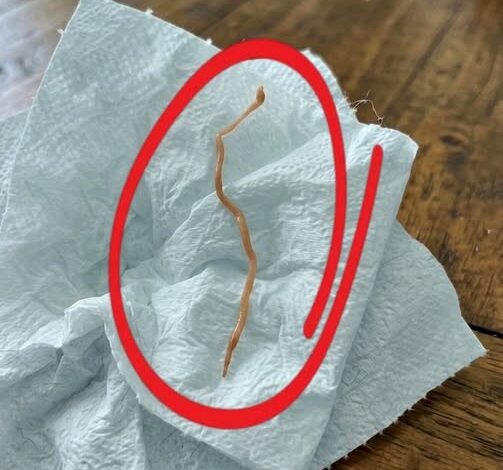
The moment I saw it curl slightly in the pan, my stomach dropped.
Thin.
Pale.
String-like.
For one horrifying second, my brain stopped processing dinner and started processing danger.
I froze with the spatula still in my hand while oil hissed softly around the chicken breast. Steam rose toward the kitchen light, carrying the familiar smell of garlic and butter, but suddenly none of it felt comforting anymore. The entire meal transformed instantly from ordinary to contaminated in my mind.
Because once fear enters a room, imagination rushes in behind it.
I leaned closer carefully.
The thing protruding from the meat looked disturbingly alive at first glance — a tiny white strand tightening as the chicken cooked. Every terrible possibility arrived at once:
parasites,
worms,
spoiled meat,
some hidden contamination I had somehow missed despite buying the package from the same grocery store I trusted every week.
My appetite vanished immediately.
So did logic, briefly.
That’s the strange power disgust holds over human beings. Rationality collapses astonishingly fast once the brain suspects contamination. Evolution trained us that way deliberately. Better to panic unnecessarily than consume something dangerous. Fear around food helped keep humans alive long before expiration dates and refrigeration existed.
Still, standing there in my kitchen staring at that pale string embedded in the chicken, I could feel my thoughts spiraling far beyond reason.
Had the whole package been infected?
Had I already eaten pieces from the same batch earlier in the week?
What if microscopic parasites survived cooking somehow?
What if I got sick?
What if I gave it to someone else without noticing?
The mind builds monsters quickly once uncertainty appears.
I turned the stove off completely.
Then I did what almost everyone does now when fear outruns certainty:
I searched the internet.
That was both helpful and catastrophic.
Images appeared instantly.
Forums.
Warnings.
Medical horror stories.
Confident strangers insisting every strange texture in meat signaled imminent disaster.
But mixed among the panic were calmer explanations too.
“Tendon.”
“Connective tissue.”
“Normal in chicken breast.”
I looked back at the pan unconvinced.
Because emotionally, “normal” felt impossible in that moment.
The strand looked too unsettling.
Too biological.
Too close to something alive.
Yet once the initial panic softened enough for me to examine it carefully, another reality slowly emerged. The “worm” wasn’t moving independently at all. It stayed anchored exactly where muscle naturally connects. As the meat cooked further, the strand tightened and became even more visible against the white flesh surrounding it.
That was when recognition finally replaced fear.
It wasn’t a parasite.
It was tendon.
Simple connective tissue — the fibrous material helping muscles attach and function — now exposed because heat had caused the meat to contract around it.
Ordinary.
Harmless.
Common.
I stared at it for a long moment feeling equal parts relieved and embarrassed.
Not because the fear itself was irrational. Most people react strongly when confronted suddenly with unfamiliar textures in food. But because my mind had transformed something biologically mundane into catastrophe almost instantly.
And even after understanding the truth intellectually, disgust lingered stubbornly anyway.
That surprised me.
Because facts do not always calm emotion immediately.
Knowing the strand was harmless didn’t magically restore appetite. The chicken still looked unsettling now that I’d examined it so closely. Once something familiar becomes strange under scrutiny, it rarely returns fully to innocence again.
I ended up making toast instead.
Not dramatic.
Not proud.
Just honest.
And while eating dry buttered toast at my kitchen counter later that evening, I kept thinking about how quickly my brain filled uncertainty with monsters.
That realization stayed with me longer than the ruined dinner itself.
Because the kitchen incident suddenly felt strangely connected to larger patterns in human life.
How often do we encounter something unfamiliar and immediately assume danger?
How many fears begin exactly this way — with incomplete information and imagination racing ahead to protect us before reality catches up?
A text message unanswered too long becomes rejection.
A medical symptom becomes catastrophe after midnight internet searches.
Someone’s silence becomes anger.
A misunderstanding becomes betrayal.
The human mind hates ambiguity.
So it narrates.
Quickly.
Protectively.
Sometimes inaccurately.
Evolution built brains designed to detect threats, not necessarily to interpret situations fairly. That instinct kept ancestors alive against predators and poison. But in modern life, those same survival systems often misfire against uncertainty itself.
A strange shape in food.
A look on someone’s face.
A headline.
A silence.
And suddenly fear writes entire stories before evidence arrives.
Standing in my kitchen earlier, I truly believed I was looking at something dangerous because my brain prioritized emotional reaction over observation initially. Only after slowing down — after examining carefully instead of panicking immediately — did reality become visible again.
Not a parasite.
Just anatomy.
Something entirely ordinary viewed up close for the first time.
There’s something strangely humbling about moments like that.
They remind us how partial our perception really is. How quickly we mistake unfamiliarity for danger. How easily fear expands into certainty when left unchecked.
And perhaps that’s why the experience lingered emotionally after the panic faded.
Not because of the chicken itself.
Because the little white tendon became symbolic somehow.
Proof that many terrifying things lose power once examined carefully enough.
Proof that disgust and truth are not always the same thing.
Proof that minds create monsters fastest in spaces where understanding has not arrived yet.
Of course, some fears are justified.
Some dangers are real.
But not all unsettling discoveries signal catastrophe.
Sometimes the horrifying thing in the pan is simply connective tissue doing exactly what connective tissue has always done — holding life together quietly beneath the surface until heat exposes it.
And sometimes the thing we fear most is not danger itself.
It is the uncomfortable moment of seeing ordinary reality clearly enough to realize how much our imagination added on its own.