My Stepfather Raised Five Children Who Weren’t His – After His Funeral, We Each Received a Letter That Was Never Meant for the Others to See

Some people spend their entire lives terrified that love can disappear overnight.
A parent leaves.
A promise breaks.
A phone stops ringing.
And from that moment forward, part of them quietly waits for abandonment to happen again.
Thomas understood that fear better than most.
Maybe that is why he built his entire life around fighting it in other people.
Not through speeches.
Not through dramatic declarations.
Through lunchbox notes.
Porch lights.
Adoption papers.
Burned pancakes on Saturday mornings.
Library books about braiding hair.
The kind of ordinary devotion that slowly teaches wounded children:
you are staying here,
and so am I.
That is what makes the story of Thomas and his children so heartbreaking.
Not because he died.
Because he died carrying a misunderstanding that stole years from one of the people he loved most.
And perhaps even more tragic:
he let himself believe silence was kinder than risking another painful conversation.
The funeral itself already carried the emotional weight of unfinished things.
Rain at funerals always feels symbolic even when it is not. The soaked cemetery grass, black umbrellas, shoes sinking into mud — all of it creates the strange sense that the world itself is mourning alongside the people gathered there.
But what lingers most in the beginning is not the rain.
It is the memory of who Thomas actually was.
The man who called roof leaks “temporary indoor water features.”
The father who gave a five-year-old girl a damaged teddy bear because he sensed she would understand broken things needing love.
The stepfather who looked at a grieving child after her mother died and simply said:
“She’s my daughter.”
That sentence matters because it reveals everything essential about him immediately.
Thomas did not seem interested in technical definitions of family.
Blood meant very little to him compared to presence.
And in many ways, that belief shaped the entire household he eventually built.
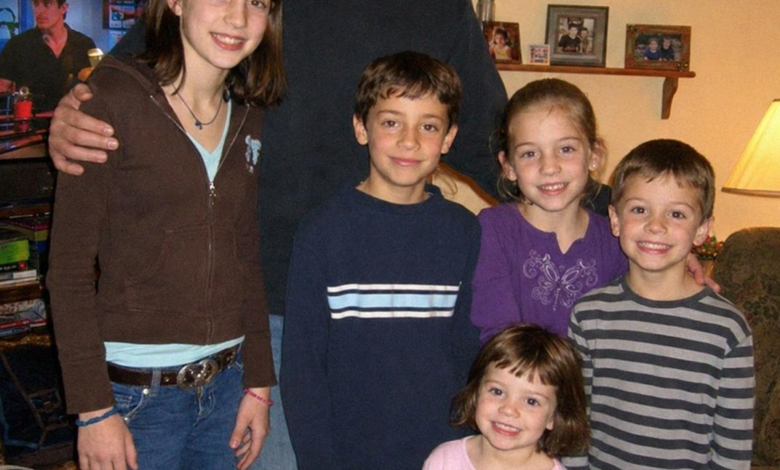
Five children.
Different beginnings.
Different histories.
Different wounds.
One home.
That kind of parenting requires something deeper than generosity.
It requires emotional courage.
Because children coming from abandonment, grief, foster systems, or instability often arrive carrying invisible tests:
Will you still want me when I’m difficult?
Will you leave too?
Am I temporary here?
Thomas answered those questions repeatedly not through words alone, but through consistency.
And consistency is what children trust most.
Which makes Susan’s disappearance two years before his death feel emotionally devastating for everyone involved.
Not only because she left.
Because Thomas never stopped waiting for her.
The porch light detail becomes almost unbearably painful afterward.
“Leave the porch light on, Pumpkin. Just in case.”
That line transforms into the emotional center of the entire story because it reveals the shape of Thomas’s hope even near the end of his life.
He did not want revenge.
Did not demand apology.
Did not speak bitterly.
He simply kept the light on.
People who truly love deeply often continue preparing emotional space for someone long after logic says they should stop.
And perhaps no one understood the damage Susan’s departure caused more clearly than the siblings who stayed behind.
Michael and Mara especially carried visible resentment at the funeral because from their perspective, they watched Thomas suffer silently for years while Susan disappeared.
They remembered:
the unanswered calls,
birthday cards,
the porch light glowing every night,
their father pretending hope had not exhausted him yet.
To them, loyalty looked simple:
you stay for the people who raised you.
But grief becomes dangerous when people only understand each other through partial stories.
And Susan had been living inside an entirely different emotional reality.
“You don’t know Thomas the way I do.”
That sentence sounds cruel initially.
Accusatory.
Almost unfair.
Until the truth arrives.
Then suddenly everything changes shape.
Because Susan had spent two years believing Thomas was not her rescuer, but the man who abandoned her mother.
That misunderstanding alone could destroy a young person emotionally.
Imagine finding a hidden photograph connecting your adoptive father to your dead mother.
Imagine being eighteen already carrying all the volatility and emotional absolutism of that age.
Imagine believing the person who raised you had concealed some devastating betrayal your entire life.
And then imagine confronting him — only to leave before hearing the full explanation.
That is the cruel thing about emotionally charged misunderstandings.
Once pain hardens into certainty, people stop listening halfway through conversations.
Susan thought she was protecting herself from a lie.
Thomas thought giving her space might eventually bring her back.
Between those two fears, years disappeared.
And perhaps the most heartbreaking detail in the entire story is this:
Thomas actually tried to explain.
He simply lost courage after failing the first time.
That psychological detail feels painfully human.
Because people often imagine devastating family fractures happen through cruelty alone.
But sometimes they happen through hesitation,
fear,
bad timing,
and conversations abandoned too early.
Thomas was not hiding monstrous behavior.
He was carrying grief and shame connected to his younger sister Elise.
Elise had run away young.
Vanished for years.
Then finally reached out needing help.
By the time Thomas found her, she was already gone.
Only Noah and Susan remained.
And Thomas did what he always seemed to do with abandoned children:
he brought them home.
That revelation changes Susan’s story completely.
The man she believed abandoned her mother was actually the man who returned afterward to rescue her children.
Not father.
Uncle.
Not betrayer.
Caretaker.
The emotional collapse she experiences under the oak tree afterward feels inevitable because her entire understanding of her own history shatters at once.
“I made a terrible mistake, Christie.”
That line carries the full weight of irreversible time.
Because once someone dies, clarification becomes permanent grief.
Susan cannot call Thomas afterward.
Cannot hear him explain it in person.
Cannot apologize face-to-face.
She is left only with letters,
memories,
and the unbearable realization that he spent years loving her while she believed he had betrayed her.
Meanwhile, Thomas spent those same years carrying the truth silently because he no longer knew how to bridge the distance between them.
“He lost his courage at exactly the wrong time.”
That sentence may be the most quietly devastating observation in the entire story.
Because so many families break apart not from lack of love, but from fear surrounding difficult conversations.
One person delays explaining.
Another stops asking.
Pride hardens.
Assumptions calcify.
Time passes.
Then suddenly years are gone.
What saves this story emotionally is that Thomas built something stronger than biology before he died:
a family culture rooted in return.
Notice what happens after the truth emerges.
Noah does not let Susan walk away again.
Christina wraps her arms around her before judgment.
Michael uses humor because grief overwhelms him otherwise.
Mara cries instead of attacking.
Even wounded, they instinctively move toward reunion rather than permanent division.
That instinct did not happen accidentally.
Thomas taught them that home remains available even after mistakes.
Especially after mistakes.
The return to the house becomes emotionally powerful for exactly that reason.
The porch light still glowing.
The smell of coffee and cedar.
The cinnamon mints in jacket pockets.
Photo albums.
Old jokes.
Christmas pajamas bought on clearance and falsely advertised as “designer.”
These details matter because grief attaches itself to ordinary objects first.
Death rarely feels real through funeral speeches.
It feels real through:
unused mugs,
familiar smells,
empty chairs,
a coat still hanging near the door.
And yet inside all that grief, something healing begins happening too.
Susan finally stops defending herself.
The others stop seeing her only as the sibling who left.
The truth creates room for compassion where resentment once lived.
That emotional shift reflects something important about families generally:
understanding changes people faster than punishment often does.
Once they understood why Susan ran, anger softened into sorrow instead.
And perhaps the final cemetery scene captures Thomas’s legacy most beautifully.
Not the funeral.
Not the letters.
The lantern.
A small warm light beside his grave mirroring the porch light he left on for years.
That image transforms the entire story into something larger than one family misunderstanding.
The porch light becomes symbolic of unconditional belonging itself.
Thomas spent his life telling abandoned children:
home is not something you earn by behaving perfectly.
It is not revoked the moment you fail.
It does not disappear because you got angry,
ran away,
or misunderstood someone you loved.
Home stays lit for you.
And perhaps that is why the ending feels so emotionally satisfying despite the grief.
Because Susan does come back.
Too late for conversation.
Too late for repair in the ordinary sense.
But not too late for belonging.
That distinction matters deeply.
People often assume reconciliation only counts if every wound gets fully resolved face-to-face.
But sometimes healing begins simply through returning honestly after years of distance.
By the final walk away from the cemetery, the siblings move “like siblings.”
That line feels earned because siblinghood in this story was never about shared DNA anyway.
It was built through shared shelter,
shared pain,
shared dinners,
shared survival,
and one stubborn man who kept leaving the porch light on no matter how long someone stayed away.
In the end, Thomas’s greatest legacy was not adoption papers or even the home itself.
It was the emotional safety he built around children who once believed they were temporary.
He taught them something many people spend their whole lives trying to learn:
love is not proven by blood.
It is proven by who stays.