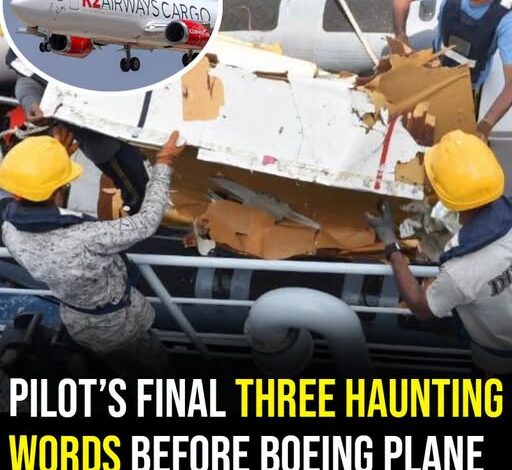
The night sky above the Arabian Sea offered no warning. What began as another routine cargo flight soon became a mystery that would haunt investigators, aviation experts, and the families waiting for five men who never came home. Within minutes, a normal journey transformed into a desperate struggle inside the cockpit, ending in silence so complete that even experienced air traffic controllers were left searching their radar screens for answers.
The Boeing 737 had departed on what should have been an uneventful overnight cargo mission. The aircraft was carrying freight rather than passengers, and the experienced crew had flown similar routes many times before. Weather conditions were not initially considered extreme, and communications with air traffic control were calm and professional as the aircraft settled into its planned course over the dark waters below.
Then something changed.
The first indication of trouble sounded surprisingly ordinary. The pilots reported a problem involving the aircraft’s navigation system. It was the kind of technical issue that crews train to manage and one that, by itself, would not normally suggest an impending disaster. Controllers acknowledged the transmission, expecting further updates as the crew worked through checklists designed for exactly these situations.
Those updates never came.
Instead, radar operators noticed behavior that immediately raised concern. The aircraft no longer appeared to be maintaining a stable flight path. Rather than cruising smoothly at altitude, it began losing height at an alarming rate. Witnesses later described the radar data as showing an airplane that seemed to roll or drift unnaturally, almost as if it were no longer responding normally to control inputs.
Inside the cockpit, what had started as a manageable technical problem may have escalated into a life-threatening emergency within seconds.
Modern commercial aircraft are designed with multiple backup systems and extensive safeguards, allowing crews to continue flying even when individual components fail. Yet aviation history has repeatedly shown that rare combinations of failures—or a single catastrophic malfunction affecting critical systems—can overwhelm even highly trained pilots. In those moments, every second matters, every decision carries enormous weight, and the margin for recovery shrinks rapidly.
As the Boeing continued descending, controllers watched helplessly.
Thousands of feet disappeared from the altitude readout in an astonishingly short period of time. The airplane’s movements no longer resembled a controlled descent. Something was profoundly wrong.
Then, without warning, the radar target vanished.
No final distress call followed.
No urgent mayday.
No last transmission explaining what had happened inside the cockpit.
Only silence.
For the controllers monitoring the flight, that silence spoke louder than words ever could. Losing radar contact over open water immediately triggered emergency procedures. Communication attempts intensified, nearby aircraft were alerted, and search-and-rescue teams began preparing for the possibility that the cargo jet had gone down somewhere in the vast darkness of the Arabian Sea.
The search that followed became a race against both time and nature.
Ships, aircraft, and rescue crews spread across the suspected impact area, scanning enormous stretches of ocean illuminated only by searchlights and dawn’s first light. Every floating object demanded investigation. Every radar calculation was reviewed again and again in hopes of narrowing the search zone.
Hours passed without answers.
Nearly twelve hours after the aircraft disappeared, search teams finally located pieces of wreckage floating on the water’s surface. Fragments of the aircraft, damaged cargo, and scattered debris confirmed the worst fears: the Boeing had crashed into the sea.
Yet the discovery answered only one question while creating many more.
The largest sections of the aircraft remained missing beneath the ocean. The main fuselage had not yet been located, and with it were the five crew members who had been aboard when the aircraft vanished from radar. Families waiting desperately for news were forced to endure agonizing uncertainty as rescue operations gradually shifted toward recovery efforts.
For loved ones, every passing hour became heavier than the last.
Instead of welcoming fathers, sons, brothers, or colleagues home after another completed assignment, families found themselves clinging to hope while officials searched waters that concealed both the aircraft and the truth. Behind every headline stood five individual lives, each with unfinished plans, conversations left unsaid, and people whose futures changed forever the moment the aircraft disappeared.
Meanwhile, investigators began assembling the puzzle piece by piece.
Every recovered fragment was carefully cataloged and examined for clues. Damage patterns on the wreckage could help determine whether structural failure occurred before impact or resulted from striking the water. Maintenance records, crew training histories, weather data, radar information, and communications with air traffic control all became part of an exhaustive investigation intended to reconstruct the flight’s final minutes.
Particular attention centered on the crew’s initial report of a navigation system problem.
Investigators sought to determine whether the reported malfunction was directly connected to the loss of control or whether it simply happened to be the first visible symptom of a much larger failure. Specialists also examined the possibility of mechanical defects, flight-control malfunctions, electrical problems, instrument failures, or other rare combinations of events that might explain the aircraft’s sudden and dramatic descent.
The eventual recovery of the flight data recorder and cockpit voice recorder—if located—would likely become the investigation’s most valuable evidence.
Often referred to as the aircraft’s “black boxes,” these devices can preserve crucial information about system performance, pilot actions, warning messages, and cockpit conversations during an emergency. Together, they frequently provide investigators with the clearest picture of what unfolded when everything else remains uncertain.
Until then, many questions remain unanswered.
What transformed a manageable technical issue into a catastrophic emergency? Why did the aircraft lose altitude so rapidly? Why was there no opportunity for a final distress call? Was the crew fighting a failure they could not overcome, or did events unfold too quickly for any response to succeed?
For now, the Boeing’s final moments remain hidden beneath the waters where it disappeared.
As investigators continue examining every recovered fragment and every available piece of data, one goal remains above all others: discovering exactly what happened and ensuring that whatever caused this tragedy is fully understood. Each answer has the potential to improve aviation safety, preventing future crews from facing the same fate.
Until that day comes, the story remains one of profound loss.
Five aviation professionals left expecting to complete another routine flight. Instead, they became part of one of aviation’s unresolved mysteries, remembered not only for the questions surrounding their final journey, but for the lives they lived before that silent descent into the darkness over the Arabian Sea.