At first, it looks harmless.
Just five tiny dots.
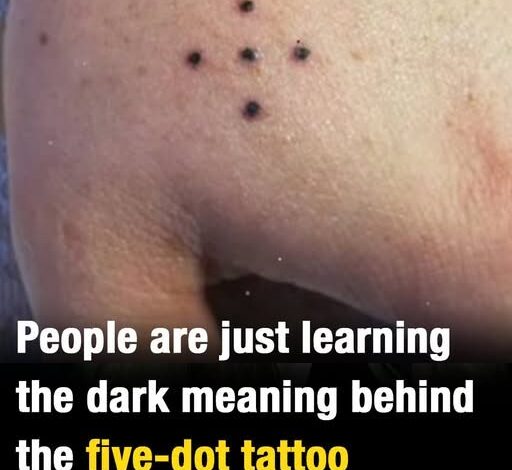
Nothing flashy. Nothing dramatic. A simple pattern—four dots surrounding a single dot in the center, arranged exactly like the number five on a pair of dice.
Most people wouldn’t think twice about it.
You might notice it on someone’s hand while standing in line at a grocery store. You might spot it on a stranger’s thumb while they reach for a coffee cup. You might even see it tattooed between the thumb and index finger, small enough to go unnoticed unless you’re looking closely.
To the average person, it appears to be just another minimalist tattoo.
But according to tattoo artists, historians, and people familiar with prison culture, those five tiny dots can carry a message far darker than most realize.
And for decades, that message has been understood in prisons around the world.
The Hidden Language of Tattoos
Tattoos have always been more than decoration.
Long before tattoo studios existed, people were marking their bodies with symbols that carried meaning, identity, and history.
Archaeologists have discovered tattooed remains dating back thousands of years. Evidence of ancient tattooing has been found on mummies and preserved human remains across Asia, Europe, Africa, and the Pacific Islands. In many cultures, tattoos served as rites of passage, spiritual protection, indicators of social status, or symbols of belonging.
For centuries, a tattoo could tell an entire story without a single word being spoken.
Even today, body art continues to serve that purpose.
Some tattoos commemorate loved ones.
Others celebrate personal achievements.
Some symbolize religious faith, cultural heritage, military service, or important life experiences.
But not every tattoo carries an obvious meaning.
In fact, some symbols have histories hidden beneath the surface—histories that many people never learn until it’s too late.
One of the most discussed examples in recent years is the five-dot tattoo.
The Symbol That Sparked Online Curiosity
The conversation exploded online after a Reddit user posted a simple question.
He had recently moved into a new neighborhood and noticed something unusual about one of his neighbors.
The man had a tattoo consisting of five dots arranged in a cross-like pattern near his thumb.
At first, the user assumed it was random.
But then he realized he had seen the exact same design on multiple people over the years.
Curious, he asked:
“What does this tattoo mean? I’ve seen it several times and it always looks exactly the same.”
The responses arrived almost immediately.
Many users recognized the symbol instantly.
And the explanation surprised thousands of readers.
According to numerous commenters familiar with prison culture, the tattoo has traditionally been associated with incarceration.
A Symbol Born Behind Bars
The meaning behind the design is simple—and unsettling.
The four outer dots represent the four walls of a prison cell.
The center dot represents the prisoner trapped inside.
That’s it.
Five dots.
One life surrounded by confinement.
For decades, the symbol has been linked to prison life, incarceration, and gang culture in various parts of the world.
The design is sometimes referred to as the “quincunx,” a geometric arrangement that appears in mathematics, architecture, and symbolism. However, within prison culture, it took on a very different meaning.
Instead of representing balance or design, it became a visual shorthand for life behind bars.
A silent statement.
A permanent reminder.
A mark understood by those who shared similar experiences.
In some regions, the tattoo has reportedly appeared among inmates associated with prison gangs, including groups linked to organizations such as the People Nation and Nuestra Familia.
Because prison tattoos often develop their own language and traditions, interpretations can vary depending on location, culture, and criminal networks.
Still, the basic symbolism remains remarkably consistent.
The center dot is the prisoner.
The surrounding dots are the walls.
The message is confinement.
Why Some People Still Choose It
Not everyone who wears the tattoo has a criminal background.
That’s where the confusion begins.
As minimalist tattoo designs became increasingly popular, many people started choosing simple geometric patterns without researching their history.
To some, the five dots simply look aesthetically pleasing.
They’re small.
Symmetrical.
Easy to hide.
Easy to tattoo.
But according to tattoo professionals, that can sometimes lead to unexpected misunderstandings.
Tattoo artist Claudio Traina recently explained that symbols often carry different meanings depending on where you are and who sees them.
A design that appears innocent in one environment may communicate something entirely different in another.
“Nowadays, many people get these tattoos purely because they like how they look,” Traina explained.
“But certain symbols have histories attached to them. In some places, those meanings are still taken very seriously.”
That’s why experienced tattoo artists often encourage clients to research symbols thoroughly before committing to them permanently.
Because once a tattoo is on your skin, people may interpret it in ways you never intended.
The Debate Online
As awareness of the five-dot tattoo spread online, reactions were mixed.
Some people expressed surprise that such a small symbol could carry such a specific meaning.
Others questioned why anyone would voluntarily tattoo a prison symbol onto their body.
“If I spent time in prison,” one commenter wrote, “the last thing I’d want is a tattoo reminding everyone about it.”
But others saw the issue differently.
For some former inmates, surviving incarceration represents a major chapter of their lives.
A painful chapter.
A transformative chapter.
Sometimes a chapter they are proud to have survived.
“You might not be proud of going to prison,” another commenter explained. “But you might be proud of surviving it and becoming a different person afterward.”
That perspective sparked further debate about whether tattoos should be viewed only through their historical meanings or whether personal interpretation matters more.
Like many symbols throughout history, meanings evolve.
What once represented one thing can eventually come to represent something entirely different.
Yet the original associations often remain.
A Reminder to Look Beyond the Ink
The fascination surrounding the five-dot tattoo highlights a broader truth about body art.
Not every tattoo is what it seems.
Some designs carry stories stretching back decades.
Others are tied to cultures, organizations, or experiences that outsiders may never fully understand.
A tiny symbol that appears meaningless to one person may instantly communicate a powerful message to another.
That doesn’t mean everyone with a five-dot tattoo has been to prison.
Nor does it mean every person wearing the symbol understands its history.
But it does serve as a reminder that tattoos often contain layers of meaning hidden beneath their appearance.
And before placing any symbol permanently on your skin, it’s worth taking the time to learn what that symbol has meant to others.
Because sometimes the smallest tattoos carry the biggest stories.
And sometimes, five tiny dots reveal far more than anyone expects.