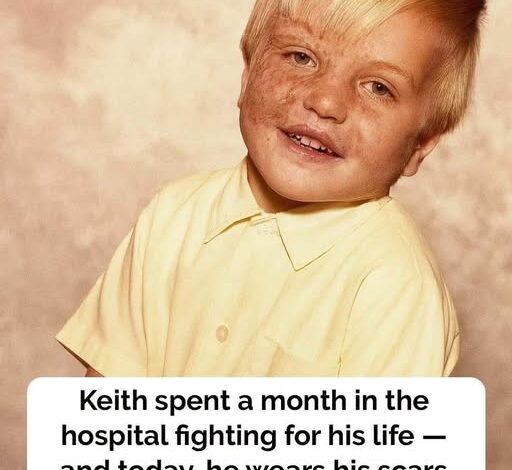
For much of his childhood, every glance in a mirror reminded him of a tragedy he never chose. The scars covering his face and body attracted curious stares, whispered conversations, and cruel remarks from strangers who knew nothing about the pain behind them. Long before he understood resilience, he learned what it felt like to be judged before saying a single word. The trauma he carried wasn’t limited to his injuries—it reached into every corner of his life, shaping how he saw himself and the world around him.
The physical wounds came from an act of violence that should never have happened.
Instead of growing up surrounded by safety and stability, he was forced to recover from devastating injuries while also coping with the emotional devastation that followed. The legal system delivered consequences for the person responsible, but to him, the punishment never seemed to match the damage that had been done. As the years passed, that sense of injustice lingered, feeding anger that often felt impossible to escape.
School offered little refuge.
Rather than finding acceptance, he frequently became the target of bullying. Classmates stared openly, asked invasive questions, or mocked his appearance without understanding the suffering hidden beneath his scars. Every insult reinforced the painful belief that he would never be seen as anything more than the tragedy reflected in his face.
The emotional burden grew heavier with each passing year.
Unable to silence the memories or the shame, he turned to alcohol as a way to numb emotions he didn’t know how to process. One drink became another, and soon entire nights disappeared into blackouts. For a while, intoxication seemed easier than confronting the grief, anger, and loneliness that followed him everywhere. But every morning brought the same reality back into focus, unchanged and waiting.
There were moments when revenge seemed like the only path toward peace.
He imagined confronting the man whose actions had permanently altered his life. The desire for justice slowly blurred into fantasies of retaliation, fueled by years of unresolved pain and unanswered questions. Holding on to that anger felt powerful at first, but over time it became another prison, trapping him in a past he could never rewrite.
Eventually, something inside him shifted.
The turning point wasn’t dramatic. There was no single life-changing speech or miraculous event. Instead, it came through a quiet realization that continuing down the same path would only create more suffering. If his life was ever going to change, he would have to make that choice himself.
Sobriety became the first step.
Choosing recovery meant facing emotions he had spent years trying to escape. It required patience, discipline, and the willingness to confront painful memories without hiding behind alcohol. Progress wasn’t immediate, and setbacks tested his resolve, but each day of sobriety became proof that healing, however slow, was possible.
As his life stabilized, a new purpose began to emerge.
Rather than allowing his scars to define him, he started using his experiences to connect with others facing unimaginable hardship. He recognized that countless children living with abuse, neglect, or visible injuries carried the same crushing belief that they were somehow broken beyond repair. Having survived those feelings himself, he knew his story could offer something few others could: genuine understanding.
That realization inspired him to create a foundation dedicated to helping vulnerable children.
Through mentoring, advocacy, and community programs, he began showing young survivors that their value had never depended on their appearance or the trauma they endured. He spoke openly about pain, recovery, addiction, and hope, not because revisiting those memories was easy, but because honesty gave others permission to believe healing was possible for them too.
Children who met him often saw something adults overlooked.
They didn’t simply see scars.
They saw someone who understood fear.
Someone who understood shame.
Someone who could honestly tell them that the worst thing that ever happened to them did not have to become the only thing that defined them.
Perhaps the most remarkable transformation came through forgiveness.
It did not happen quickly, nor did it erase the suffering he endured. Forgiveness never meant excusing cruelty or pretending justice no longer mattered. Instead, it became a decision to stop allowing hatred to control the future. By releasing the burden of revenge, he reclaimed something that had been stolen from him years earlier: the freedom to live without being consumed by the past.
His scars never disappeared.
Neither did the memories.
But both gradually changed meaning.
What had once symbolized pain became evidence of survival. What had once invited pity became a source of strength that inspired others to keep fighting through their own darkest moments.
Today, his legacy reaches far beyond his own story.
The foundation he built continues supporting children who desperately need someone to believe in them. Every life touched through his work represents another reminder that compassion can interrupt cycles of trauma, replacing fear with hope and isolation with belonging.
His journey stands as a powerful testament to human resilience.
He began life carrying wounds that seemed impossible to overcome. He struggled with addiction, anger, and despair. Yet instead of allowing those experiences to define his future, he transformed them into a mission that gives countless others the courage to keep going.
His life proves that while no one can choose how their story begins, everyone has the power to influence how it continues. Even after unimaginable suffering, it is possible to build a future rooted not in bitterness, but in purpose, compassion, and hope. In doing so, he offered the world a profound reminder: sometimes the strongest people are not those who escape pain, but those who use it to help someone else find the strength to heal.