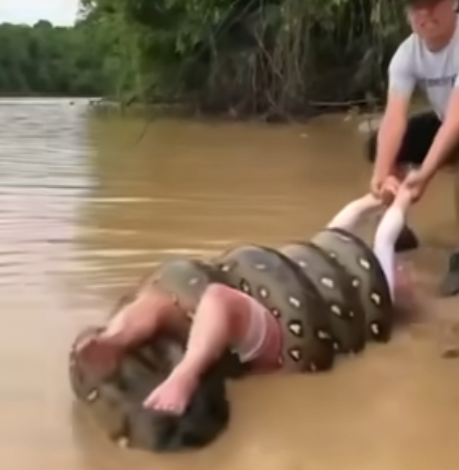
The woman doesn’t scream.
She doesn’t appear to fight.
In fact, she barely seems to move at all.
And for millions of people watching the disturbing video online, that silence may be the most unsettling part.
The clip appears to show a terrifying struggle unfolding in murky water. A man stands knee-deep in what looks like a river or flooded area, desperately pulling at a motionless woman while an enormous snake-like creature appears wrapped around her body.
Its coils seem impossibly thick.
One section appears locked around her torso. Another stretches across her legs. The man pulls harder, water splashes around them, and the creature seems unwilling to release its grip.
At first glance, the story appears obvious.
A woman has been caught by a gigantic anaconda, and another person is desperately trying to save her before it’s too late.
But then you watch it again.
And questions begin replacing fear.
Where did this happen?
Who filmed it?
Who is the woman?
What happened afterward?
And perhaps most importantly:
Is any of it real?
That question has transformed the short clip from another shocking animal encounter into a fascinating example of how difficult it has become to trust what appears on our screens.
Some viewers remain convinced the footage captures a genuine emergency.
They point toward the man’s frantic movements.
He doesn’t appear to be casually posing for a camera. His body seems tense as he struggles against what looks like considerable weight.
The water reacts around them.
The apparent snake moves.
Everything happens quickly enough that the brain instinctively fills in the missing information.
Danger.
Snake.
Trapped woman.
Rescue.
And because anacondas are real animals capable of constricting prey, the scenario feels just plausible enough to trigger genuine fear.
That’s how powerful viral imagery can be.
You don’t necessarily analyze it first.
You react.
Only afterward do you begin searching for inconsistencies.
And there are several details that have caused skeptical viewers to question the clip.
The woman’s behavior is perhaps the biggest.
If someone were genuinely trapped in the coils of an enormous constricting snake, viewers naturally expect frantic movement, visible attempts to escape, screaming, or some other obvious reaction.
Instead, she appears strangely motionless.
There could theoretically be explanations for someone not moving during an emergency, so silence alone proves nothing.
But combined with other peculiarities, it raises questions.
Then there is the snake itself.
Its enormous body appears almost too visually dramatic, wrapping around the woman in a way that seems perfectly designed for a shocking social-media thumbnail.
Some viewers have pointed to the appearance of the coils and movement as possible evidence of digital manipulation.
Others have suggested the footage could involve compositing—combining real video with digitally created elements.
And increasingly, one possibility dominates discussions surrounding suspicious viral videos:
Artificial intelligence.
AI-generated video has improved dramatically.
Scenes that would once have required professional visual-effects teams can now be created far more easily. Animals can be inserted into environments where they never existed. Human movements can be generated or altered. Lighting, reflections, and camera motion can be simulated well enough to appear convincing during a quick viewing on a phone.
The technology doesn’t have to produce something perfect.
It only needs to produce something believable for several seconds.
That’s especially effective on social media.
Videos are often watched quickly.
Screens are small.
Compression hides imperfections.
People are scrolling rather than conducting forensic examinations.
And emotion moves faster than skepticism.
If something frightens, angers, or amazes us immediately, we’re more likely to watch again.
Maybe we send it to someone.
Maybe we comment.
Maybe we share it with the caption, “Is this real?”
Ironically, even skepticism helps questionable footage spread.
Every argument gives the video more attention.
One group insists it’s authentic.
Another calls it obvious AI.
Someone zooms into individual frames.
Another person posts a slowed-down version.
Before long, millions of people have seen footage whose original source may remain completely unclear.
That’s another major problem with the supposed anaconda encounter.
There appears to be little reliable context accompanying the circulating versions.
A genuine attack of this apparent severity would naturally raise questions about location, witnesses, rescue efforts, medical treatment, and the identities of those involved.
Yet viral reposts frequently arrive stripped of that information.
No clear location.
No independently confirmed account from the woman.
No obvious statement from relatives.
No easily verifiable report from local authorities.
Instead, viewers are left with the footage itself.
And footage is no longer enough.
That may be the most important part of this entire story.
Not whether one particular snake is real.
But the fact that we’ve reached a point where seeing something with our own eyes no longer automatically settles the question.
For generations, photographs and video carried an almost instinctive authority.
“There’s footage” meant something.
A camera was considered a witness.
Digital editing weakened that assumption, but sophisticated manipulation once required significant skill and time.
AI is changing the equation again.
Now the distance between imagining a shocking scene and producing something that resembles footage of that scene is shrinking rapidly.
A giant snake attack.
A dramatic rescue.
A wild animal entering someone’s house.
An impossible natural disaster.
The stranger and more emotional the footage, the more rapidly it may spread.
That means viewers increasingly need to look beyond the pixels.
Where did the video originate?
Is there an identifiable original uploader?
Does the account provide a specific location and date?
Are reputable local sources reporting the incident?
Are there independent witnesses?
Do different angles or photographs exist?
Has anyone connected to the supposed event spoken publicly?
If all roads lead back to the same anonymous viral clip, skepticism is reasonable.
That doesn’t mean automatically declaring every extraordinary video fake.
Real life produces extraordinary moments too.
The point is to resist allowing emotional intensity to substitute for evidence.
Because the viral anaconda clip works precisely because it targets something ancient in us.
The fear of being trapped.
The fear of enormous predators hidden beneath dark water.
The helplessness of watching another person in danger.
You don’t need to understand snake biology to feel your stomach tighten when those apparent coils close around the woman’s body.
But there is now another fear layered over the first.
What if none of it happened?
What if the woman was never in danger?
What if the snake never existed?
What if millions of people experienced genuine fear over an event created entirely to manipulate them into watching and sharing?
That possibility is disturbing in a completely different way.
Because today it’s a giant snake.
Tomorrow it could be footage involving a politician, a war, a celebrity, a crime, or an emergency where believing fabricated imagery could have far more serious consequences.
For now, without reliable independent confirmation of the people, location, and circumstances shown in the clip, the dramatic footage should be treated as unverified rather than accepted as proof of a real anaconda attack.
Watch closely.
Ask questions.
Search for the source before sharing.
And remember that the strangest thing lurking in that dark water may not be the enormous snake at all.
It may be the uncomfortable realization that in the age of AI, our own eyes are no longer enough.


