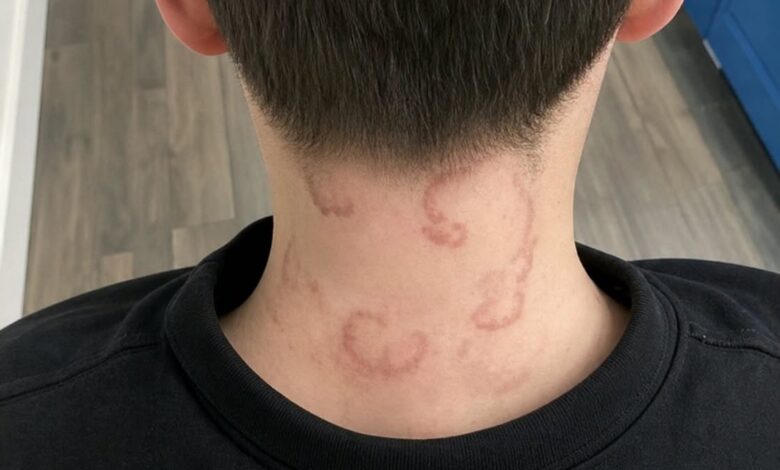
The first few days, you tell yourself not to worry.
Children get rashes.
Maybe it’s the new laundry detergent. Maybe it’s heat, dry weather, a plant brushed against during play, or some minor irritation that will disappear as mysteriously as it arrived.
So you watch.
A week passes.
Then another.
And somewhere between taking another photograph and checking the same patch of skin under brighter bathroom light, reassurance begins turning into uncertainty.
When a child’s rash has been lingering for weeks—especially if it is spreading, worsening, changing, or repeatedly returning—the hardest part isn’t always the rash itself.
It’s not knowing what it means.
You find yourself trapped between two thoughts.
It’s probably nothing serious.
And:
What if I’m overlooking something important?
That uncertainty can make the internet irresistible.
You take a clear photograph.
Then another from a different angle.
You search descriptions.
Red patches.
Small bumps.
Circular rash.
Dry rash.
Rash without fever.
Rash that won’t disappear.
Within minutes, you’ve seen dozens of photographs that look vaguely similar and read explanations ranging from harmless irritation to conditions frightening enough to keep you awake.
The problem is that many skin conditions resemble one another.
A photograph can show what a rash looks like at one moment, but it cannot reliably tell the entire story.
It doesn’t tell someone how the skin feels.
Is it itchy?
Painful?
Warm?
Tender?
Does it burn after bathing?
Did it begin in one location and gradually spread?
Does it fade and return?
Is there scaling, crusting, blistering, drainage, or swelling?
Did anything change before it appeared?
New soap?
Medication?
Sunscreen?
Laundry product?
Clothing?
Pet?
Swimming pool?
Illness?
Travel?
Those details can matter.
So can the child’s overall condition.
A child running around, eating normally, sleeping comfortably, and behaving like themselves presents a different picture from a child who is feverish, unusually sleepy, struggling to breathe, experiencing facial swelling, developing rapidly spreading skin changes, or otherwise appearing seriously unwell.
That is why a persistent rash eventually reaches a point where guessing is no longer the best strategy.
If it has been present for two months, the question is no longer simply:
Should I wait another day?
The better question is:
Why hasn’t this resolved?
That doesn’t automatically mean something dangerous is happening.
Persistent does not mean catastrophic.
Many long-lasting skin problems are manageable once properly identified.
But duration is information.
If the skin has been telling the same story for eight weeks, it deserves someone qualified to read it.
A pediatrician can examine the child as a whole, not just an isolated photograph.
A dermatologist can evaluate the skin’s pattern, texture, distribution, borders, and other characteristics that may be difficult to appreciate through a screen.
They can also ask questions that an image cannot answer.
When did it begin?
What appeared first?
Has anyone else in the household developed similar symptoms?
Does the child have allergies or a history of sensitive skin?
Is there a family history of certain skin conditions?
Does sweating make it worse?
Does anything improve it?
What treatments have already been tried?
Those questions help narrow possibilities.
Sometimes the answer may be relatively straightforward.
Other times, further evaluation or testing may be appropriate.
Either way, an examination replaces some of the uncertainty with an actual plan.
While waiting for that appointment, restraint can be surprisingly useful.
When parents become worried about a rash, the understandable instinct is to do something.
A new cream.
Then another.
An antibacterial wash.
An essential oil someone recommended.
A medicated product suggested in a comment section.
A stronger moisturizer.
A home remedy.
Soon the irritated skin is being exposed to five new substances, and nobody knows whether one of them is helping, worsening the problem, or creating a second irritation on top of the first.
Unless a clinician has given different instructions, gentle care is often the more sensible holding pattern.
Use mild products the child already tolerates.
Avoid unnecessary fragrances and aggressive scrubbing.
Keep track of meaningful changes.
And be cautious about applying medicated creams simply because they helped someone else’s apparently similar rash. Different conditions can require very different treatment, and something that improves one problem may complicate another.
Documentation, however, can genuinely help.
Take occasional photographs under similar lighting rather than photographing the rash obsessively throughout the day.
Note dates.
Record where it began and where it appears later.
Write down itching, pain, fever, illness, medications, new products, or other changes that seem relevant.
If the rash seems connected with a particular activity or exposure, record that too.
You’re not trying to diagnose the condition yourself.
You’re creating a timeline that can help the clinician see what happened between appointments.
Most importantly, watch the child, not only the skin.
Children sometimes say they’re “fine” because they don’t want attention, don’t have the vocabulary to describe discomfort, or have simply adapted to something that has bothered them for so long that it now feels normal.
Ask specific questions.
“Does it itch when you’re trying to sleep?”
“Does your shirt hurt when it rubs there?”
“Does it sting in the shower?”
“Do you scratch it at school?”
Specific questions can reveal things that “Does it bother you?” doesn’t.
And some situations should not wait for a routine appointment.
A rash accompanied by trouble breathing, swelling of the face or tongue, fainting, severe illness, rapidly worsening symptoms, or other signs of a serious allergic reaction needs urgent medical attention. Likewise, concerning combinations such as significant fever with a rapidly spreading or purple/non-blanching rash, severe pain, blistering or peeling skin, or a child who appears seriously unwell warrant prompt evaluation.
The purpose of saying that isn’t to turn every red spot into an emergency.
It’s to understand the difference between vigilance and panic.
Panic says every unfamiliar rash is dangerous.
Dismissal says every rash is harmless.
Good judgment lives between them.
It notices.
It watches.
It asks questions.
And when something doesn’t resolve as expected, it gets appropriate help.
That is especially important after weeks have turned into months.
At that point, seeking medical advice isn’t overreacting.
It’s responding to the information you already have:
the problem is still there.
There is also relief in accepting that you don’t have to solve the mystery yourself.
Parents are expected to notice changes in their children.
They are not expected to identify every dermatological condition from photographs.
You don’t need to become an expert in skin disease overnight.
You need to recognize when uncertainty has lasted long enough to justify expertise.
So make the appointment.
Bring the timeline.
Bring photographs showing how the rash has changed.
Mention everything you’ve applied to it, including over-the-counter and “natural” products.
Describe what your child has told you—and what you’ve observed yourself.
Then let someone examine the skin in person.
Maybe the explanation will be simple.
Maybe treatment will take patience.
Maybe the clinician will want to investigate further.
Whatever the outcome, you’ll have moved from endless speculation toward informed care.
Because when a child’s skin has been trying to tell you something for two months, the protective response isn’t panic.
And it isn’t another midnight image search.
It’s calm attention, careful observation, and knowing when it’s time to let a professional take a closer look.