Every Store Told My Daughter She Was Too Big for Prom Until Her Best Friend Revealed a Secret That Left the Entire School in Tears

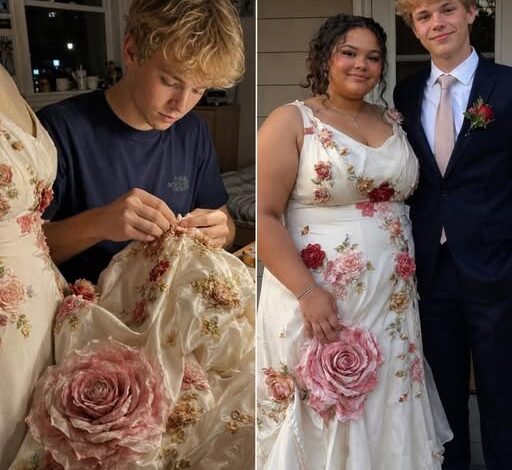
The moment my daughter stepped through the gymnasium doors, the entire room fell silent.
Hundreds of eyes followed her.
For a second, nobody seemed to breathe.
The music continued playing softly in the background, but it felt distant, drowned out by the weight of what everyone was seeing.
Hazel walked forward slowly, her head held higher than I had seen in months.
And wrapped around her wasn’t just a dress.
It was a story.
A statement.
A transformation.
Every cruel nickname. Every hateful comment. Every message that had once left her crying alone in her bedroom had been stitched into the fabric of that gown. The words that had been thrown at her like weapons were no longer hidden away on phone screens or buried in painful memories.
They were visible.
Impossible to ignore.
Yet somehow, they no longer looked ugly.
They had been turned into roses.
Beautiful hand-crafted roses that flowed across the dress like a garden in bloom. What had once been symbols of humiliation had become something entirely different—symbols of survival.
As she crossed the gym floor, I glanced toward Eli.
His hands trembled.
His eyes were already filled with tears.
For weeks, he had carried the burden of a secret project. Every night after school, every weekend, every spare moment had been spent working on that dress.
Most people thought he was helping Hazel prepare for prom.
They had no idea what he was really doing.
When he finally stepped forward and took the microphone, the room remained frozen.
The silence was so complete that you could hear the faint hum of the gym’s air-conditioning system.
Eli swallowed hard.
For a moment, he couldn’t speak.
Then his voice cracked.
“I need everyone to understand something.”
His words echoed through the room.
He looked at Hazel.
Then at the crowd.
Then back at Hazel again.
“Every flower on this dress started as something cruel.”
A murmur rippled through the audience.
Many students shifted uncomfortably.
Others stared at the floor.
Eli continued.
“Every rose was made from words people used to hurt her.”
His voice shook harder now.
“I spent nights reading things that nobody should ever have to read.”
Hazel lowered her eyes as tears began forming.
Eli pressed forward.
“I read messages telling her she wasn’t good enough.”
His voice cracked.
“I read comments making fun of how she looked.”
The room grew quieter.
“I read posts that laughed when she was struggling.”
Some students were already crying.
Others looked physically unable to meet his gaze.
Eli held up one section of the dress.
“This flower came from a comment that made her cry herself to sleep.”
He pointed to another.
“This one came from a message that made her stop wanting to go to school.”
Another.
“This one came from someone who thought a joke was harmless.”
The silence became unbearable.
No one laughed now.
No one whispered.
No one hid behind excuses.
Because the evidence was standing right in front of them.
Visible.
Undeniable.
Real.
For months, many of those students had convinced themselves that their words didn’t matter.
That it was just teasing.
Just jokes.
Just social media.
Now they were being forced to confront the truth.
Words leave scars.
And those scars had been woven into every inch of the dress Hazel wore.
A girl in the front row began crying openly.
Then another.
A teacher wiped tears from her eyes.
Several students buried their faces in their hands.
One boy who had often joined the mocking couldn’t stop staring at the floor.
The weight of collective guilt hung over the room.
For the first time, nobody could pretend they hadn’t known.
Nobody could claim they didn’t mean it.
Nobody could escape what their actions had created.
And in the center of it all stood Hazel.
The same girl they had targeted.
The same girl they had underestimated.
The same girl who had spent months wondering whether she would ever feel whole again.
Tears streamed down her cheeks.
But these tears weren’t born from pain.
Not anymore.
They came from something else.
Recognition.
Relief.
Freedom.
For so long, she had allowed the voices of others to define how she saw herself.
Every insult became a mirror.
Every cruel remark became a truth she slowly started believing.
But standing there, surrounded by roses made from the very words that once broke her, she finally saw something different.
She saw survival.
She saw courage.
She saw strength.
Most importantly, she saw herself.
Not the version her bullies created.
The real version.
The one who had endured everything and remained standing.
The room erupted into applause.
It started slowly.
One person.
Then another.
Then dozens.
Soon the entire gym was on its feet.
Not because of the dress.
Not because of the presentation.
But because everyone understood they had witnessed something far bigger.
They had watched pain become power.
They had watched shame become resilience.
They had watched a young woman reclaim her story.
I looked at Hazel and saw something I hadn’t seen in a very long time.
Peace.
Not complete healing.
Not complete closure.
Those things take time.
Some wounds don’t disappear overnight.
The grief was still there.
The memories were still there.
And nothing could change what had already happened.
Nothing could bring Mason back.
Nothing could erase the darkest days.
But for the first time, the future didn’t seem buried beneath the past.
For the first time, hope looked possible again.
Later that night, after the crowd had gone home and the lights in the gym had been turned off, we drove home in near silence.
Not an uncomfortable silence.
A healing one.
Hazel sat in the back seat holding part of the dress carefully in her hands.
Every now and then she touched one of the roses.
As if reminding herself that it was real.
When we finally arrived home, she hugged Eli for a long time.
No words.
Just gratitude.
Just understanding.
Just love.
The next morning, something happened that nearly brought me to tears.
I walked into the kitchen expecting another quiet breakfast.
Another day of cautious conversations.
Another reminder of everything our family had been carrying.
Instead, Hazel came downstairs.
She sat at the table.
Poured herself a glass of orange juice.
Looked around the room.
And smiled.
Not a forced smile.
Not one meant to reassure anyone else.
A real smile.
The kind that reaches the eyes.
The kind that comes from somewhere deep inside.
For a moment, nobody spoke.
We simply stared.
Because after everything she had endured, that smile felt miraculous.
It was small.
Simple.
Ordinary.
Yet it changed everything.
The house felt lighter.
The silence that had lingered for so long finally loosened its grip.
The sadness was still there.
The healing wasn’t finished.
But something important had returned.
Hope.
Quietly.
Gently.
Like sunlight finding its way through a storm cloud.
That night in the gym didn’t erase the past.
It didn’t undo the damage.
And it didn’t magically solve every struggle.
What it did was something far more important.
It reminded Hazel that she was never the cruel words people used against her.
She was never the rumors.
Never the insults.
Never the labels.
She was stronger than every one of them.
And as our family watched her begin to believe that truth for herself, we realized something too:
The most powerful victories aren’t always loud.
Sometimes they’re found in a simple smile at a breakfast table.
Sometimes they’re hidden inside a dress made of roses.
And sometimes they’re the moment a person finally sees their own worth after spending far too long believing they had none.
That was the day hope came home.
And this time, it stayed.