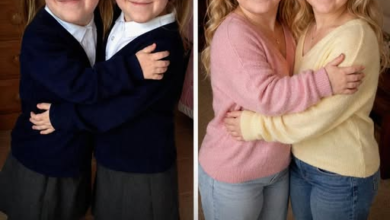
Tattoed woman who keeps her nose in a jar reveals what she looked like before – you better sit down


Her transformation does not look like evolution.
It looks like rebellion.
The kind that arrives suddenly enough to make people stop scrolling, stare twice, and question whether they are even looking at the same person.
In older photographs, she appears almost ordinary by conventional standards. Attractive, certainly, but familiar. The kind of face that blended easily into the crowd. Someone you might pass in a shopping mall, sit beside in a café, or cross paths with on a busy street without giving a second thought.
Nothing about those images hinted at what was coming.
Nothing suggested she would one day become one of the most visually striking and controversial figures on the internet.
Then came the transformation.
And with it, the disappearance of familiarity.
The woman in the newer photographs seems almost impossible to reconcile with the one who came before. Darkened eyes command attention. Tattoos spread across her body like an ever-expanding map of self-expression. Her tongue, split deliberately down the middle, challenges expectations before a single word is spoken.
Most startling of all is the absence where a nose once was.
Not hidden.
Not accidental.
Intentional.
A choice impossible to ignore.
The empty space immediately captures attention because it violates something people unconsciously expect to see. Faces are among the most familiar things humans encounter. We spend our entire lives recognizing them, reading them, interpreting them. When a face breaks those expectations, the reaction is immediate.
Shock.
Curiosity.
Discomfort.
Fascination.
Sometimes all at once.
To outsiders, the changes can appear extreme.
Even unsettling.
Many look at her and see loss.
She looks at herself and sees liberation.
That difference is where the real story begins.
When she speaks about her appearance, she often uses a word that surprises people.
Imperfection.
But her definition bears little resemblance to the one most people carry.
For many, imperfection implies deficiency—a flaw to correct, a mistake to hide, a deviation from an accepted standard.
For her, imperfection means freedom.
Freedom from expectations.
Freedom from beauty standards she never agreed to.
Freedom from the pressure to remain recognizable, acceptable, or understandable to strangers.
In her eyes, every modification represents a decision made for herself rather than for public approval.
And perhaps that is why reactions to her remain so intense.
Because people are not simply responding to altered features.
They are responding to what those changes represent.
Some admire her.
To them, she embodies radical self-determination.
A woman refusing to allow society to dictate how she should look.
A person willing to endure criticism, ridicule, and misunderstanding in pursuit of authenticity.
They see courage.
They see conviction.
They see someone powerful enough to abandon the comfort of acceptance in exchange for personal truth.
Others see something entirely different.
They mourn the face they remember.
They compare old photographs to new ones and describe the transformation as destruction rather than creation.
To them, she discarded a kind of beauty that was already valuable.
A beauty they understood.
A beauty they approved of.
A beauty that fit comfortably inside familiar cultural expectations.
That response reveals something interesting.
Many criticisms are framed as concern.
But beneath them often lies a deeper assumption:
That beauty belongs, at least partially, to public opinion.
That when someone is considered attractive, there is an obligation to preserve that attractiveness.
That altering it requires explanation.
Or permission.
Or justification.
Her existence challenges that assumption directly.
Because she is not treating her body as a display for collective approval.
She is treating it as a canvas.
And artists rarely ask permission before creating.
The tension between those perspectives explains why her image generates such strong reactions.
She exists at the intersection of personal freedom and public expectation.
Every tattoo.
Every modification.
Every visible alteration becomes part of an ongoing conversation about identity, autonomy, and the boundaries of self-expression.
What makes the conversation uncomfortable is that there is no simple answer.
People naturally respond to appearances.
Humans always have.
Attraction, familiarity, and social norms are powerful forces.
Yet there is also an undeniable truth that remains difficult to challenge:
Her body belongs to her.
Not to admirers.
Not to critics.
Not to strangers on the internet.
Not to anyone who feels entitled to an opinion simply because they can see her.
That reality remains unchanged regardless of whether someone views her transformation as inspiring or unsettling.
And perhaps she understands something many people do not.
Attention itself has power.
Whether people react with admiration, confusion, fascination, or disbelief, they are still reacting.
Still engaging.
Still looking.
Still thinking.
In a world saturated with images competing for a few seconds of notice, becoming unforgettable is a kind of statement all its own.
She has become impossible to ignore.
Not because she followed society’s definition of beauty.
But because she rejected it.
The result is a figure who provokes questions more than answers.
A woman some view as fearless.
Others view as extreme.
Many simply cannot stop talking about.
Yet beyond the debates, the headlines, and the endless arguments about appearance lies a simpler reality.
She chose herself.
Repeatedly.
Deliberately.
Without asking for consensus.
And whether people see that as empowerment, controversy, art, or rebellion, it remains the one thing nobody can reasonably deny.
The transformation was never designed to make everyone comfortable.
It was designed to make one person feel free.
Everything else—the shock, the admiration, the criticism, the fascination—became part of the picture afterward.
And perhaps that was the point all along.