The first person to notice something was wrong on Flight 782 was not a flight attendant.
It was not the man sitting beside the frightened girl.
It was not anyone who could hear the hesitation in her voice or the sharpness in his.
It was a passenger across the aisle who could hear almost nothing at all.
Julian Ross had spent most of his life learning to read the world with his eyes.
Profound hearing loss had changed the way he moved through public places. Airports, train stations, restaurants, crowded streets—most people experienced them as noise first. Julian experienced them as motion. A tightening jaw. A hand pressed too firmly against someone’s arm. A smile that arrived too late. Eyes that searched for exits. Shoulders held too high. Fingers twisting fabric under a table.
To him, silence was never empty.
It was full of clues.
That night, as passengers boarded the overnight flight from Seattle to Atlanta, Julian noticed the girl before he noticed the man.
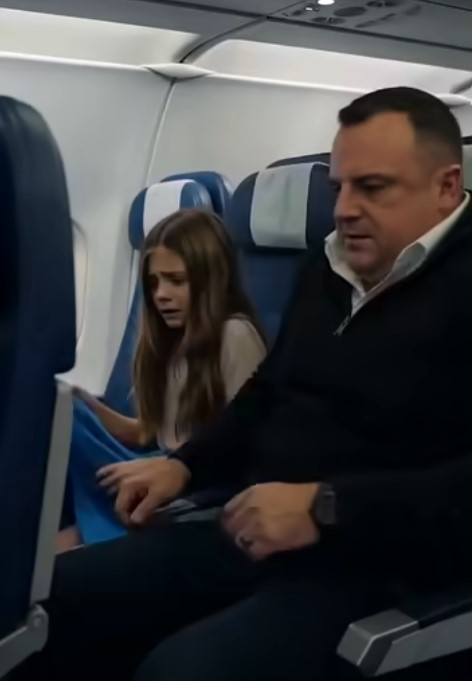
She was fourteen, maybe fifteen at most, with dark hair pulled into a loose ponytail and a gray sweatshirt slightly too large for her frame. She moved down the aisle with her head lowered, one hand wrapped around the strap of her backpack as if it were the only stable thing in the world.
The man behind her looked ordinary.
That was what made him easy to ignore.
Middle-aged.
Pressed jacket.
Clean shoes.
A polite smile for the flight attendant.
He carried himself with the practiced patience of someone used to being believed.
When the girl hesitated near row 18, he placed one hand against the back of her shoulder.
Not roughly.
Not enough to draw attention.
But Julian saw the way her body stiffened.
The man leaned closer and said something Julian could not hear.
The girl nodded too quickly.
Then she slid into the window seat.
The man sat beside her.
To anyone else, they looked like family.
A tired father and daughter.
Maybe an uncle and niece.
Maybe a guardian and a reluctant teenager traveling overnight.
Nothing dramatic.
Nothing obvious.
Nothing that would make anyone stop boarding, put down a suitcase, and ask questions.
Julian told himself the same thing.
Don’t assume.
People carry fear for many reasons.
Teenagers are anxious.
Families argue.
Flights are stressful.
He knew better than to turn a feeling into a conclusion.
So he sat in 18D, across the aisle and one row back, placed his small bag beneath the seat, and opened the book he had brought for the flight.
But he kept looking up.
The girl’s name, he later learned, was Maya.
The man’s name was Raymond.
At first, Raymond behaved exactly the way an attentive adult might behave. He buckled Maya’s seat belt. Pointed toward the air vent. Spoke to the flight attendant when she asked if they needed anything. When the attendant smiled at Maya and asked if she was excited to reach Atlanta, Raymond answered for her.
Julian could not hear the words, but he could read the rhythm.
The attendant looked at Maya.
Raymond responded.
Maya’s mouth opened slightly, then closed.
The attendant moved on.
Julian’s eyes narrowed.
It was a small thing.
Too small to matter on its own.
But the small things were where truth often hid.
As the plane taxied and lifted into the dark sky, the cabin settled into the strange intimacy of overnight travel. Window shades lowered. Reading lights glowed. Passengers wrapped themselves in blankets and tried to turn narrow seats into beds.
Maya did not sleep.
She sat with her hands folded tightly in her lap, staring at the seatback in front of her. Her shoulders were raised, rigid beneath the oversized sweatshirt. Every time Raymond shifted, she flinched before catching herself.
Julian watched the reflection in the dark window beside her.
Raymond seemed calm.
Too calm, perhaps.
He leaned close when he spoke. Smiled when flight attendants passed. Rested one arm across the shared armrest in a way that made Maya press closer to the window.
Julian looked away again.
Then looked back.
He hated the uncertainty.
He hated that appearances could deceive in either direction. A girl could look frightened because she was ill, grieving, exhausted, angry, or afraid of flying. A man could look controlling because he was worried, overprotective, or misunderstood.
But something about Maya’s stillness felt wrong.
Not ordinary teenage discomfort.
Not boredom.
Not motion sickness.
Fear.
Julian recognized it because fear had a language.
The body spoke it even when the mouth stayed quiet.
About an hour into the flight, a flight attendant stopped near their row.
Her name tag read Allison.
Julian saw her crouch slightly beside Maya’s seat, her expression kind and professional.
Raymond leaned into the aisle.
He smiled.
He spoke for longer than the question seemed to require.
Allison’s expression shifted into sympathy.
She nodded.
Maya looked down.
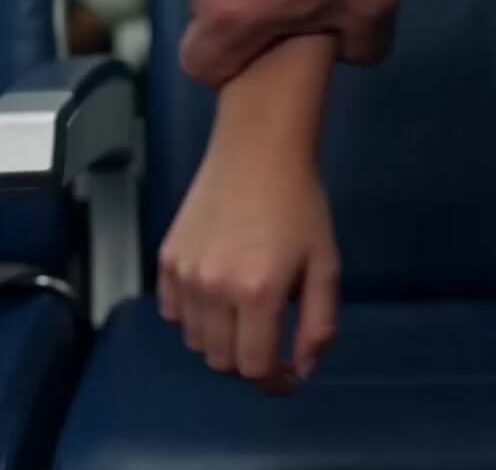
Raymond touched the girl’s wrist.
Only lightly.
But Maya’s fingers curled into her palm.
Julian felt his pulse change.
When Allison moved away, she paused near Julian’s row to adjust a bag in the overhead compartment. Julian caught her eye and lifted one hand.
She leaned toward him.
He spoke carefully, aware that his own voice sometimes sounded flatter than he intended.
“The girl by the window,” he said. “Is she all right?”
Allison glanced toward row 18.
“The teenager?”
Julian nodded.
“She seems frightened.”
Allison’s face softened.
“The gentleman said she’s been going through a difficult time. Family situation. He said she doesn’t like flying.”
It was a reasonable explanation.
Perfectly reasonable.
That was the problem.
The most dangerous explanations often were.
Julian nodded slowly.
“Maybe,” he said.
Allison studied him for a second longer than expected.
“You noticed something?”
He hesitated.
“I read body language more than most people. I may be wrong.”
Allison’s professional expression returned, but now there was alertness behind it.
“I’ll keep an eye on them.”
“Thank you.”
She moved on.
Julian sat back, hoping he had done enough.
For the next hour, nothing obvious happened.
A man across the aisle snored softly. Someone opened a bag of pretzels. A baby whimpered and was soothed back to sleep. The plane hummed through darkness.
Maya remained awake.
So did Raymond.
Then Raymond took something from his jacket pocket.
A prescription bottle.
Julian leaned slightly toward the aisle, careful not to stare too openly.
Raymond shook one pill into his palm.
Maya shook her head.
The movement was tiny.
Raymond’s expression did not change, but something in his posture hardened.
He spoke.
Maya looked at the pill.
Then at the aisle.
Then back down.
Raymond placed the pill into her hand and lifted a cup of water toward her.
Julian’s stomach tightened.
Medication on a plane was not suspicious by itself. People took prescriptions every day. Anxiety medication. Nausea medication. Sleep aids. Painkillers.
But Maya’s reluctance mattered.
Her fear mattered.
She held the pill for several seconds before finally putting it in her mouth.
Raymond watched until she swallowed.
Julian felt cold spread through him.
Across the aisle, another passenger had noticed too.
A woman seated in 17C turned slightly, her eyes moving from Maya to Raymond to Julian. She wore a navy sweater and had a medical journal open on her tray table. When she saw Julian watching, she gave him a small, serious nod.
Later, he would learn her name was Sarah Jenkins.
A pediatric nurse.
Sarah stood under the pretense of stretching and walked toward the galley. Julian waited a moment, then followed.
Near the back of the plane, beneath the soft glow of service lights, Sarah spoke first.
“You saw that too?”
Julian nodded.
“I couldn’t hear what he said.”
“I could,” Sarah said quietly. “Not all of it. Enough.”
“What did he say?”
“He told her to stop making things difficult.”
Julian’s chest tightened.
Sarah glanced toward the cabin.
“She’s showing signs of severe stress. Maybe panic. Maybe exhaustion. But something about him feels off.”
“I told the flight attendant.”
“Allison?”
“Yes.”
Sarah exhaled.
“Good. But we need to be careful. If he’s harmless, we don’t want to cause a scene. If he isn’t, we don’t want to scare him into doing something worse.”
Julian appreciated that immediately.
Sarah was not dramatic.
She was thinking.
They returned to their seats separately.
Maya’s head had begun to droop.
Her eyes looked heavy now, unfocused.
Raymond adjusted the blanket over her lap with the precise tenderness of someone performing care for an audience.
Julian felt the urgency rising inside him.
Observation was no longer enough.
But how could he reach her?
He could not speak to her without Raymond hearing.
He could not accuse the man without proof.
He could not sit there and do nothing.
Then he looked at the notebook in his bag.
Julian tore out a page and wrote carefully.
Are you safe?
If you need help, touch the window twice.
He folded the paper once.
Then waited.
The chance came when Raymond stood to use the lavatory.
The moment he stepped into the aisle and moved toward the rear, Julian leaned across.
“Maya.”
She turned at the movement, not the sound.
Her eyes were glassy, but alert enough to focus.
Julian held the note where she could see it, then gently placed it in the seat pocket in front of her.
She looked terrified.
He raised both hands slightly.
No pressure.
No demand.
Then he sat back.
Maya did not move at first.
Raymond returned.
Julian’s heart pounded as the man settled back into his seat.
For several minutes, nothing happened.
Then, slowly, Maya’s hand moved toward the seat pocket.
She slipped the note out beneath the blanket.
Read it.
Her face changed.
Not much.
But enough.
Hope is sometimes barely visible.
She looked toward the window.
Then, with two trembling fingers, she tapped the glass.
Once.
Twice.
Julian’s throat tightened.
Across the aisle, Sarah saw it too.
She stood immediately and walked to the galley.
This time, Allison returned with another flight attendant and the lead purser.
They did not rush.
They did not shout.
They did exactly what trained professionals do when panic could make danger worse.
They created a reason.
Allison approached Raymond with a polite smile.
“Sir, we need to reseat your daughter for a few minutes. There’s a minor issue with the window panel in this row.”
Raymond looked up sharply.
“She’s fine.”
“I understand,” Allison said. “It’s just procedure.”
“She stays with me.”
The warmth vanished from Sarah’s face as she stepped into the aisle behind Allison.
“I’m a nurse,” she said calmly. “She appears overly sedated. I’d like to check her pulse.”
Raymond’s jaw tightened.
“She has medication.”
“What medication?” Sarah asked.
Raymond hesitated.
Only a fraction of a second.
But everyone saw it.
Julian rose from his seat.
A large man two rows ahead stood as well, not aggressively, simply present.
The aisle seemed narrower now.
Raymond looked around and realized the cabin was no longer ignoring him.
Maya began to cry silently.
Allison crouched beside her.
“Maya,” she said gently, “do you want to come with me?”
Raymond snapped, “She’s my niece.”
Maya’s voice came out so soft Julian almost missed the shape of the words.
“No, he’s not.”
The cabin froze.
Raymond moved.
Not far.
Not successfully.
The man from two rows ahead blocked the aisle before Raymond could stand fully. The purser signaled toward the front. Another flight attendant lifted the onboard phone.
Sarah unbuckled Maya’s seat belt and helped her into the aisle.
Maya stumbled.
Julian reached out, steadying her by the elbow.
She clung to his sleeve with surprising strength.
Raymond’s face had gone pale.
“This is a misunderstanding,” he said loudly. “She’s confused. She’s troubled.”
Maya shook her head, tears running down her face.
“He told me not to talk.”
Allison wrapped an airline blanket around her shoulders and guided her toward the forward galley.
The crew moved Raymond to a separate area under watch from several passengers. No one touched him unnecessarily. No one attacked him. No one turned the cabin into chaos.
But he was no longer in control.
The remaining hour of the flight felt endless.
Maya sat near the front with Sarah and Allison. Julian remained close enough that she could see him when she looked up. He did not crowd her. Did not ask questions. Did not demand her story.
He simply stayed visible.
Sometimes that is what safety begins with.
A person who stays.
When the plane landed in Atlanta, passengers were told to remain seated.
Blue lights flashed beyond the windows.
Law enforcement officers entered first.
Then paramedics.
Raymond was escorted off the aircraft separately.
Maya was taken gently into medical care, still wrapped in the airline blanket, still clutching Julian’s handwritten note in one hand.
As she passed his row, she paused.
Her lips moved.
Thank you.
Julian nodded once.
He did not trust his voice.
In the days that followed, official details emerged slowly, as they always do in cases involving minors. Investigators would determine the facts. Authorities would decide what charges applied. Professionals would evaluate Maya’s condition, her circumstances, and the full chain of events that had brought her onto that plane.
But Julian never needed every detail to understand the most important truth.
Something had been wrong.
And people had paid attention.
That was what stayed with him most.
Not one heroic gesture.
Not one dramatic confrontation.
But a series of small decisions.
A passenger noticing a stiffened shoulder.
A flight attendant taking concern seriously.
A nurse trusting her training.
A girl brave enough to tap a window twice.
A cabin full of strangers choosing, at the crucial moment, not to look away.
Air travel places people beside one another for only a few hours. Then everyone scatters into different cities, different lives, different stories. Most passengers never learn one another’s names.
But sometimes, for a brief stretch of darkness between takeoff and landing, strangers become the difference between danger and rescue.
Julian thought about that long after the flight ended.
He thought about how easy it would have been to dismiss Maya’s fear as teenage moodiness.
How easy it would have been to accept Raymond’s explanation.
How easy it would have been to remain polite, silent, uninvolved.
Politeness is often mistaken for goodness.
But there are moments when goodness requires discomfort.
It requires asking a question.
Alerting someone trained to help.
Watching carefully without jumping to conclusions.
Caring enough to risk being wrong.
Because appearances rarely tell the whole story.
Fear can hide beneath obedience.
Danger can travel under the name of family.
And help can begin with something as simple as a handwritten note passed quietly across an airplane aisle.
By morning, Flight 782 had landed.
Passengers collected their bags.
Crews prepared for the next route.
The aircraft would be cleaned, refueled, and sent back into the sky as if nothing extraordinary had happened.
But for Maya, everything had changed.
For Sarah and Allison, it was a reminder that training matters.
For Julian, it confirmed what he had learned from years of reading a world he could not fully hear:
People are always speaking, even in silence.
The question is whether anyone is paying attention.
And on that overnight flight, someone did.
That was enough to save a girl who might otherwise have disappeared into the noise of ordinary travel.