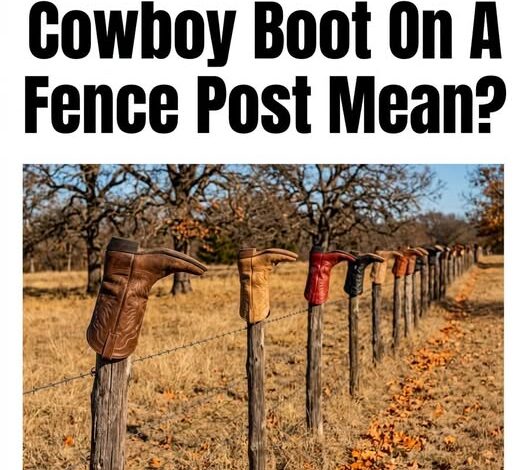
At first glance, it looks like nothing more than an old boot abandoned on a fence post.
Sun-bleached leather.
Cracked soles.
A weathered shape standing alone against miles of open country.
To someone speeding past on the highway, it might seem like roadside litter that somehow landed in an unlikely place. But if you’ve spent time in farming communities, ranch country, or small rural towns, you learn that a boot perched on a fence post is often much more than forgotten footwear.
More often than not, it’s a story.
And every story belongs to someone.
For many ranchers and farmers, a good pair of boots becomes part of daily life in a way few possessions ever do. They carry their owners through predawn mornings, muddy fields, freezing winters, blistering summers, long days in the saddle, and countless hours spent tending livestock or repairing fences.
Over time, those boots become worn in ways that only hard work can create.
Every scuff marks another chore completed.
Every cracked seam recalls another season survived.
When the leather finally gives out and the soles can no longer be repaired, throwing them into the trash feels strangely wrong.
Instead, some people give them one last place of honor.
They lift the boots onto a fence post overlooking the very land they helped care for.
It isn’t an official tradition with written rules.
It’s simply a quiet gesture of respect.
A final resting place for something that faithfully carried its owner through years of honest work.
Sometimes those boots commemorate far more than labor.
In many rural communities, a single boot on a fence post quietly serves as a memorial.
It may honor a rancher who spent decades walking those pastures before passing away.
It may remember a cowboy whose absence is still felt every time cattle are gathered.
Occasionally, it isn’t placed there for a person at all.
Some boots stand in memory of a beloved horse that carried its rider across thousands of acres before growing old or passing on.
To outsiders, it may seem like an ordinary boot.
To the family who placed it there, it marks a place where memories still live.
Every glance toward that fence becomes a quiet reminder that someone important once rode those trails, opened those gates, and called that stretch of land home.
Not every boot carries such solemn meaning, however.
Country roads have always attracted a healthy sense of humor.
Every now and then you’ll spot something completely unexpected—a bright red cowboy boot balanced high on a fence, a sequined high heel catching the afternoon sun, or a pair of glitter-covered boots standing proudly where no one would ever expect to find them.
Sometimes they’re inside jokes shared among neighbors.
Sometimes they’re playful decorations meant to surprise passing travelers.
And sometimes they’re simply a reminder that rural life has room for laughter alongside hard work.
Few things spark curiosity faster than seeing an unexpected boot standing watch over an empty pasture.
Long before satellite navigation guided every journey, unusual landmarks played an important role in helping people find their way.
A weathered windmill.
An old cottonwood tree.
A red barn.
Or a single boot nailed to a fence post.
Directions often sounded something like this:
“Drive until you see the boot on the fence, then turn left.”
For generations, these familiar landmarks became far more memorable than street numbers or mile markers.
Even today, locals often trust those visual reference points more than digital maps.
In some communities, boots also function as quiet signals.
An old boot placed in a certain location may tell neighbors someone is home.
It might suggest the tractor is out working nearby.
It may even serve as an unspoken invitation that coffee is brewing and visitors are welcome to stop by for a conversation.
Without a single written word, one simple object can communicate familiarity, presence, and connection within a close-knit community.
Its meaning depends entirely on the people who know the land.
That quiet language is part of what makes rural traditions so enduring.
They aren’t created by committees or preserved in official manuals.
They survive because neighbors continue passing them from one generation to the next, often without realizing they’re preserving history at all.
Children grow up asking why the boot is there.
Grandparents answer with stories.
Those stories become family memories.
Eventually, another generation adds its own boot to another fence post somewhere down the road.
The tradition quietly continues.
Of course, not every boot you see carries deep symbolic meaning.
Sometimes an old boot is simply an old boot.
A worn-out pair may have been set there for convenience, forgotten during fence repairs, or left behind after a day’s work.
But part of the charm lies in never knowing for certain.
Every weathered boot invites a question.
Who wore it?
How many miles did it travel?
What mornings did it witness?
Whose laughter echoed across those fields?
What losses, triumphs, and ordinary days became stitched into its faded leather?
Those answers rarely appear on roadside signs.
They remain with the families who know them.
The next time you pass a lone boot standing quietly atop a fence post, resist the temptation to dismiss it as roadside clutter.
Instead, imagine the life that may have walked inside it.
Perhaps it belonged to someone who greeted every sunrise with work to do.
Perhaps it honors a loved one whose memory still lingers across those open fields.
Perhaps it makes neighbors smile every time they drive by.
Or perhaps it’s simply marking home in a language only that community fully understands.
Whatever its purpose, one thing remains true.
That boot is doing more than decorating a fence.
It’s standing watch over a story.
A story of work.
Of family.
Of loss.
Of laughter.
Of home.
And without speaking a single word, it quietly tells everyone willing to notice:
Someone lived here. Someone mattered here. And their story is still standing.