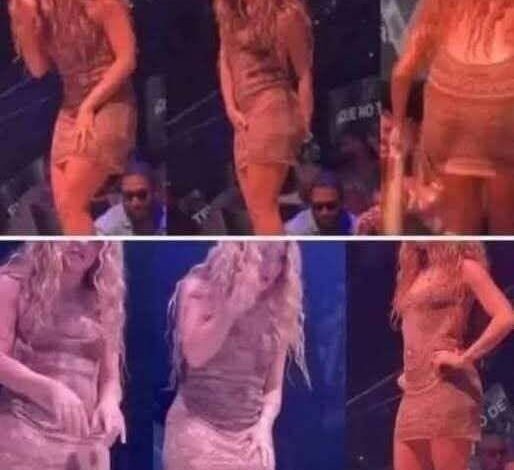
Everything about the night felt flawless.
The arena pulsed with energy. Thousands of voices blended into a roar that echoed through the venue. Bright lights swept across the crowd while the music thundered through the speakers. Every beat, every movement, every moment seemed perfectly synchronized.
At the center of it all, she looked completely at ease.
She moved across the stage with the confidence of someone who had done it countless times before. The audience was captivated. Phones were raised in every direction, recording what appeared to be another unforgettable performance.
Nothing seemed out of place.
Until it did.
The change was so subtle that most people missed it.
A brief glance downward.
A slight hesitation.
A tiny adjustment in her movement that lasted no more than a second.
To the average person in the crowd, it was invisible. The music continued. The lights flashed. The performance carried on.
But for those paying close attention, something had shifted.
Her focus was no longer entirely on the show.
For an instant, her attention locked onto something near the stage.
Something unexpected.
Something that clearly wasn’t part of the plan.
At first, she tried to continue as if nothing had happened.
Professionals are trained to perform through distractions. Technical problems, unexpected interruptions, and unpredictable moments are all part of live entertainment. Most of the time, the audience never realizes anything is wrong.
But this felt different.
As the seconds passed, her movements became noticeably more careful. She remained composed, refusing to break character, yet there was a new level of caution in the way she carried herself.
Whatever had caught her eye had not disappeared.
And now she was making a decision.
Keep going?
Or stop?
The crowd remained unaware.
Fans continued cheering, singing along, and enjoying the performance. To them, everything looked normal. The energy was still electric. The show was still moving forward.
But behind the scenes of that carefully controlled moment, a quick calculation was taking place.
She had noticed something.
Something important enough to pull her attention away from thousands of people watching her.
Then came the moment that changed everything.
Without panic.
Without dramatic gestures.
Without drawing unnecessary attention.
She stepped away.
It happened quickly, yet deliberately.
There was no attempt to pretend everything was fine. No effort to force the performance forward simply for the sake of appearances.
Instead, she trusted her instincts.
Experienced performers understand something that audiences often forget: not every interruption is worth ignoring.
Sometimes the smartest decision is knowing when to pause.
Knowing when something deserves immediate attention.
And knowing that maintaining control occasionally means stepping back rather than pushing forward.
The performance continued to be discussed long after the music stopped.
Within hours, videos of the moment began circulating online.
Then came the replays.
The slow-motion breakdowns.
The frame-by-frame analyses.
People watched the footage repeatedly, searching for clues.
What had she seen?
What exactly caught her attention?
Why did she react the way she did?
Every second was scrutinized.
Every expression was examined.
Every movement became part of the conversation.
Social media quickly filled with theories.
Some viewers believed they spotted the exact moment her expression changed. Others pointed to her body language, arguing that it revealed concern before she ever stepped away. Countless people shared clips, each convinced they had discovered the detail everyone else had missed.
The more people watched, the more curiosity grew.
Yet despite the speculation, one fact remained undeniable.
She noticed something before anyone else did.
While thousands of fans were focused on the performance, her attention shifted toward something happening in real time around her.
And instead of ignoring that instinct, she acted on it.
That decision may be what people remember most.
Not the music.
Not the lights.
Not even the interruption itself.
But the split-second awareness that led her to respond.
Because sometimes the most important moments during a live performance are not the ones carefully rehearsed beforehand.
They are the unexpected moments that reveal how someone reacts under pressure.
The crowd came to watch a show.
Instead, they witnessed something far more human.
A performer making a judgment call in real time.
A moment of awareness hidden inside a spectacle.
And a reminder that even in front of thousands of people, instinct can speak louder than the music.
Long after the final song ended, people were still talking about that brief moment on stage.
Not because it was dramatic.
But because it was real.
For just a few seconds, the performance stopped being about choreography, timing, or entertainment.
It became about trust.
Trusting what she saw.
Trusting her instincts.
And making a decision that, in that moment, felt more important than the show itself.