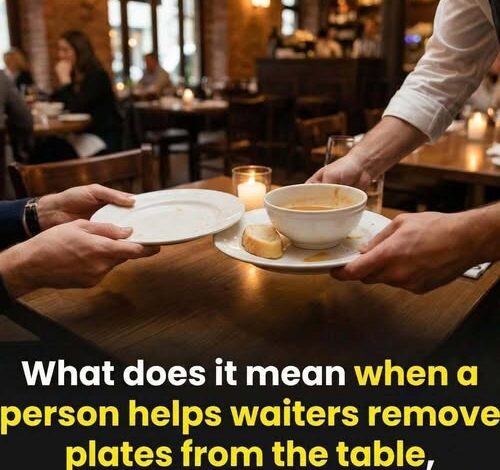
It happens in just a few seconds.
The meal is over.
The conversation begins to slow.
A waiter approaches the table, balancing a tray already crowded with dishes.
Before they’re even asked, one person quietly gathers a few plates and hands them over with a smile.
Most people barely notice the moment.
The waiter says, “Thank you.”
The plates disappear.
Life moves on.
But that small gesture often says far more than people realize.
In a busy restaurant, where everyone is focused on enjoying their own meal, choosing to make someone else’s job just a little easier reflects something deeper than simple manners.
It reflects awareness.
Empathy.
And the quiet habit of noticing other people.
Not Every Act of Kindness Is Loud
We often associate kindness with grand gestures.
Large donations.
Heroic rescues.
Life-changing moments.
But some of the most meaningful acts happen almost invisibly.
Holding a door.
Picking up something another person dropped.
Letting someone merge into traffic.
Helping a server clear a crowded table.
These actions rarely make headlines.
Yet they shape the emotional atmosphere of everyday life.
Psychologists sometimes refer to these behaviors as prosocial actions—voluntary choices intended to benefit someone else without expecting anything in return.
The reward isn’t recognition.
It’s simply knowing you made another person’s day a little easier.
Seeing the Work Behind the Service
Restaurant staff perform physically demanding work that often goes unnoticed.
They carry heavy trays.
Walk miles during a single shift.
Balance multiple conversations.
Remember complicated orders.
Handle unexpected problems.
Smile through stressful moments.
Most customers see only the finished service.
The meal arrives.
The drinks are refilled.
The plates disappear.
But people who instinctively lend a hand often recognize the effort happening behind the scenes.
Perhaps they’ve worked in restaurants themselves.
Maybe they’ve held customer service jobs.
Or perhaps they simply notice what others overlook.
Either way, they understand that a small gesture can reduce someone’s workload, even if only for a few seconds.
And sometimes those few seconds matter.
Empathy in Everyday Moments
Helping a waiter isn’t usually about efficiency.
It’s about perspective.
Instead of viewing the dining experience as a one-sided transaction, some people naturally see it as a shared interaction between human beings.
One person prepares the meal.
Another serves it.
Another enjoys it.
Everyone contributes in different ways.
That perspective changes behavior.
Rather than asking, “What am I paying for?”
They quietly ask, “How can I make this easier?”
The answer might be as simple as passing a plate.
Making room on the table.
Stacking empty cups.
Moving a chair aside.
Tiny actions.
Meaningful impact.
The Confidence to Notice
Interestingly, helping often reflects confidence rather than obligation.
People who feel socially comfortable tend to notice subtle cues others miss.
The waiter balancing too many dishes.
The crowded table.
The awkward reach.
The moment when assistance would genuinely help.
They don’t interrupt.
They don’t take over.
They simply step in naturally, without making the interaction uncomfortable.
That’s an important distinction.
True helpfulness isn’t performative.
It doesn’t seek applause.
It doesn’t announce itself.
In fact, the most thoughtful gestures are often so seamless that they barely interrupt the flow of the moment.
Helping becomes part of who someone is, not something they do for attention.
Humility in Action
Small acts like handing a server a few plates can also reveal humility.
In environments where social roles are clearly defined, some people unconsciously reinforce those divisions.
Others don’t.
They don’t see themselves as above simple tasks.
They don’t believe basic courtesy somehow diminishes them.
Instead, they understand something simple.
Respect isn’t measured by status.
It’s demonstrated through behavior.
Helping someone doesn’t reduce your dignity.
If anything, it reveals it.
Of Course, Context Matters
It’s also important not to overinterpret these moments.
Not everyone who stays seated while a waiter clears the table is inconsiderate.
Many people were simply raised differently.
Some cultures encourage customers to leave everything untouched.
Others view helping as polite.
Some diners worry that stacking plates incorrectly may actually make the server’s job harder.
Others hesitate because they don’t want to interfere with the staff’s routine.
Personal boundaries, cultural expectations, and previous experiences all influence how people respond.
One gesture alone cannot define someone’s character.
What matters most is intention.
If someone helps because they genuinely want to make another person’s day easier, that kindness carries meaning.
If someone doesn’t help because they believe they’re respecting professional boundaries, that isn’t automatically disrespectful.
Human behavior is rarely that simple.
The Ripple Effect of Courtesy
Even so, small moments of thoughtfulness often create effects far beyond what we immediately see.
A waiter finishes clearing one table more quickly.
Stress eases, even briefly.
That extra minute allows them to check on another customer.
Another customer leaves feeling cared for.
The mood shifts.
One simple action quietly influences several people.
Kindness has a remarkable way of spreading.
Not because people are keeping score.
Because positive interactions naturally encourage more positive interactions.
A smile invites another smile.
Patience encourages patience.
Respect often inspires respect.
The World We Quietly Create
Modern life can feel rushed.
Busy schedules.
Crowded spaces.
Constant distractions.
In that environment, it’s easy to focus entirely on ourselves.
Our meal.
Our conversation.
Our plans.
Yet the smallest acts often remind us that we are sharing space with other human beings.
People carrying invisible burdens.
Working long hours.
Managing difficult days.
Trying their best.
Sometimes all it takes is a small gesture to remind someone they are seen.
Not as a uniform.
Not as a role.
But as a person.
A Simple Gesture, A Lasting Impression
Perhaps that’s why moments like these stay with us.
Not because handing someone a plate changes the world.
But because it reflects the kind of world we want to live in.
One where people notice.
One where kindness doesn’t require an audience.
One where respect is offered freely rather than earned through status.
The next time you’re finishing a meal and a waiter approaches your table, you may or may not instinctively reach for the plates.
Neither choice alone defines who you are.
But it can be worth asking a simple question:
Is there a small way I can make someone else’s day a little easier?
Because the strongest expressions of character are rarely dramatic.
More often, they’re found in quiet moments.
A shared smile.
A thoughtful gesture.
A helping hand offered without being asked.
And sometimes, something as simple as passing a few empty plates reminds us that kindness is measured not by its size, but by its sincerity.