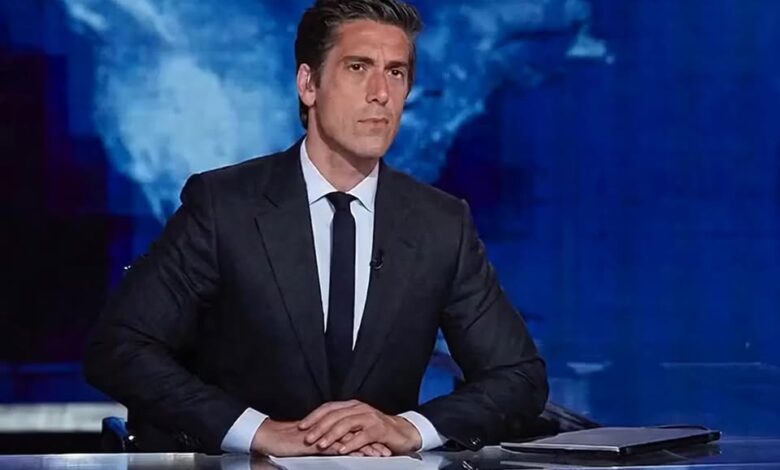
When the world feels like it’s coming apart, David Muir’s presence is designed to do the opposite. He doesn’t compete with the chaos; he translates it. From war zones to disaster sites, he has learned to sift terror and confusion into clear, measured reporting, giving people not just facts, but footing. Viewers lean on his steadiness because it never feels performative; it feels earned.
Behind that calm delivery is a relentless focus on people, not just headlines. He looks for the mother searching rubble, the nurse working through the night, the family waiting for a missing call. By centering their voices, he turns abstract crises into human reality, without exploiting their pain. Off-camera, his insistence on privacy reinforces the message: the story is never about him. It’s about the lives altered by events he is duty-bound to explain with honesty, restraint, and unwavering respect.
In an age addicted to noise, David Muir built his reputation on something quieter:
control.
Not control in the sense of domination or ego, but emotional steadiness. The kind that allows viewers to sit through horrifying headlines without feeling completely abandoned to panic. Every evening, millions of people invite him into their homes during moments when the world often feels fractured beyond recognition:
wars,
mass shootings,
natural disasters,
political collapse,
economic fear,
global uncertainty.
And somehow, his delivery rarely amplifies the chaos already flooding people’s nervous systems.
He slows it down instead.
That distinction explains much of his influence.
Modern media increasingly rewards emotional escalation. Louder voices generate stronger reactions. Outrage spreads faster than nuance. Panic keeps audiences watching longer. Yet Muir’s approach often moves in the opposite direction. He speaks with urgency when events require it, but rarely with hysteria. Even while standing inside devastation, he maintains the sense that clarity still matters more than spectacle.
Viewers trust that instinctively.
Because when people are frightened, they are not only searching for information. They are searching for orientation. They want someone capable of looking directly at catastrophe without either minimizing it or emotionally collapsing under its weight.
That balance is harder than it appears.
Especially in television news.
The camera changes human behavior naturally. Some journalists become performative once attention intensifies around them. Others retreat into detached professionalism so cold it strips humanity from suffering entirely. Muir occupies a narrower and more difficult middle ground:
emotionally present,
but disciplined,
empathetic,
but controlled.
His reporting style developed over years spent moving toward crisis rather than away from it.
War zones.
Hurricane wreckage.
Refugee camps.
Hospitals overflowing during global emergencies.
Journalists covering those environments confront an unusual psychological burden. They witness fear and grief repeatedly while still being expected to function clearly under pressure. The camera may only capture a ninety-second segment, but behind those minutes often exist hours or days spent listening to survivors describe the worst moments of their lives.
That accumulation changes people.
And yet Muir’s public presence rarely centers his own emotional experience. Even after witnessing devastation firsthand, he redirects focus outward toward those actually living inside the crisis permanently rather than temporarily documenting it.
That restraint matters.
Because audiences increasingly distrust journalism that appears self-centered or emotionally manipulative. People can sense when suffering becomes backdrop for a reporter’s performance rather than the story itself.
Muir’s strength lies partly in understanding that distinction instinctively.
When he reports from disaster areas, the coverage often lingers less on destruction itself than on the human beings trying to survive inside it:
parents searching through rubble,
families waiting outside hospitals,
children carrying water,
volunteers distributing food,
doctors refusing sleep because too many patients still need care.
These details ground overwhelming events in recognizable human experience.
Statistics alone rarely move people deeply.
Faces do.
A death toll becomes emotionally comprehensible when attached to a single family standing in silence beside a collapsed home. A war becomes real when seen through the exhaustion of a nurse cleaning blood from hospital floors at dawn. Muir consistently searches for those human anchors because they transform abstract catastrophe into moral reality.
Importantly, he usually does this without crossing fully into exploitation.
That line is delicate in journalism.
There is always tension between documenting suffering honestly and turning grief into spectacle. Cameras possess enormous power. They can create empathy, but they can also invade vulnerability. The best reporters understand that not every tear requires close-up focus and not every tragedy benefits from theatrical framing.
Muir’s interviews often reveal patience rather than intrusion.
He lets silence exist.
Lets survivors finish thoughts slowly.
Lets ordinary people explain extraordinary pain in their own words instead of rushing them toward dramatic sound bites.
That patience communicates respect.
And respect may be one of the rarest emotional qualities left in modern public discourse.
Part of why audiences remain fascinated by Muir personally is precisely because he reveals so little about himself publicly. In a culture where visibility often functions as currency, his privacy feels almost old-fashioned. There are no constant oversharing interviews, no carefully manufactured scandals, no endless social media confessions designed to sustain attention.
He maintains boundaries.
That choice strengthens his credibility because it reinforces the idea that journalism should not revolve around the journalist’s personal mythology. Viewers know enough about him to trust him professionally, but not enough to feel manipulated into emotional intimacy artificially.
The mystery itself becomes stabilizing.
People project steadiness onto public figures who resist turning every aspect of life into performance. Muir’s private restraint contrasts sharply with celebrity culture’s endless demand for exposure and confession. Off-camera, he appears determined to preserve a separation between the work and the self performing it.
That separation likely protects him psychologically too.
Because anyone spending years documenting global suffering without boundaries risks emotional collapse eventually. Reporters are not immune to trauma simply because they hold microphones instead of living permanently inside war zones or disaster areas. Secondary trauma accumulates quietly:
images remembered,
voices replayed,
grief witnessed repeatedly.
The ability to continue functioning requires emotional discipline many viewers never fully see.
And yet, despite that discipline, moments occasionally break through where Muir’s humanity becomes unmistakably visible.
A pause before speaking.
A slight tightening in his expression.
The softness in his voice while interviewing grieving parents or frightened children.
Those moments matter precisely because they remain restrained. He does not collapse emotionally onscreen, but audiences can sense genuine feeling underneath the professionalism. That emotional authenticity creates trust more effectively than exaggerated reactions ever could.
Viewers believe him because he appears affected by suffering without exploiting it.
That distinction defines much of his success.
There is also something deeply symbolic about the role evening news anchors still play culturally, even in fragmented digital media environments. People no longer consume information collectively the way previous generations once did, yet anchors like Muir continue serving as stabilizing figures during national crises.
When disasters happen, audiences still gravitate toward familiar voices.
Not necessarily because those voices possess all the answers, but because familiarity itself becomes comforting during uncertainty. Ritual matters psychologically. Sitting down at the same hour hearing the same measured cadence creates continuity in moments when events feel disorienting.
Muir understands that responsibility.
His broadcasts often function emotionally as translation services between chaos and ordinary life. Most viewers will never stand inside war zones or disaster sites personally. They rely on journalists not only to inform them what happened, but to contextualize events clearly enough that fear does not become paralyzing.
That requires judgment.
Which images to show.
Which details to emphasize.
How much horror audiences can absorb responsibly without becoming numb or overwhelmed.
Journalism at its best is not simply information delivery.
It is moral framing.
And Muir’s reporting consistently suggests he believes human dignity should remain central even while covering humanity at its worst.
That philosophy becomes especially visible during interviews with vulnerable people. He does not speak to survivors as symbols or political tools. He speaks to them as individuals enduring circumstances no one should have to endure.
The difference sounds subtle.
It is not.
Too much modern discourse reduces suffering into content categories:
refugees,
victims,
casualties,
displaced populations.
Muir repeatedly returns attention to names, faces, relationships, and individual lives because abstraction makes empathy easier to avoid.
By restoring specificity, he restores humanity.
Of course, no journalist escapes criticism entirely. Public trust in media remains deeply fractured politically and culturally. Some viewers see bias where others see integrity. Some distrust institutions broadly no matter who delivers the news. Muir operates inside that environment constantly.
Yet even many critics acknowledge his professionalism.
Perhaps because professionalism itself has become increasingly rare and therefore more noticeable.
He rarely appears interested in becoming the loudest voice in the room. He does not chase constant provocation or personal branding theatrics. Instead, he leans heavily into preparation, composure, and emotional steadiness.
Old-fashioned qualities, perhaps.
But powerful ones.
Especially during periods when public life feels emotionally overheated.
What ultimately separates David Muir from many media personalities is that he seems to understand his role not as celebrity, but as witness.
Witnesses matter historically.
They document.
Clarify.
Translate.
Remember.
And good witnesses know the story belongs primarily to those living through events directly, not to the person holding the microphone.
That humility runs quietly beneath much of Muir’s work.
It explains why viewers continue trusting him during moments when trust itself feels endangered culturally. They are not looking merely for headlines. Headlines already flood every screen constantly. They are looking for coherence, seriousness, and human decency strong enough to survive inside overwhelming events.
Muir offers that consistently.
Not perfection.
Not omniscience.
Steadiness.
And perhaps that is why his presence resonates so deeply during frightening times. In a world increasingly shaped by emotional extremes, his calm does not feel detached from reality.
It feels like someone choosing, deliberately and repeatedly, not to let chaos become contagious.