Most people walk past a honey locust tree without giving it a second thought.
Its delicate leaves cast dappled shade across parks, neighborhoods, and country roads. In summer, it blends seamlessly into the landscape, appearing no different from countless other trees that quietly occupy the background of daily life.
Yet hidden beneath that ordinary appearance is a remarkable story.
For centuries, the honey locust was far more than a source of shade. Long before supermarkets, hardware stores, and modern household products, this unassuming tree provided food, materials, and practical solutions that helped people navigate everyday life.
To those who understood its value, the honey locust wasn’t simply part of the scenery.
It was a resource.
A pantry.
A toolbox.
And, in some cases, even a medicine cabinet.
Today, much of that knowledge has faded.
Modern convenience has a way of making old wisdom disappear.
When nearly everything we need can be purchased with a few clicks or a quick trip to the store, it’s easy to overlook the role nature once played in meeting basic human needs.
The honey locust offers a fascinating reminder of that forgotten relationship.
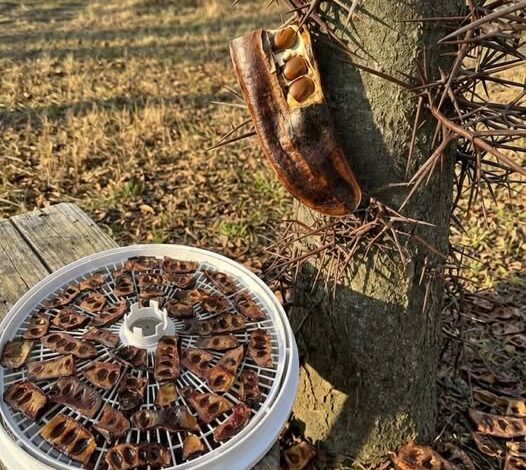
One of the tree’s most distinctive features appears each year in the form of long, twisting seed pods that dangle from its branches.
To many people, these pods look like little more than yard debris.
Some homeowners rake them up and throw them away without a second glance.
But generations ago, people knew better.
Inside those dark pods lies a sweet, sticky pulp rich in natural sugars.
In fact, that sweetness is what inspired the tree’s name.
The honey locust earned its reputation because of the sugary substance hidden inside its pods.
Indigenous communities were among the first to recognize this gift. Long before European settlers arrived, many Native American groups gathered the pods and used the sweet pulp as a source of nourishment. The pulp could be eaten directly, mixed with water, or incorporated into various foods and beverages.
When settlers later encountered the tree, many adopted similar practices.
At a time when refined sugar was expensive and often difficult to obtain, naturally sweet foods were highly valued. The honey locust offered an accessible alternative growing freely across the landscape.
Some families transformed the pulp into homemade syrups.
Others used it to flavor drinks.
In certain regions, lightly fermented beverages were produced using the sugary contents of the pods.
What seems unusual today was once a practical way to make use of available resources.
Even the seeds found inside the pods were rarely wasted.
Resourceful individuals discovered multiple uses for them.
The seeds could be roasted and brewed into a warm drink somewhat similar to coffee. Others ground them into meal or experimented with incorporating them into various recipes.
Nothing was discarded unnecessarily.
That mindset reflected a broader reality of life before modern abundance.
People learned to use what nature provided because they often had little choice.
The honey locust’s usefulness extended far beyond food.
Its wood became one of its greatest assets.
Honey locust wood is exceptionally strong, dense, and resistant to decay. Those qualities made it highly desirable for applications requiring durability and longevity.
Farmers frequently used it for fence posts because it could withstand years of exposure to weather without rotting.
Wagon builders valued its strength.
Craftsmen used it for tool handles and equipment that needed to endure constant use.
In an era when replacing broken items was difficult and expensive, durability mattered enormously.
A well-made object wasn’t expected to last a few years.
It was expected to last decades.
Honey locust wood helped make that possible.
Yet perhaps one of the tree’s most surprising historical uses involved something most people would never expect.
Cleaning.
Long before store shelves were filled with detergents, soaps, and household cleaners, people often relied on natural alternatives.
Parts of the honey locust contain compounds known as saponins.
When mixed with water, these compounds create a mild lather.
Resourceful households learned that crushed pods and bark could be used to produce a simple cleansing solution suitable for basic washing tasks.
While it wasn’t identical to modern soap, it offered a practical option in a world where commercial cleaning products did not exist.
It’s a perfect example of how earlier generations viewed nature differently.
They weren’t merely surrounded by plants and trees.
They understood them.
They knew which plants could heal.
Which could feed.
Which could clean.
Which could build.
Knowledge that once passed naturally from generation to generation has gradually become specialized information known only to a handful of enthusiasts, historians, and botanists.
The honey locust also continues to provide important benefits in the modern world.
Many landscape designers appreciate the tree for its unique canopy structure.
Unlike dense shade trees that block nearly all sunlight, honey locust leaves allow filtered light to pass through. This creates a comfortable environment where grass, flowers, and smaller plants can continue growing beneath the branches.
Homeowners often appreciate this balance.
The tree provides shade without creating a dark, barren area underneath.
Wildlife benefits as well.
During colder months, animals frequently feed on fallen seed pods when other food sources become scarce.
Birds, deer, and various small mammals all make use of the resources the tree provides.
Pollinators are attracted to its spring blossoms, helping support healthy ecosystems.
In many ways, the tree continues serving the natural world just as it has for centuries.
Of course, wild honey locust trees are also famous for something less pleasant.
Their thorns.
Some varieties produce massive, intimidating thorns that can grow several inches long and appear in large clusters along trunks and branches.
Historically, these thorns may have evolved as protection against large grazing animals.
Today, they can make maintenance challenging.
Fortunately, many modern cultivated varieties have been bred specifically to eliminate this feature, allowing homeowners to enjoy the tree’s benefits without dealing with dangerous spikes.
The result is a tree that remains both beautiful and practical in urban environments.
Yet despite all these qualities, the honey locust’s most valuable contribution may be the perspective it offers.
It reminds us that usefulness isn’t always obvious.
That value often hides beneath familiar appearances.
That the natural world contains solutions, resources, and lessons many people have forgotten how to recognize.
The next time you pass a honey locust tree, take a closer look.
Notice the seed pods hanging from its branches.
Imagine the generations who relied upon them.
Picture the farmers who used its wood, the families who found nourishment in its pods, and the households that discovered creative uses for every part of the tree.
What appears ordinary today once played an important role in daily survival.
And perhaps that’s the greatest lesson the honey locust has to offer.
Sometimes the most remarkable things are hiding in plain sight.
All it takes is curiosity to see them.