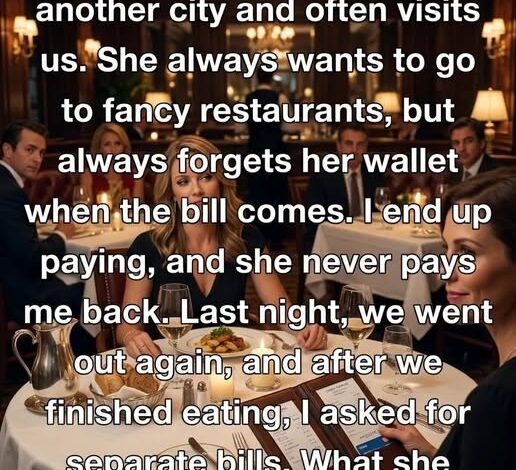
My sister-in-law had a habit.
A very expensive habit.
Every time she came to visit, she wanted to eat somewhere nice.
Not just nice.
The kind of places where the menus didn’t have prices printed next to every item and the desserts arrived looking like artwork.
And every single time the bill arrived, something remarkable happened.
She forgot her wallet.
At first, I genuinely believed it was an accident.
Who hasn’t left a wallet behind once or twice?
The first time, I smiled and paid.
The second time, I laughed it off.
The third time, I started noticing a pattern.
By the fifth time, I knew exactly what was happening.
She would order appetizers.
Cocktails.
Desserts.
Then, as soon as the check appeared, she’d perform the same routine.
Patting her purse.
Searching every pocket.
Making a face.
“Oh no.”
Then the inevitable line.
“I forgot my wallet.”
And somehow, I always ended up paying.
Not because she forced me.
Because social pressure did.
Nobody wants to create a scene in a crowded restaurant.
Especially not with family.
My husband hated conflict.
Whenever I mentioned it afterward, he’d shrug.
“That’s just how she is.”
That sentence became my least favorite phrase in the English language.
Because “that’s just how she is” always seemed to mean everyone else had to tolerate behavior that would never be acceptable from anyone else.
Still, I stayed quiet.
For a while.
Then came the dinner that changed everything.
She was visiting for the weekend and suggested a trendy new restaurant downtown.
Of course she did.
As we drove there, I made a decision.
I wasn’t going to argue.
I wasn’t going to accuse.
I was simply going to remove the escape route.
Before she arrived, I quietly pulled the waiter aside.
I explained the situation.
His smile suggested this wasn’t the first time he’d heard a story like mine.
I asked for separate checks.
And one more thing.
Bring hers first.
Along with a small note.
The waiter nodded.
An hour later, dinner ended.
The food was excellent.
The conversation was pleasant.
Everything seemed normal.
Then the waiter appeared.
He placed her bill in front of her.
Attached was a small printed card.
“No worries. We accept Apple Pay, Google Pay, Venmo, PayPal, bank transfers, and all major credit cards.”
I nearly laughed.
My sister-in-law read it.
Then blinked.
Then smiled.
Then began her performance.
“Oh shoot.”
She searched her purse dramatically.
“I think I forgot my wallet again.”
There it was.
Right on schedule.
I smiled politely.
“That’s okay.”
I pointed toward the note.
“They take mobile payments.”
For the first time, she looked genuinely caught off guard.
A pause followed.
Then she recovered.
“Oh.”
Another pause.
“My phone died.”
Of course it did.
“Dead as a rock.”
I nodded.
“No problem.”
Relief immediately appeared on her face.
Then I added:
“I’ll cover it for now and send you a PayPal request afterward.”
The relief vanished.
The rest of dinner felt slightly awkward.
Sure enough, I sent the request before we even left the parking lot.
She never paid it.
Not that week.
Not the next.
Not the month after.
The request simply sat there.
Ignored.
Unanswered.
Proof of something I had already known.
The issue was never the forgotten wallet.
The issue was the assumption that someone else would always pick up the tab.
Once I started paying attention, I noticed other things too.
She stayed at our house whenever she visited.
Without asking.
She monopolized the bathroom.
Borrowed things without returning them.
Left dishes behind.
Dropped wet towels on the floor.
Expected meals to appear.
Expected plans to be made.
Expected everything to happen around her.
None of it was malicious.
That was the frustrating part.
She wasn’t cruel.
She was simply accustomed to being taken care of.
And people like that often don’t realize the burden they’re creating.
Eventually, I reached my limit.
The next time she announced a visit, I told her we had plans.
We didn’t.
I just needed breathing room.
A few hours later, she called my husband.
I could hear parts of the conversation from across the room.
By the time he hung up, he looked exhausted.
“She thinks you’re avoiding her.”
I folded a towel slowly.
“Am I?”
He hesitated.
“She says you’ve been cold lately.”
I laughed softly.
Not because it was funny.
Because it was predictable.
The people who benefit from your silence are often the first to complain when you stop providing it.
The next morning, I sat down and wrote her a message.
Not angry.
Not accusatory.
Just honest.
I told her I cared about her.
I told her I enjoyed spending time together.
Then I told her the truth.
The unpaid dinners bothered me.
The assumptions bothered me.
The lack of consideration bothered me.
I explained that resentment grows in silence.
And that I wanted a better relationship than that.
Then I pressed send.
She left me on read.
For two days.
Then came a reply.
“Wow. Didn’t realize you felt that way.”
Another pause.
“I’ll stay in a hotel next time.”
Then:
“Thanks for being honest.”
It wasn’t warm.
It wasn’t particularly friendly.
But it was something.
Months passed.
We barely spoke.
Then one afternoon, a package arrived.
Inside was a small keychain from a boutique in her city.
And a handwritten card.
The note wasn’t long.
It simply said:
“I’m not good at this stuff.”
“I got used to people taking care of me.”
“I think when I visit, I want to feel like I’m home.”
“But that isn’t an excuse.”
“You were right.”
“I’m trying to do better.”
“Next dinner is on me.”
I stared at the card for a long time.
Then I cried.
Not because the situation was fixed.
Because she listened.
Really listened.
That alone felt remarkable.
A month later, she visited again.
This time, she booked a hotel.
Without being asked.
She arrived carrying groceries.
Offered to cook.
Cleaned up afterward.
And never once acted like she deserved applause for it.
During dinner, she looked at me across the table.
“You know,” she said, “I didn’t realize how much work you were doing.”
I smiled.
“Most hosts don’t announce it.”
She nodded slowly.
“Exactly.”
Then she laughed.
“I basically treated you like a free concierge service.”
“Pretty much.”
She winced.
“Yeah. That’s fair.”
For the first time, we felt like equals.
Not host and guest.
Not giver and taker.
Family.
Real family.
Then life tested all of us.
A year later, my husband lost his job.
Unexpected layoffs.
One meeting.
One conversation.
Gone.
The months that followed were difficult.
We cut expenses.
Canceled plans.
Counted every dollar.
One evening, while I sat at the kitchen table clipping coupons, someone knocked at the door.
It was my sister-in-law.
Carrying bags of groceries.
“I thought I’d cook tonight.”
I tried to object.
She ignored me.
Three hours later, our kitchen smelled incredible.
Fresh garlic.
Homemade sauce.
Warm bread.
The kind of meal that feels like comfort.
After dinner, she sat quietly for a moment.
Then said:
“You were there for me long before I deserved it.”
I felt tears forming.
She continued.
“Let me return the favor.”
That night, I realized something important.
Growth doesn’t always happen dramatically.
Sometimes it happens one conversation at a time.
One uncomfortable truth.
One honest boundary.
One chance to do better.
Today, our relationship is stronger than ever.
She still loves fancy restaurants.
But now she makes reservations herself.
Sometimes she pays before anyone else can.
And every single time she visits, she thanks us for having her.
A few weeks ago, we were watching old family videos.
She looked over at me and smiled.
“I didn’t know how to be family before.”
I laughed.
“What does that mean?”
She thought about it for a second.
Then said:
“I knew how to show up.”
“But I didn’t know how to contribute.”
That sentence stayed with me.
Because it’s true for a lot of people.
Showing up is easy.
Contributing takes awareness.
Respect.
Effort.
The truth is, boundaries don’t destroy relationships.
Resentment does.
Silence does.
Pretending everything is fine when it isn’t does.
Honest conversations feel uncomfortable in the moment.
But sometimes they’re the very thing that saves a relationship from quietly breaking apart.
And sometimes, if you’re lucky, the person on the other side surprises you.
Not by being perfect.
But by being willing to grow.
And honestly?
That’s worth more than any restaurant bill ever could.